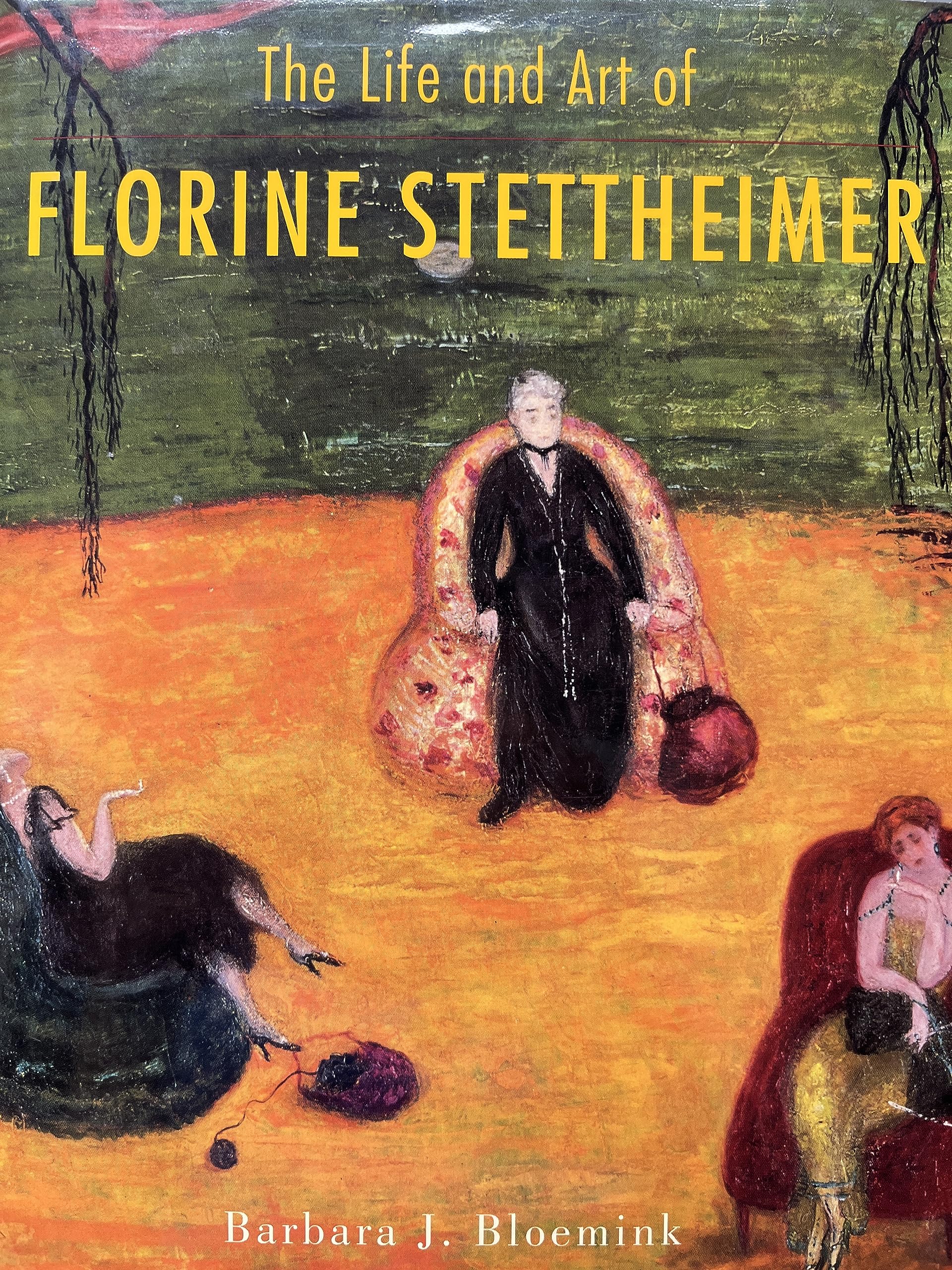



Carl Van Vechten wrote of Florine Stettheimer after her death in 1944, "There have been important women painters in the history of art [and] Stettheimer is one of the most distinctive of the lot. She was both the historian and the critic of her period ... in painting that has few rivals in her day or ours." Yet today Stettheimer remains an oddity, known largely as an eccentric, upper-middle-class German-Jewish spinster who lived in New York with her two sisters and mother and who accomplished her best work when she was over fifty years old. In this book, Barbara Bloemink presents the first full account of Stettheimer's life and art, showing that her bold and inventive paintings provide biting social commentary on American culture of her period. Fortunately, these excellent volumes appear within a short time of each other, coinciding with a major retrospective of Stettheimer's (1871-1944) work at the Whitney Museum of American Art in New York City. They make widely available the comprehensive monographic and analytical treatment necessary to understand this little known but major visionary painter. Bloemink's study originates from doctoral research. Academically thoroughgoing, it is, nonetheless, especially well-written. Bloemink clearly displays her admiration and insight, defining the paintings as narrative, psuedo- or neoprimitive, jazzy but sophisticated, and childlike. There is commentary on saturated colors, diaphanous "cellophane" effects-imitating Florine's bedroom and studio decor-gilded and raised painted objects, etc. Duchamp's term multiplication virtuelle and Carl Van Vechten's importance to the artist are discussed. Paragraphs of less critical exegesis are found in lengthy end notes. It suffers a little from a lack of a bibliography, and, though the colorplates are abundant, much of the witty detail is lost due to the large scale of the paintings. The Whitney catalog is also fascinating, but with smaller reproductions. Sussman posits the impact of gender issues, asserting that Stettheimer's "artificiality, stylization, eccentric elegance, and sexual ambiguities" offered "an American female version of camp and dandyism that appealed to many gay admirers." Bloemink writes here on the artist's sense of temporality, indeterminate space, and adds that "the voyage of life and love is made up of isolated episodes, arranged in our memory like miniature versions of a Mozart or Rossini opera." The book concludes with Nochlin's 1980 seminal essay "Florine Stettheimer: Rococo Subversive." Highest recommendation for both volumes. Mary Hamel-Schwulst, Towson State Univ., Md. Copyright 1995 Reed Business Information, Inc. Barbara J. Bloemink is the director and the William T. Kemper Curator of the Kemper Museum of Contemporary Art and Design, Kansas City, Missouri.