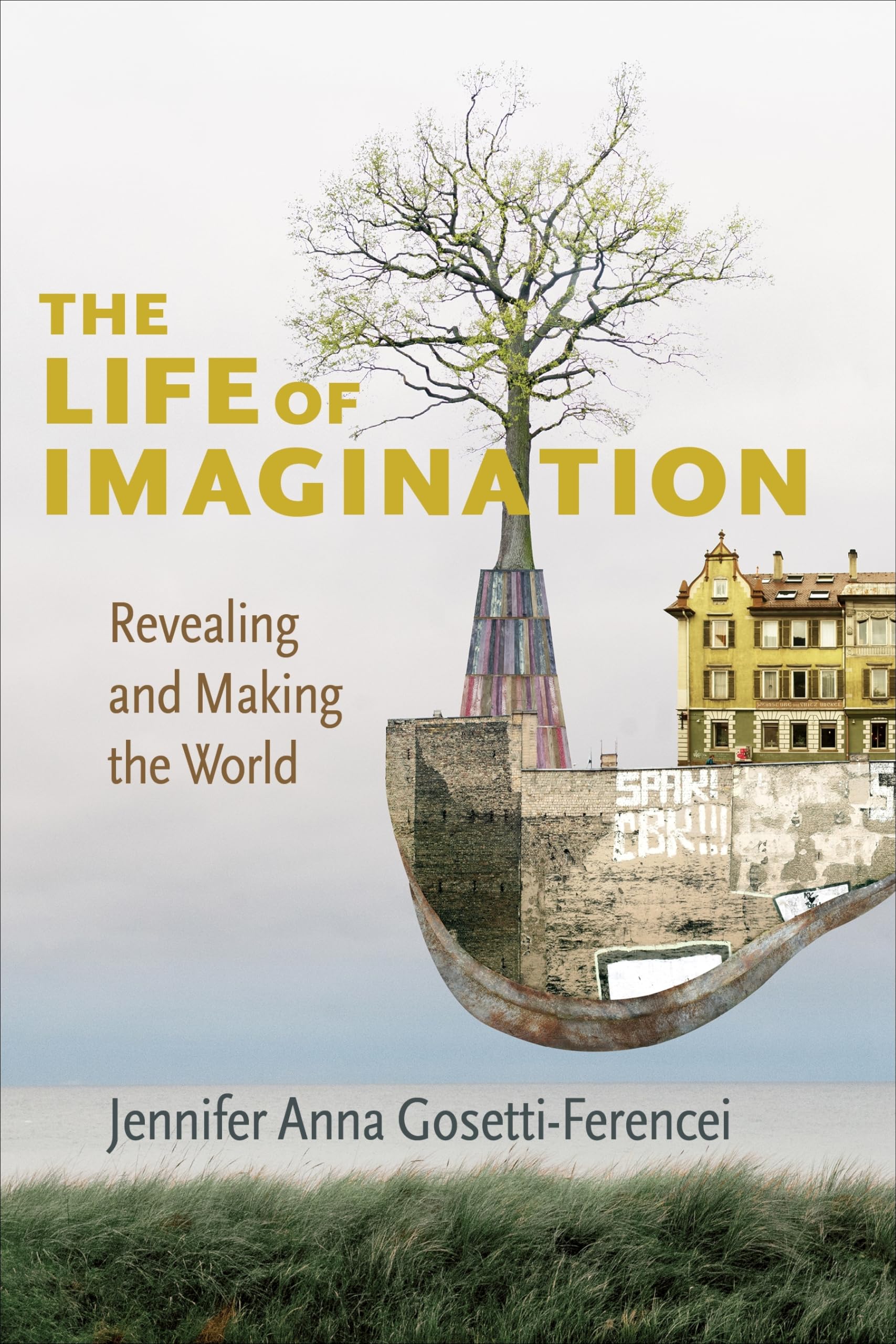
The Life of Imagination: Revealing and Making the World
$26.00
by Jennifer Anna Gosetti-Ferencei



Imagination allows us to step out of the ordinary but also to transform it through our sense of wonder and play, artistic inspiration and innovation, or the eureka moment of a scientific breakthrough. In this book, Jennifer Anna Gosetti-Ferencei offers a groundbreaking new understanding of its place in everyday experience as well as the heights of creative achievement. The Life of Imagination delivers a new conception of imagination that places it at the heart of our engagement with the world―thinking, acting, feeling, making, and being. Gosetti-Ferencei reveals imagination’s roots in embodied human cognition and its role in shaping our cognitive ecology. She demonstrates how imagination arises from our material engagements with the world and at the same time endows us with the sense of an inner life, how it both allows us to escape from reality and aids us in better understanding it. Drawing from philosophy, cognitive science, evolutionary anthropology, developmental psychology, literary theory, and aesthetics, Gosetti-Ferencei engages a spectacular range of examples from ordinary thought processes and actions to artistic, scientific, and literary feats to argue that, like consciousness itself, imagination resists reductive explanation. The Life of Imagination offers a vital account of transformative thinking that shows how imagination will be essential in cultivating a future conducive to human flourishing and to that of the life around us. Integrating the arts with the sciences of human nature is one of the most exciting frontiers of knowledge, and this exploration of imagination is a rich and creative example. -- Steven Pinker, author of How the Mind Works This book provides the most insightful, nuanced, and expansive phenomenological account of human conscious imaginative activity I have had the pleasure to read. It probes the way imagination arises from our bodily engagement with the world to make and transform meaning via processes of inner imaging, hypothetical thinking, and our most creative acts of reconfiguring and transcending our current frames and perspectives. These creative imaginative enactments are beautifully illustrated with examples from science, painting, poetry, dance, music, and fictional narrative. -- Mark Johnson, author of The Meaning of the Body: Aesthetics of Human Understanding The Life of Imagination is a bold, breakthrough book. Contesting an entire tradition of regarding imagination as a separate autonomous activity located in a rarefied realm of pure mind, Gosetti-Ferencei shows imagining to be deeply embedded in concretely embodied activities of human beings as they are fully engaged in the world―a world that is itself in significant measure shaped and structured by imagination itself. She guides us with lucidity and force through the many ways in which imagining invests our lives―in dancing, sauntering on the land, in artists’ re-imagination of ordinary experience, and in countless other ways. The result is a breathtaking contribution to the understanding of imagination as ingredient in all that we feel, think, and do. -- Edward S. Casey, author of Imagining: A Phenomenological Study A monumental achievement, Gosetti-Ferencei creates a philosophy of productive imagination that is precedent-setting. Intertwining cognitive theory and phenomenology, especially Merleau-Ponty on embodiment, her inviting, nuanced writing ranges across the history of philosophy, the arts, and literature, arriving at a beautiful discussion of the creativity of jazz. The book shows why imagination is a necessary power for social transformation. It will be the essential benchmark for all future studies. -- Galen A. Johnson, author of The Retrieval of the Beautiful: Thinking Through Merleau-Ponty's Aesthetics In a compelling synthesis of ideas from many disciplines―including archaeology, developmental psychology, philosophy, literary theory, cognitive science, and art history―Jennifer Gosetti-Ferencei offers an eloquent and inclusive account of the imagination. She shows that the human imagination not only penetrates our conception of reality at ground level but also enables us to soar upward in our creative endeavors, scientific as well as artistic. -- Paul Harris, author of The Work of the Imagination This is an impressively wide-ranging interdisciplinary project, in which the author patiently, critically, and imaginatively engages with expressions and analyses of the imagination drawn from a variety of philosophical, artistic, and scientific sources, in order to develop an original and thought-provoking characterization of that elusive human capacity. -- Stephen Mulhall, author of The Self and Its Shadows: A Book of Essays on Individuality as Negation in Philosophy and the Arts Jennifer Gosetti-Ferencei argues with style and insight for the ubiquity of imagination in human life across all aspects of the mind’s grappling with the world, through the arts and sciences to ord