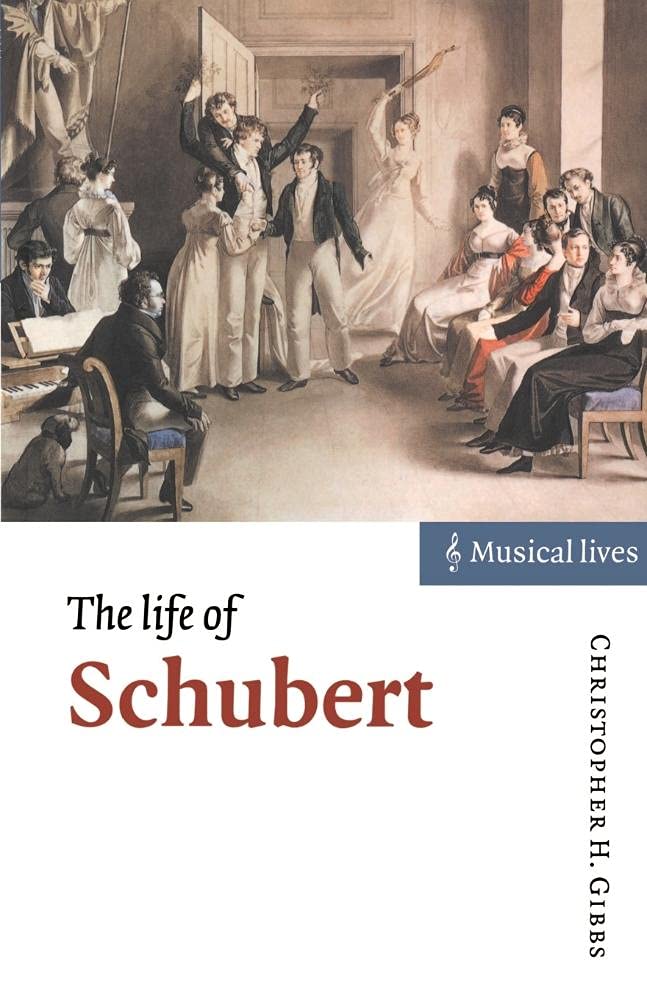



Franz Schubert's tragically short life was lived in one of Europe's most richly musical cities: a Vienna that worshipped Beethoven and where Rossini and Paganini drew crowds. Christopher Gibbs considers how and what Schubert composed, taking a fresh look at this misunderstood composer, particularly the unfolding of his professional career, his relationship to Beethoven, the growth of his reputation and public image and his darker side of drinking, depression and sexual ambiguity. This searching and sympathetic biography questions the customary sentimental clichés and the recent revisionist views concerning this elusive genius. Franz Schubert is a singularly undocumented composer. Direct accounts of his life are scarce, incomplete, and contradictory; even the memoirs of his closest friends, mostly written long after his death, reflect the writers more than the subject. His own surviving letters and diaries are often poignant, but sparse; it is in his music that he truly revealed himself. No wonder he has been the victim of endless speculation and rumor, leaving his image encrusted in fantasy, sentimentality, and condescension. Numerous serious, conscientious biographies have attempted to rectify this. Christopher Gibbs's excellent, informative, generously illustrated new study is a welcome addition. Gibbs has written and lectured widely on Schubert; his style is lucid, scholarly but not pedantic, and except for a stiff, ponderous beginning, flows with natural ease. Gibbs focuses on some relatively unexplored areas, notably Beethoven's profound influence on Schubert, both personal and musical, though they never met. He also demolishes several popularly held misconceptions, showing, for example, that Schubert took an active part in promoting his own career, enjoyed frequent successes, and lived to see his fame begin to grow. Gibbs demonstrates that Schubert was by no means a "natural," untutored composer who simply shook melodies out of his sleeve, and that it was not his untimely death that caused so many works to remain "unfinished." Some of these refutations have already been offered by previous writers, but are well worth repeating. Dietrich Fischer-Dieskau, in his splendid book On the Trail of the Schubert Songs , points out that Schubert's self-criticism often drove him to compose the same text several times, though unlike Beethoven he left no "sketchbooks that resemble battlefields." Hans Gál, in his Franz Schubert and the Essence of Melody (a beautiful book despite the clumsy title), suggests with a composer's empathetic insight that Schubert may have abandoned a work, like the C-major Piano Sonata, because he had modulated himself into a corner or hit a snag in the development, going on to something else while hoping for future inspiration. Gibbs deserves special gratitude for attacking the credibility of the most recent Schubert scholarship, which claims to have uncovered evidence of heavy drinking, debauchery, and unbridled sensuality, both hetero- and homosexual, born and bred from Vienna's depraved climate, Schubert's hedonistic circle of friends, and his own allegedly immoral nature. These assertions reveal more about our own times and attitudes than about Schubert and his world. --Edith Eisler Here, Gibbs (music, SUNY at Buffalo; editor, The Cambridge Companion to Schubert) focuses on the relationship of Schubert's music to his brief life (he died at 31 of unknown causes) and vice versa, with background on friends, teacher Antonio Salieri, and the social scene in 18th-century Europe. Along the way, he analyzes the copious biographical material on Schubert, acknowledging some of the more sensational issues (his sexual orientation) and critical evaluations (superficiality of his output). But rather than take sides, Gibbs carefully assesses the evidence, and, for the most part, allows the reader to make judgments. The organization is more or less chronological, paced by the compositions. Explorations of individual compositions rarely resort to technical analysis; instead, Gibbs is more interested in discussing each work's aesthetics and relating it to Schubert's life. Although clearly a fan, he does not gloss over Schubert's human frailties. The net result is a well-researched, warmly written, and refreshing new look at the Austrian composer. [Other recent books on Schubert include Elizabeth Norman McKay's Franz Schubert (LJ 10/1/96) and Brian Newbould's Schubert: The Music and the Man (LJ 3/15/97).DEd.]DTimothy J. McGee, Univ. of Toront. -DTimothy J. McGee, Univ. of Toronto Copyright 2000 Reed Business Information, Inc. "...timely and valuable." "Mr. Gibbs, with his solid grounding and balanced view, packs a great deal into a small space and supplies a corrective still sorely needed." --New York Times, June 19, 2000 "One of the best concise depictions of the man Schubert." Alan Hirsh, Booklist "A well researched, warmly written, and refreshing new look at the Austrian composer." Timot