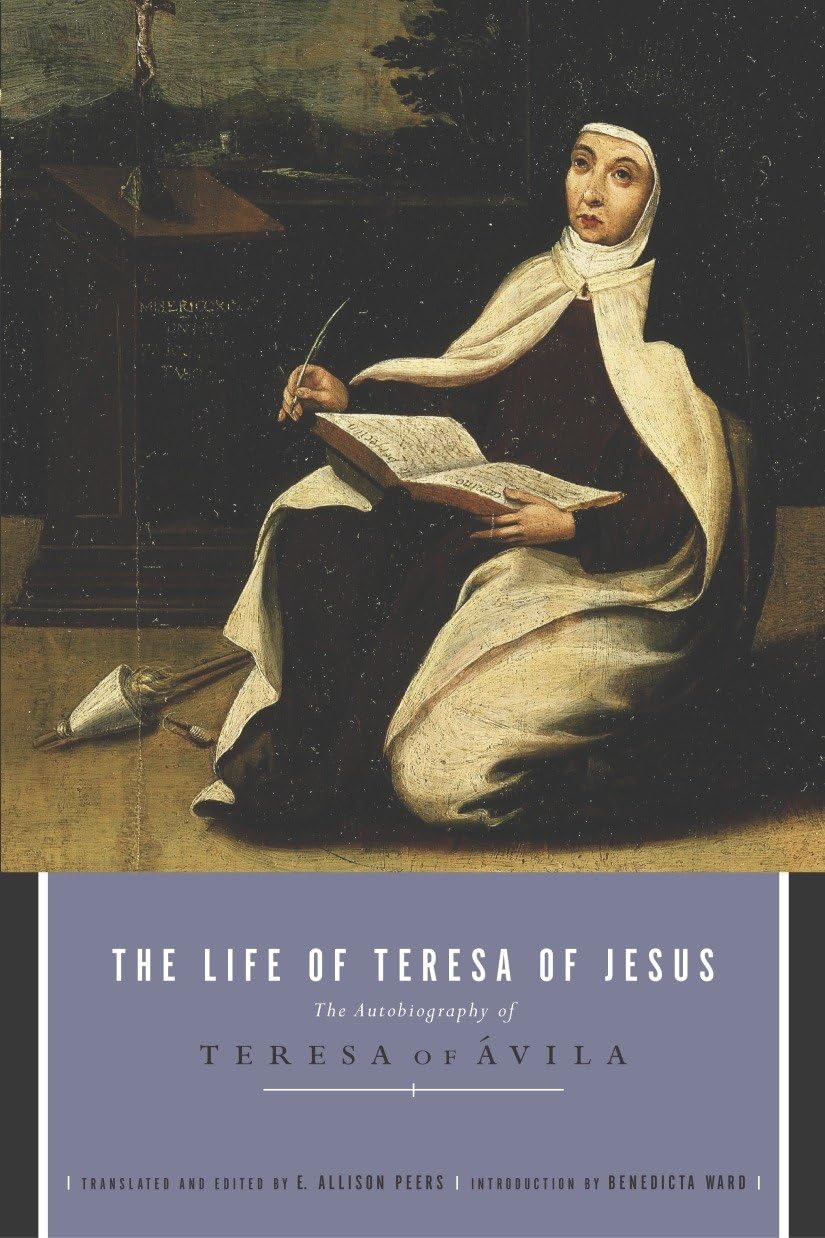
The Life of Teresa of Jesus: The Autobiography of Teresa of Avila
$13.79
by E. Allison Peers



Written in 1565 at the request of her confessor, St. Teresa's autobiography is at once an extraordinary chronicle of a life governed by the desire to draw closer to God and a literary masterpiece that brings to life a woman of candor, humor, and great spiritual strength. Teresa writes of her early life, the conflicts and crises she faced, and her decision to enter a life of prayer. Her lyrical, almost erotic descriptions of ecstatic experiences call to mind the senuous language of the Song of Songs. A religious classic for centuries, this is the compelling autobiography of the great Spanish saint, mystic, and reformer, with an illuminating introduction by one of the world's leading experts on feminine spirituality. A religious classic for centuries, this is the compelling autobiography of the great Spanish saint, mystic, and reformer, with an illuminating introduction by one of the world's leading experts on feminine spirituality. A religious classic for centuries, this is the compelling autobiography of the great Spanish saint, mystic, and reformer, with an illuminating introduction by one of the world's leading experts on feminine spirituality. TERESA OF ÁVILA (1515-82), also called St. Teresa of Jesus, was a Spanish nun and one of the great mystics and religious women of the Roman Catholic Church. She was the leader of the Carmelite Reform, which restored and emphasized the austerity and contemplative character of this religious order. Canonized in 1622, she was elevated to Doctor of the Church by Pope Paul VI in 1970, the first woman to be so honored. E. ALLISON PEERS is the translator of many great works of Spanish verse and mysticism. Chapter I Describes how the Lord began to awaken her soul in childhood to a love of virtue and what a help it is in this respect to have good parents. If I had not been so wicked it would have been a help to me that I had parents who were virtuous and feared God, and also that the Lord granted me His favour to make me good. My father1 was fond of reading good books and had some in Spanish so that his children might read them too. These books, together with the care which my mother took to make us say our prayers and to lead us to be devoted to Our Lady and to certain saints, began to awaken good desires in me when I was, I suppose, about six or seven years old. It was a help to me that I never saw my parents inclined to anything but virtue. They themselves had many virtues. My father was a man of great charity towards the poor, who was good to the sick and also to his servants--so much so that he could never be brought to keep slaves, because of his compassion for them. On one occasion, when he had a slave of a brother of his in the house,2 he was as good to her as to his own children. He used to say that it caused him intolerable distress that she was not free. He was strictly truthful: nobody ever heard him swear or speak evil. He was a man of the most rigid chastity. My mother, too, was a very virtuous woman, who endured a life of great infirmity: she was also particularly chaste. Though extremely beautiful, she was never known to give any reason for supposing that she made the slightest account of her beauty; and, though she died at thirty-three, her dress was already that of a person advanced in years. She was a very tranquil woman, of great intelligence. Throughout her life she endured great trials and her death was most Christian.3 We were three sisters and nine brothers: all of them, by the goodness of God, resembled their parents in virtue, except myself, though I was my father's favourite. And, before I began to offend God, I think there was some reason for this, for it grieves me whenever I remember what good inclinations the Lord had given me and how little I profited by them. My brothers and sisters never hindered me from serving God in any way. I had one brother almost of my own age.4 It was he whom I most loved, though I had a great affection for them all, as had they for me. We used to read the lives of saints together; and, when I read of the martyrdoms suffered by saintly women for God's sake, I used to think they had purchased the fruition of God very cheaply; and I had a keen desire to die as they had done, not out of any love for God of which I was conscious, but in order to attain as quickly as possible to the fruition of the great blessings which, as I read, were laid up in Heaven. I used to discuss with this brother of mine how we could become martyrs. We agreed to go off to the country of the Moors, begging our bread for the love of God, so that they might behead us there; and, even at so tender an age, I believe the Lord had given us sufficient courage for this, if we could have found a way to do it; but our greatest hindrance seemed to be that we had a father and a mother.5 It used to cause us great astonishment when we were told that both pain and glory would last for ever. We would spend long periods talking about this and we liked