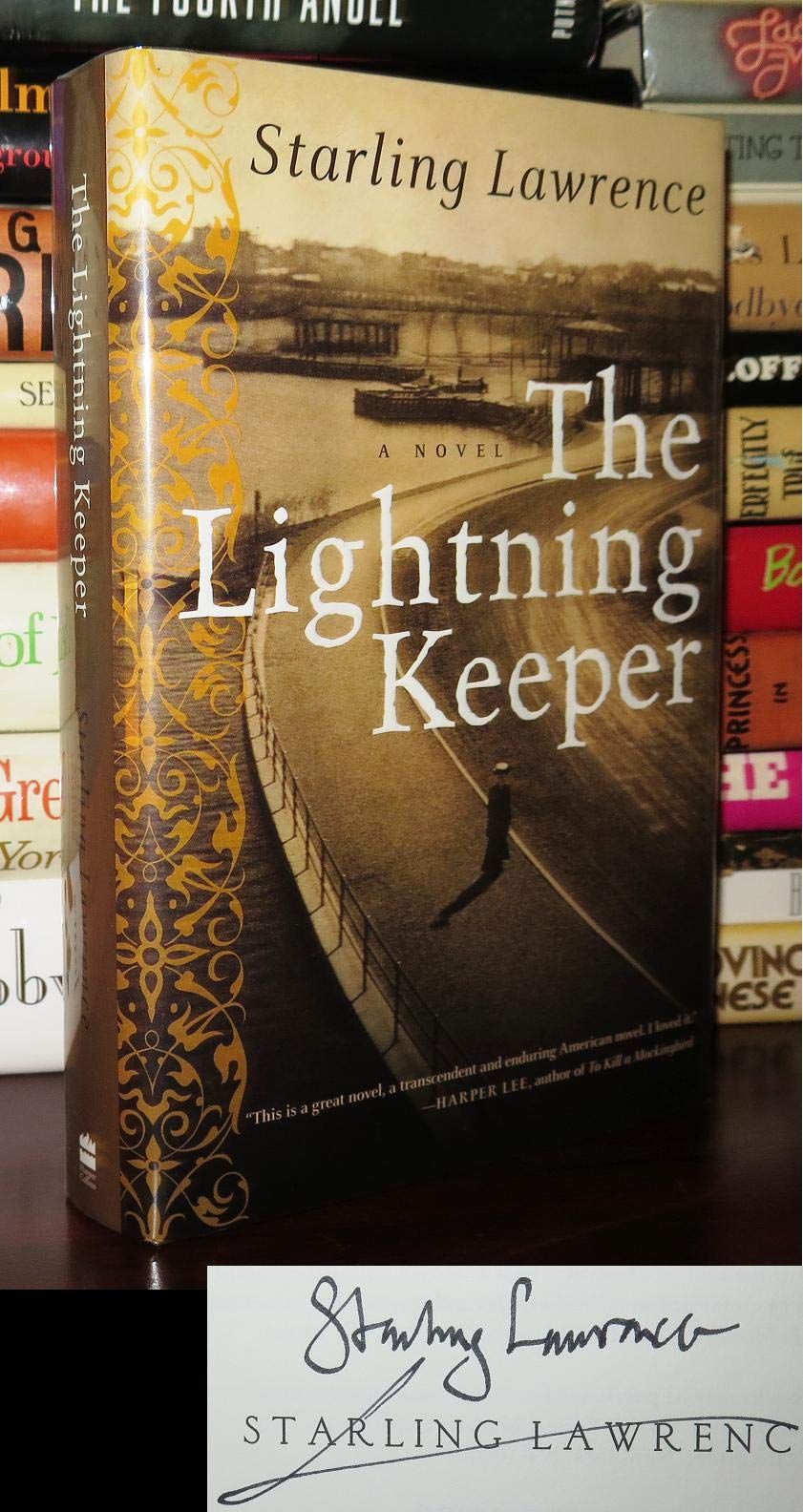



The Lightning Keeper is a sweeping epic novel of ambition, love, and enterprise in America. It is the story of an unlikely Romeo and Juliet romance at the dawn of the electric age, with the nation balancing on the brink of world war and a scientific revolution. In 1914 Toma Pekocevic is a penniless immigrant in New York recently escaped from the bloody politics of the Balkans that have claimed most of his family. He is also a gifted inventor who designs a revolutionary water turbine while working with Harriet Bigelow, scion of a proud Connecticut iron-making dynasty now fallen on hard times. Their attraction is immediate and overwhelming, but every circumstance is against them. Toma is eventually drawn inside the industrial empire of General Electric, his machine an essential cog in its grand scheme to provide electricity to the entire country. His invention is all he has after losing Harriet to a wealthy politician, but Toma is determined to win her back, setting the stage for a confrontation that could change not only his life but the course of scientific progress. Deeply evocative and utterly engrossing, The Lightning Keeper is a rich tapestry of technology, romance, and war -- an unforgettable and distinctly American saga that establishes Starling Lawrence as one of the most talented writers at work today. Starling Lawrence, editor in chief of W. W. Norton, has written a sprawling, old-fashioned novel with lessons for us all about the "miracles" of technology, personal progress, competition, and happiness. It is also about love, an inventor's mind, the battle between small businesses and corporations, and the electrification of America. Gorgeous language, rich period details, and an elegant plot impressed critics; clearly, Lawrence did his research, even if he offers up some dense passages. Photographs and the inclusion of historic figures round out the compelling story. In sum, The Lightning Keeper "draws us in and allows us to live briefly, magically, marvelously in the world as it once was" ( Chicago Tribune ). Copyright © 2004 Phillips & Nelson Media, Inc. On a trip to Italy, Harriet Bigelow meets Toma Pekocevic, igniting a spark that is still alive six years later when they meet again by chance in New York. While World War I looms, Harriet's father gets a huge contract that could save his ironworks. But to produce the number of wheels in the time given, a new source of energy is needed. Toma, somewhat of a genius with machines, uses Nikola Tesla's theories to build a new turbine that will produce all the energy needed and possibly clear his way to Harriet. However, a terrible accident and the interests of General Electric intervene, and plans go awry. Building on the story begun in his first novel, Montenegro (1997), Lawrence employs the language and style of the turn of the last century along with plenty of historical figures and references to science and technology. He has created a very American saga of the private struggles of a family business and of European immigrants alongside the very large conflicts of war and technology, and the business of both. Elizabeth Dickie Copyright © American Library Association. All rights reserved “The Lightning Keeper is a great novel, a transcendent and enduring American novel. I loved it.” — Harper Lee, author of To Kill a Mockingbird “Skillfully intertwining fact and fiction, Lawrence generates an electric history of ideas, kindled by the flames of capital and passion.” — Publishers Weekly “Lawrence blends science and romance into an immensely readable story; his descriptions … are as exciting as they are beautiful.” — Library Journal (starred review) “Lawrence has created a very American saga.” — Booklist Starling Lawrence is the editor in chief and vice chairman of W.W. Norton & Company. He is the author of the novel Montenegro and the story collection Legacies . He lives in New York City and northwestern Connecticut. In his new novel, The Lightning Keeper, Starling Lawrence paraphrases Thomas Edison's famous remark, "To invent, you need a good imagination and a pile of junk." In his own literary invention, Lawrence has jettisoned the junk but retained the imagination and given us a deeply satisfying novel of love and electricity. It is not only a complex romantic tale, but also a grand story of science and American industry in the years before World War I. We are given a window into the conniving nature of men in power, where brilliance is a valued commodity, but results, no matter how obtained, are gold. The "lightning keeper" of the title is Toma Pekocevic. We first meet him on the docks of Naples, Italy, in 1908, where he has fled the Balkan Wars. As a teenager in Naples, he has a brief, romantic encounter with Harriet Bigelow, the daughter of a Connecticut ironworks magnate vacationing with her family. After a fluttering of pages they meet again in New York, a scene that relies too much on coincidence in this otherwise tightly cons