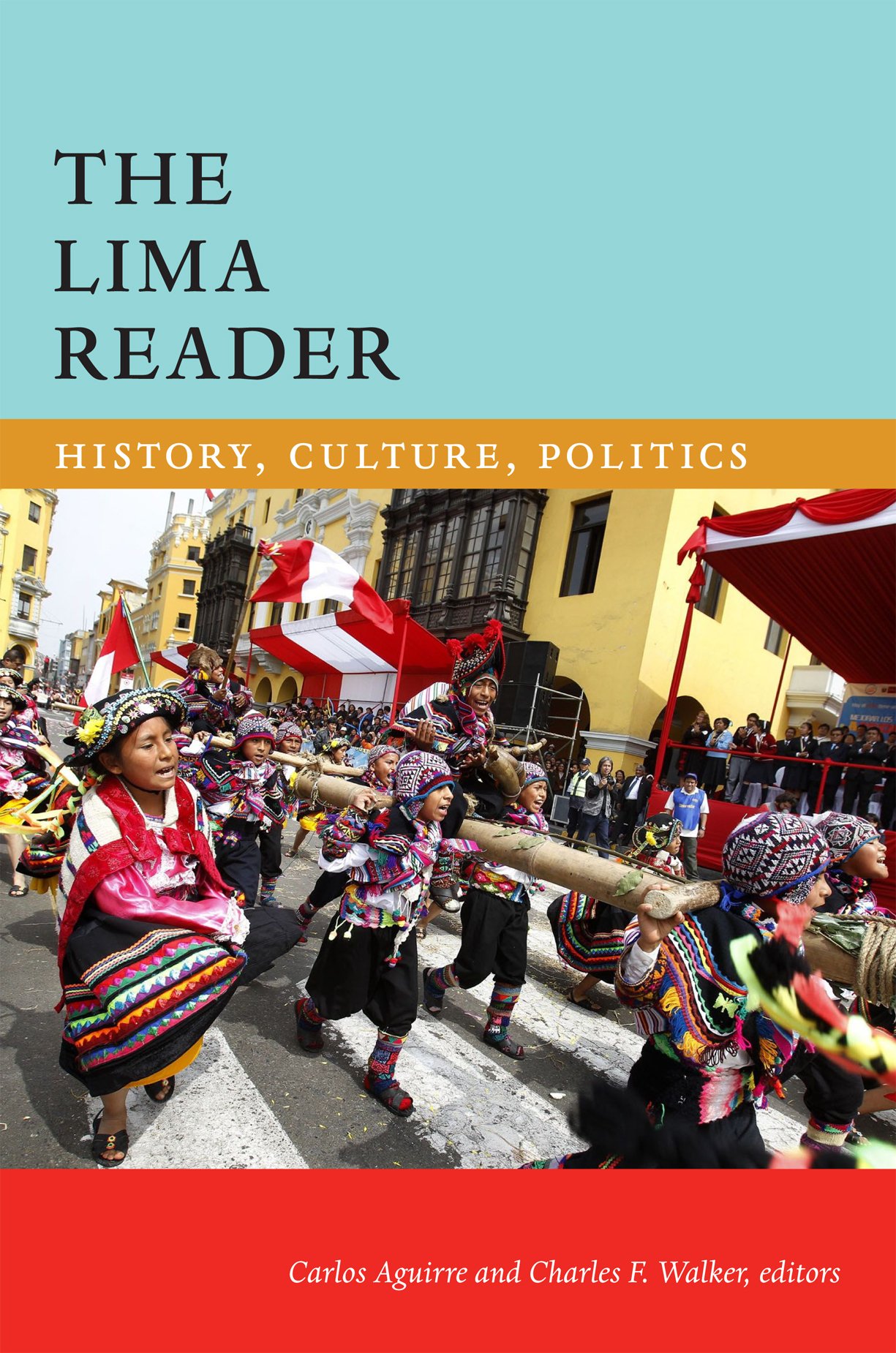
The Lima Reader: History, Culture, Politics (The Latin America Readers)
$22.41
by Carlos Aguirre



Covering more than 500 years of history, culture, and politics, The Lima Reader seeks to capture the many worlds and many peoples of Peru’s capital city, featuring a selection of primary sources that consider the social tensions and cultural heritages of the “City of Kings.” "A much-needed overview of the creation of this most important coastal city of the Andes. The Lima Reader presents a series of unpublished or not previously translated primary sources and excerpted literature that reveal the multiplicity of forces that converged to shape this contemporary metropolis. . . . An indispensable resource for the classroom and the road. The Lima Reader could greatly benefit the undergraduate survey class, provide critical information for the upper-level seminar, and be of assistance for the seasoned traveler seeking something much deeper than a generic tour guide." -- Javier Puente ― Journal of Global South Studies "Brings together an extraordinarily rich array of original sources. . . . The editors succeed admirably in selecting the best passages (and photographs) that can be found to represent the rich material and cultural tapestry that unfolds in the City of the Kings over the centuries." -- Peter Klarén ― Latin American Research Review "A welcome addition to Duke University Press’s by now well-established and well-regarded Latin American Readers series . . . The editors manage to transmit in periodized, chronological order and kaleidoscopic detail, the city’s beguiling complexity and mystique. . . . An excellent introduction to the city." -- Barry Cannon ― Bulletin of Latin American Research " The Lima Reader is the most helpful introduction to the Peruvian capital available in any language, and the most compelling since Sebastián Salazar Bondy's Lima the Horrible (1964). With a keen understanding of the city's history, demographic transformations, multiracial complexities, socioeconomic tensions, and insights of creative writers, Carlos Aguirre and Charles F. Walker present a rich gamut of historical, sociological, and literary documents whose satisfying whole is greater than its parts." -- Efraín Kristal, University of California, Los Angeles Carlos Aguirre is Professor of History at the University of Oregon and the author of The Criminals of Lima and Their Worlds: The Prison Experience, 1850–1935 , also published by Duke University Press. Charles F. Walker is Professor of History, Director of the Hemispheric Institute on the Americas, and MacArthur Foundation Endowed Chair in International Human Rights at the University of California, Davis, and the author of Shaky Colonialism: The 1746 Earthquake-Tsunami in Lima, Peru, and Its Long Aftermath and Smoldering Ashes: Cuzco and the Creation of Republican Peru, 1780–1840 , both also published by Duke University Press. The Lima Reader History, Culture, Politics By Carlos Aguirre, Charles F. Walker Duke University Press Copyright © 2017 Duke University Press All rights reserved. ISBN: 978-0-8223-6348-4 Contents Acknowledgments, Introduction, I Pre-Hispanic, Conquest, and Early Colonial Lima, II Bourbon Lima, III From Independence to the War of the Pacific (1821–1883), IV Modernizing Lima (1895–1940), V Interlude: Nostalgia and Its Discontents, VI The Many Limas (1940–), Suggestions for Further Reading and Viewing, Acknowledgment of Copyrights and Sources, Index, CHAPTER 1 Pre-Hispanic, Conquest, and Early Colonial Lima When Francisco Pizarro and his brothers in arms scouted areas in 1534 and early 1535 to establish a capital of Peru, they had the usual pragmatic concerns, above all securing sufficient water and agricultural land. Jauja in the central Andes had been an original favorite but was rejected, deemed too high and too distant from the Pacific Ocean. Instead, they selected a slightly inland spot along the Rímac River that could protect them from pirates yet lay on the coast, a good distance away from the center of the far-from-subjugated Inca Empire. On January 18, 1535, they laid out a classic Plaza Mayor just south of the river, with the state (what became the viceroy), the church, the municipality, and merchants occupying the four sides of the square and streets running from it at perfect right angles. It received two names, Lima and La Ciudad de los Reyes (The City of Kings). The first derived from a pre-Inca oracle in the valley, called Limaq (which also produced the name of the river and district, Rímac), and the second from the decision to found the city on January 6, the feast of the Epiphany or Three Kings Day. The Spanish believed that they had set in stone (and adobe) an enduring symbol of Spanish rule, one that would house the different components of the conquering Iberians and oversee the domination of the Incas and all of South America. They succeeded yet created a city very different than the one they imagined. The symbolic power of the plaza and its environs glorified S