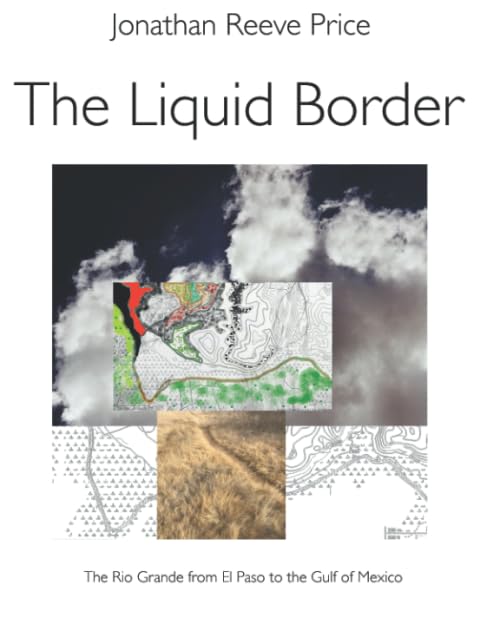
The Liquid Border: The Rio Grande from El Paso to the Gulf of Mexico
$14.95
by Jonathan Reeve Price



In a series of images, Jonathan Reeve Price explores the liquid border—the imaginary line drawn down the middle of the Rio Grande as it passes between Texas and Mexico. Starting with topographical maps from the United States Geological Service, and satellite pictures from NASA, Price zooms in on the ripples in the river, the steep cliffs and undulating desert on both banks, and the odd unnatural beauty of the digital representations seen from 30,000 feet. His images and texts may help us imagine the people struggling across the river, and the trackers from the Border Patrol waiting on the American side. This exhibition is an homage to all their treks. "How do you cut a river in half? You can’t, of course—which makes the paradox of the Rio Grande even more painful in Price’s thoughtful, poignant new book of poetry and digital art. The poet refers to that river, which makes up much of the physical border between the United States and its southern neighbor: “Throughout most of the river’s run to the Gulf of Mexico,” Price writes, “the border is in the middle of the flow, invisible, but real.” …Price’s volume seeks to map that liminal space in imagery and verse. Roughly half the book is given over to digital images; in them, the artist stitches together cartographs, photographs, and satellite images, many of them altered, to evoke the strange space between the two countries. Price calls these pieces “imaginary” maps and argues that they document “something close to reality, but not all there.” Accompanying the visuals are roughly a dozen thoughtful, poignant poems, many of which capture the torturous experience of those seeking entry into America. …Price is as adept with his poetry as he is with his pictures, and the combination is a moving testimony to the struggle of those who yearn for a better life elsewhere. A mournful, beautiful, and original synthesis of word and image."--Kirkus Reviews Jonathan Reeve Price, who started his career with a Doctorate of Fine Arts from Yale, has exhibited map works at numerous galleries and museums. In addition to his conceptual and public art, Price has written books on subjects such as video art, theater, and computer software. At Apple, he created the style guide for documentation. His high-tech clients are an A-to-Z of major computer companies in the U.S. and Japan. He lives next to the Rio Grande as it flows through New Mexico. The poetry affected me profoundly. I found myself having to take frequent breaks to blink back tears, or stop reading entirely for a while to recover from the intensity of sadness, longing, fear, relief, and loss. Each one clearly encompasses a particular moment from a different point of view: from those who are making the attempt to cross but fail, or who succeed only to succumb to some later danger, who have triumphed and are living in the new world, or who made it but were caught and put in a cell. Price's phrasing is elegant yet visceral, evoking in the reader that most basic desperate instinct of survival in just a few words. He captures the beautiful and the frightful, the surreal and the absurd, and weaves it into a kind of truth, all the while acknowledging that there is no one true story to be told. For those who enjoy poetry or fine art, or who have an interest in immigration issues and the plight of illegal immigrants, this short volume is definitely worth picking up. I am very glad I did. --Reedsy Discovery Price is as adept with his poetry as he is with his pictures, and the combination is a moving testimony to the struggle of those who yearn for a better life elsewhere. A mournful, beautiful, and original synthesis of word and image. --Kirkus Reviews This book grows out of my life next to the Rio Grande, the river that forms the liquid border between the United States and Mexico. This book offers an exploration of the ebb and flow of migration, and the terrible cost, on both sides of the border.These images and poems look at the invisible border, the imaginary line drawn right down the middle of our river that takes on two names as it flows between Texas and Mexico--the Rio Grande, or, in Spanish, El Río Bravo del Norte.Beginning with satellite images and high-resolution maps from the U.S. Geological Survey, I zoom in, pull back, exaggerate the pixels, and turn the scientific data inside out. These digital landscapes reveal the eerie beauty of the topography, the unrelenting patterns of the geology, and the life-threatening challenges that face migrants as they wade from Mexico into Texas.The poems try to give voice to the people struggling through this brutal terrain. Some of the artworks in this book have been added to the permanent collections of the Albuquerque Museum, and the Rumsey Map Collection of Stanford University. The pictures have also appeared in shows at the following galleries: 311 Gallery, Raleigh, NC.Art League Rhode Island, Providence, RI.;Farmington Museum, Farmington, NM.;Fort Works Art, Fort Worth, TX.;Mi