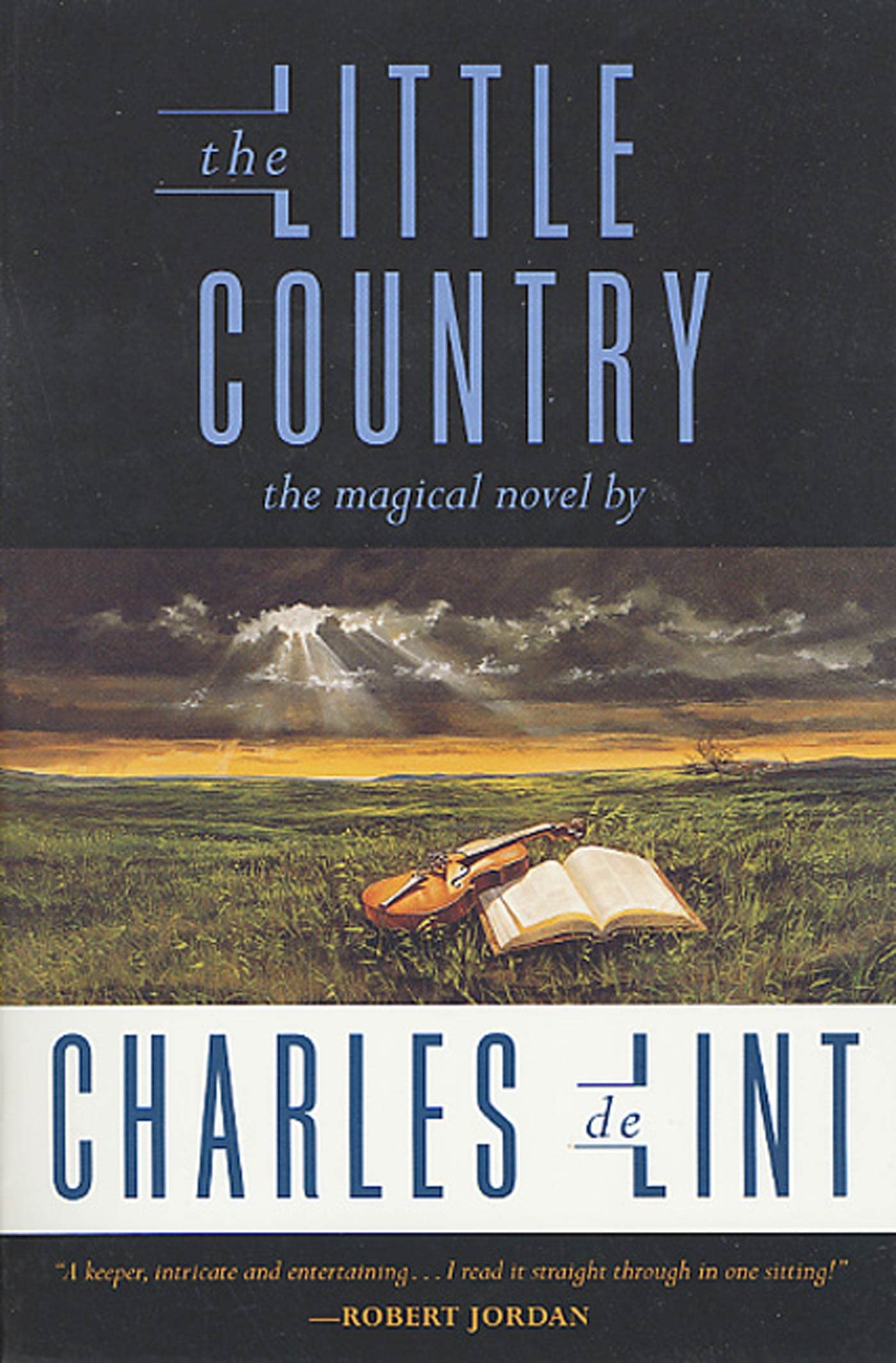



Come walk the mist-draped hills of Cornwall, come walk the ancient standing stones. Listen to the fiddles, and the wind, and the sea. Come step with Janey Little into the pages of... The Little Country. When folk musician Janey Little finds a mysterious manuscript in an old trunk in her grandfather's cottage, she is swept into a dangerous realm both strange and familiar. But true magic lurks within the pages of The Little Country, drawing genuine danger from across the oceans into Janey's life, impelling her--armed only with her music--toward a terrifying confrontation. “A keeper, intricate and entertaining...I read it straight through in one sitting!” ― Robert Jordan “What a great, galloping wonder of a book--deep and wide and witty and wise. And absolutely impossible to put down.” ― Jane Yolen “A must for all connoisseurs of high imagination.” ― Greg Bear “A masterful blend of the sinister and the fantastic.” ― Julian May “An intricately structured novel, full of a wealth of detail about music, Cornwall, and things magical and arcane. I think it is one of de Lint's best.” ― Patricia McKillip Charles de Lint and his wife, the artist MaryAnn Harris, live in Ottawa, Ontario, Canada. His evocative novels, including Moonheart, Forests of the Heart, and The Onion Girl, have earned him a devoted following and critical acclaim as a master of contemporary magical fiction in the manner of storytellers like John Crowley, Jonathan Carroll, Alice Hoffman, Ray Bradbury, and Isabel Allende. The Little Country By De Lint, Charles Orb Books Copyright © 2001 De Lint, Charles All right reserved. ISBN: 9780312876494 The Quarrelsome Piper Like burrs old names get stuck to each other and to anyone who walks among them. --Paul Hazel, from Undersea There were two things Janey Little loved best in the world: music and books, and not necessarily in that order. Her favorite musician was the late Billy Pigg, the Northumbrian piper from the northeast of England whose playing had inspired her to take up the small pipes herself as her principal instrument. Her favorite author was William Dunthorn, and not just because he and her grandfather had been mates, though she did treasure the old sepia-toned photograph of the pair of them that she kept sealed in a plastic folder in her fiddle case. It had been taken just before the Second World War in their native Mousehole—confusingly pronounced “Mouzel” by the locals—two gangly Cornish lads standing in front of The Ship Inn, cloth caps in hand, shy grins on their faces. Dunthorn had written three book-length works of fiction, but until that day in the Gaffer’s attic when Janey was having a dusty time of it, ferreting through the contents of old boxes and chests, she knew of only two. The third was a secret book, published in an edition of just one copy. The Hidden People was his best-known work, remembered by most readers with the same fondness that they recalled for Winnie the Pooh, The Wind in the Willows , and other classics of their childhood. It told of a hidden race of mouse-sized people known as the Smalls, reduced to their diminutive stature in the Middle Ages by a cranky old witch who died before her curse could be removed. Supposedly the Smalls prospered through the ages, living a hidden life alongside that of more normal-sized people right up to the present day. The book was still in print, in numerous illustrated editions, but Janey’s favorite was still the one that contained Ernest Shepard’s delightful pen and ink drawings. The other novel was The Lost Music published two years after the first. While it didn’t have nearly the success of The Hidden People —due no doubt to its being less whimsical and the fact that it dealt with more adult themes—its theories of music being a key to hidden realms and secret states of mind had still made it a classic in the fantasy field. It too remained in print, though there were few children who would find a copy of it under their Christmas tree, illustrated by whichever artist was currently the nadir of children’s book illustrating. Which was really a pity, Janey often thought, because in the long run, The Lost Music was the better book. It was the reason that she had taken up with old things. Because of it, she went back to its sources, poring over folktales and myths, discovering traditional music and finding that the references between old lore and old tunes and songs went back and forth between each other. It was a delightful exploration, one that eventually led to her present occupation. For while she had no interest in writing books, she had discovered, hidden away inside herself, a real flair for the old music. She took to playing the fiddle and went wandering through tunebooks tracked down in secondhand bookshops, the tunes sticking to her like brambles on a walk across a cliff-side field. Old tunes, old names, old stories. So Dunthorn was partially responsible for who she was tod