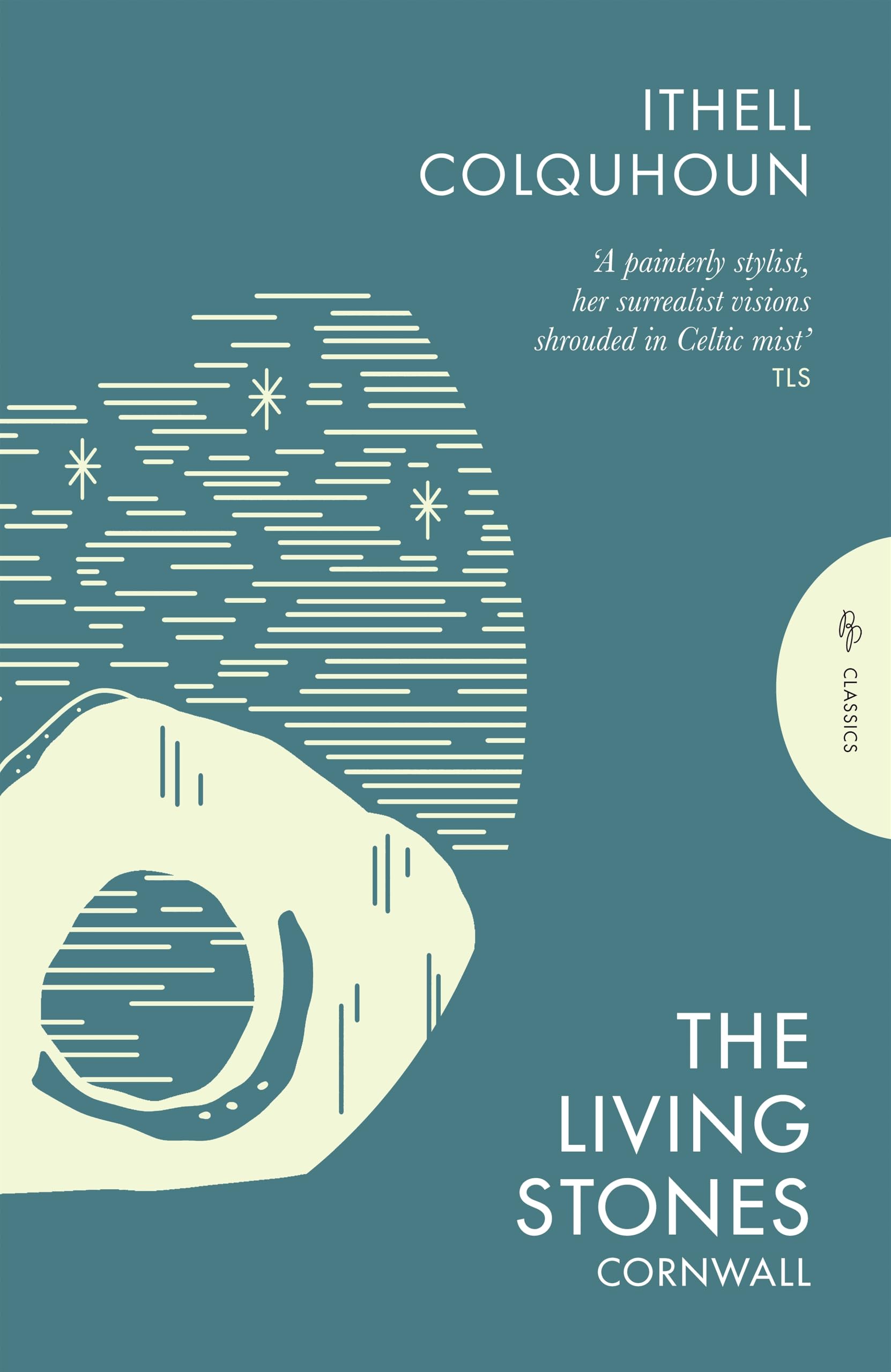



A classic travelogue by Britain's foremost female surrealist painter, which immerses the reader in a dreamlike Cornwall where landscape and legend meet “Her responses to the aura of place are keen, and her eye for detail is excitingly sharp” — Sunday Times “She is sensitive to the ways of wind and water, the flowers and birds and trees” — Country Life In the midst of the 2nd World War, surrealist painter Ithell Colquhoun withdraws from London to Cornwall, searching for a studio and a refuge from the Blitz, as well as from a shattered marriage. So begins a profound and lifelong relationship with Britain's westernmost county. It is a land of granite ridges and lush valleys, surrounded by sea and steeped in myth, where the ancient Celtic past makes contact with the present. There she finds a hut with no running water or electricity, and lovingly brings it to life, creating a haven for her creative pursuits, and slowly coming to think of these rivers, hills and caves, seen in every season, as her true home. Drawn to the sacred and the beautiful, the wild and the weird, Colquhoun writes about Cornwall as a living landscape, where every tree, standing stone and holy well is a palimpsest of folklore - and perhaps a place where everyday reality connects to the world beyond. In prose as gorgeously dreamlike as it is sharply witty, this inimitable artist gives us a travelogue deeply attuned to natural rhythms, local atmosphere and the eerie beauty of a place that is as much legend as it is water and rock. "The perfect gateway drug for readers new to Colquhoun... She was that vanishingly rare thing, someone who was wholly, unaffectedly, unapologetically herself." — The Washington Post Ithell Colquhoun (1906-1988) was born in British India and brought up in the United Kingdom. She studied at the Slade School of Fine Art and started exhibiting her paintings in the 1930s, gaining some renown as one of the few women associated with British Surrealism. She began visiting Cornwall during the Second World War, and eventually moved there, continuing to write, paint, and pursue the study of the occult until her death. As well as her novel Goose of Hermogenes , she is the author of two travelogues, The Living Stones: Cornwall and The Crying of the Wind: Ireland , both forthcoming from Pushkin Press. It was the place of deluge. It was in that place of mountains, jungle and six-months-long torrents where the people, at nodal points of the solar or the lunar year, still sustain their stone rites by wreathing pillar and circle. My origin was there, and there I would return, other than in dreams. I would see that country with eyelashes untangled by the tendrils of sleep, hear the forgotten but re-echoing sounds, savour again that smell now only remembered from half-open trunks; savour again the taste, the different touch even of the air. I should be among the wild Nagas of the snake-like name, who might once have been at home in Avebury, the serpent town, with their ivory and spears, feathers and bangles; whose women have all the mates they choose. But how to get there? Oh, for a strong heart, a bloodstream not predisposed to fever, a stomach immune to enteritis, respiration resistant to damp and dust! To be taken there in a clear breath. I began a Western search for an equivalent. I always maintained that I could remember the captain of the ship who, I believe, used to notice my precocity. He brought me away from home, and I have never returned. I used to describe him as wearing a casque-like helmet of black and gold and carrying a sword at his side, but I was told that this was impossible. After all, what could one remember at a year old? So it had to be by the sea. I believed in the Gulf Stream, which is supposed to temper the bitterness of this air, bring- ing palms and fuchsias to Western shores. And the sea ought to lie southward; sea to the north puts me off my bearings. I wanted to watch the ships passing at a great distance, seemingly on their way to India, though I know that it does not lie to the west. But before I had learned any geography I sensed the land-locked Baltic to the east and felt that the Oriental route must have a westward starting down the Channel. The poignancy of Gaelic melodies called to me, their scale identical with that of Peru: I think of The Willow and From Door to Door , which might have been heard in the Hebrides. Their common ancestry is Atlantean; Atlantis’s wisdom in their strains, they bring a message not otherwise to be expressed. How they once stabbed me to the heart; before the age of ten how vulnerable the heart is to memories of that foundered country, the ‘land-under-wave’, perfect symbol of the uncon- scious. They call me yet and perhaps more constantly, but now I accept their nostalgia – it is no longer a revelation visiting ‘the bottom of the monstrous world’ but an atmosphere. Oh ages, Oh western clouds! Sea stretches grey between relic-islands – Fastnet, Arran,