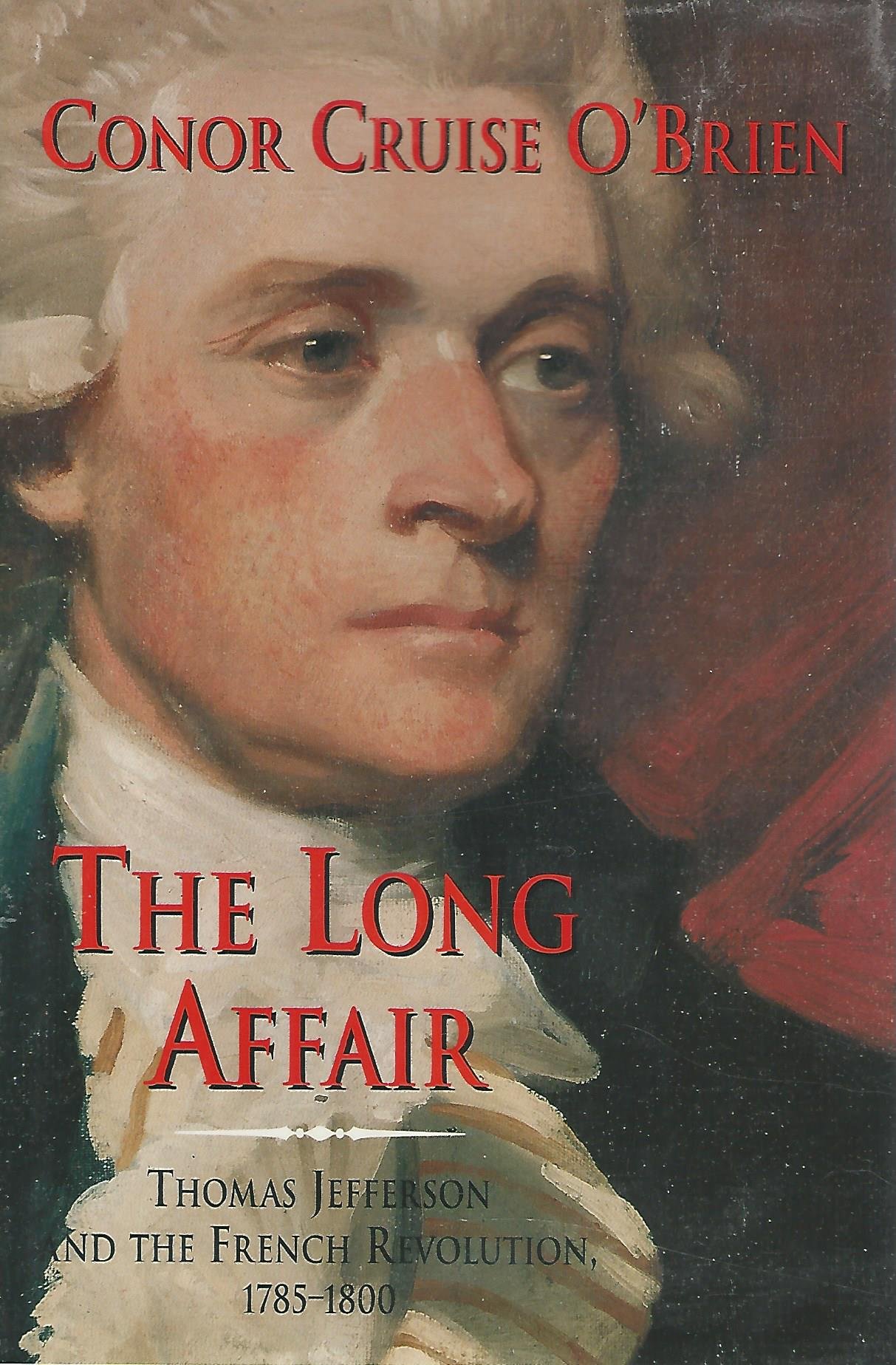
The Long Affair: Thomas Jefferson and the French Revolution, 1785-1800
$26.00
by Conor Cruise O'Brien



As controversial and explosive as it is elegant and learned, The Long Affair is Conor Cruise O'Brien's examination of Thomas Jefferson, as man and icon, through the critical lens of the French Revolution. O'Brien offers a provocative analysis of the supreme symbol of American history and political culture and challenges the traditional perceptions of both Jeffersonian history and the Jeffersonian legacy. "The book is an attack on America's long affair with Jeffersonian ideology of radical individualism: an ideology that, by confusing Jefferson with a secular prophet, will destroy the United States from within."—David C. Ward, Boston Book Review "With his background as a politician and a diplomat, O'Brien brings a broad perspective to his effort to define Jefferson's beliefs through the prism of his attitudes toward France. . . . This is an important work that makes an essential contribution to the overall picture of Jefferson."— Booklist "O'Brien traces the roots of Jefferson's admiration for the revolution in France but notes that Jefferson's enthusiasm for France cooled in the 1790s, when French egalitarian ideals came to threaten the slave-based Southern economy that Jefferson supported."— Library Journal "In O'Brien's opinion, it's time that Americans face the fact that Jefferson, long seen as a champion of the 'wronged masses,' was a racist who should not be placed on a pedestal in an increasingly multicultural United States."— Boston Phoenix "O'Brien makes a well-argued revisionist contribution to the literature on Jefferson."— Kirkus Reviews "O'Brien is right on target . . . determined not to let the evasions and cover-ups continue."—Forrest McDonald, National Review " The Long Affair should be read by anyone interested in Jefferson—or in a good fight."—Richard Brookhiser, New York Times Book Review Conor Cruise O'Brien, the distinguished Irish diplomat, constitutional historian and writer, has produced a typically vigorous and sweeping polemic against the reputation of the author of the Declaration of Independence Thomas Jefferson . O'Brien contends that liberals are mistaken in claiming Jefferson as one of their own; indeed he regards the right-wing militias as the true heirs to Jefferson's spirit. Contrasting Jefferson's position with that of his longtime hero, the anti-revolutionary Edmund Burke , O'Brien details the extreme edges of Jeffersonian political theory, in particular his commitment to the French Revolution even in the face of its excesses ("rather than it should have failed, I would have seen half the earth desolated"). For O'Brien, the American revolution is still a glorious achievement, but Jefferson is demoted to a mere "draughtsman" of the Declaration. O'Brien (Ancestral Voices, Univ. of Chicago, 1995) is one of the most respected men of letters in Europe and America today. He has also served as a diplomat and politician for his native Ireland. His present work is bound to stir debate because he gives a distinctly sober, often unflattering interpretation of the life and career of Thomas Jefferson. O'Brien traces the roots of Jefferson's admiration for the revolution in France but notes that Jefferson's enthusiasm for France cooled in the 1790s, when French egalitarian ideals came to threaten the slave-based Southern economy that Jefferson supported. Though O'Brien infers that the evidence for Jefferson's putative liaison with his slave Sally Hemings is not conclusive, he devotes much space to the topic. O'Brien is incapable of writing a dull or sloppy book. His revisionary interpretation of Jefferson, however, lacks sufficient weight to be totally persuasive. O'Brien fails to cite the works of Lawrence S. Kaplan on Jefferson's relationship to France, and O'Brien's readings in recent literature on the French Revolution is spotty. Suitable for all readers.?Thomas J. Schaeper, St. Bonaventure Univ., Copyright 1996 Reed Business Information, Inc. Those who elevate Thomas Jefferson to near sainthood in the U.S. pantheon will find this a disturbing work. As minister to France, Jefferson witnessed the first stirrings of revolution, and as secretary of state under Washington, Jefferson was seen as leader of the pro-French faction in the U.S. as the revolution became increasingly radical and violent. With his background as a politician and a diplomat, O'Brien brings a broad perspective to his effort to define Jefferson's beliefs through the prism of his attitudes toward France. At times, the picture that emerges is not a pretty one. Although he acknowledges Jefferson's devotion to "liberty" in the abstract, O'Brien lays great emphasis on Jefferson's defense of the slave-based southern economy. While Jefferson often toyed with schemes for emancipation, he was deeply skeptical of the prospects for black equality. O'Brien may not always be objective or fair; however, this is an important work that makes an essential contribution to the overall picture of Jefferson. J