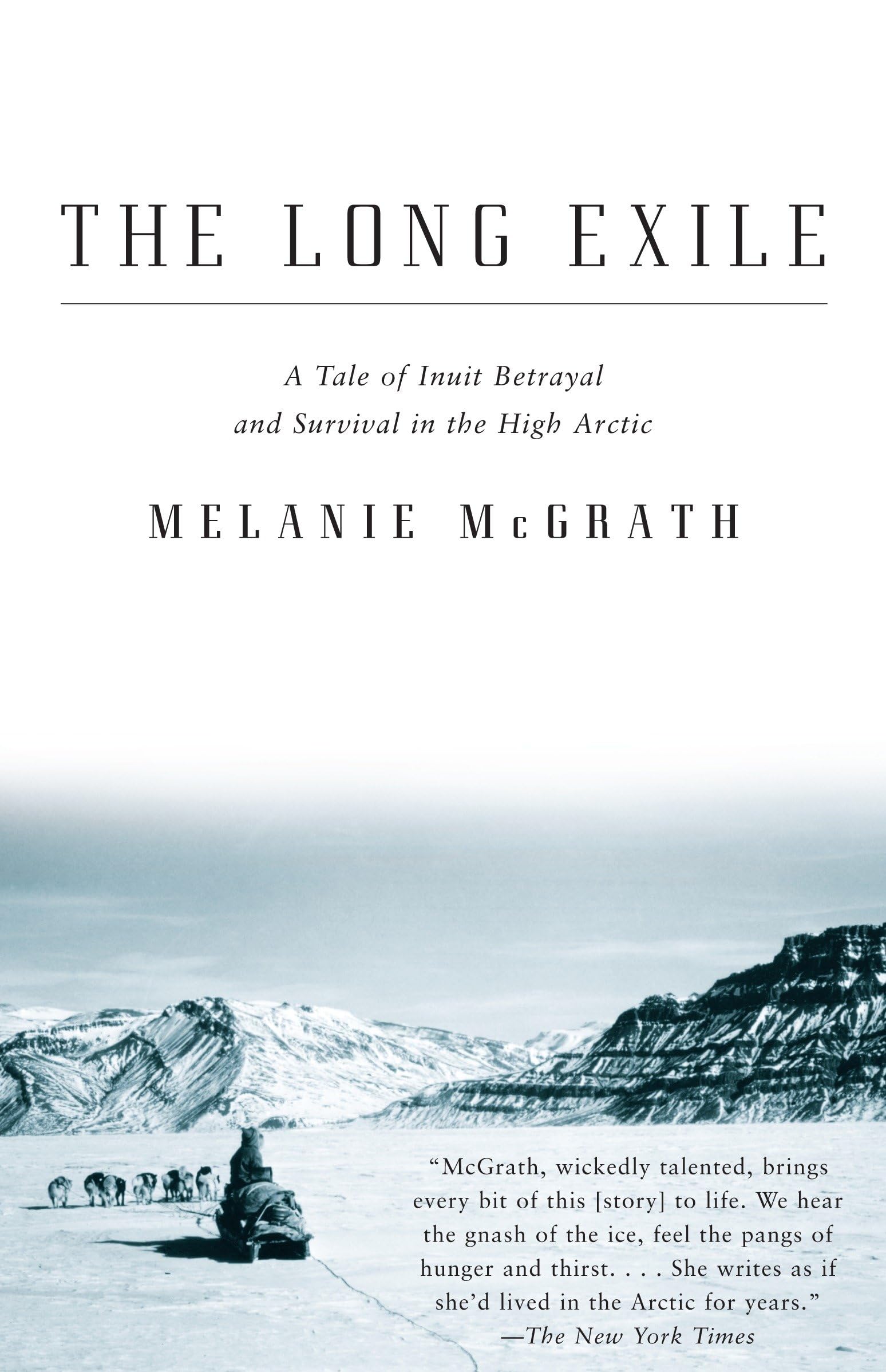
The Long Exile: A Tale of Inuit Betrayal and Survival in the High Arctic (Vintage)
$15.95
by Melanie McGrath



In 1952, the Canadian government forcibly relocated three dozen Inuit from their flourishing home on the Hudson Bay to the barren, arctic landscape of Ellesmere Island, the most northerly landmass on the planet. Among this group was Josephie Flaherty, the unrecognized, half-Inuit son of filmmaker Robert Flaherty, director of Nanook of the North . In a narrative rich with human drama, Melanie McGrath follows three generations of the Flaherty family—Robert, Josephie, and Josephie's daughters—to bring this extraordinary tale of deception and harsh deprivation to life. “McGrath, wickedly talented, brings every bit of this [story] to life. We hear the gnash of the ice, feel the pangs of hunger and thirst. . . . She writes as if she'd lived in the Arctic for years.” — The New York Times "A gripping read. . . . The Inuit's epic battle against racism and indifference is nearly cinematic." — Entertainment Weekly “McGrath documents [the Inuit's] story with an engaging passion.” — National Geographic “Her mastery of her subject is so precise and beguiling, so heartstoppingly eloquent and textured. . . . One of the most seductive reads of the decade.” — Daily Telegraph (London) Melanie McGrath was born in Essex. Her first book, Motel Nirvana , won the John Llewelyn-Rhys/Mail on Sunday award for Best New British and Commonwealth Writer under 35. She is also the author of Hard, Soft and Wet: The Digital Generation Comes of Age , and Silvertown: An East End Family Memoir . She writes for The Guardian , The Independent , The Times , The Evening Standard and Conde Nast Traveller . She is a regular broadcaster on radio, has been a television producer and presenter. She lives and works in London. Her Web site is www.melaniemcgrath.com. Chapter One In the early autumn of 1920, Maggie Nujarluktuk became a woman with another name. It happened something like this. Maggie was sitting on a pile of caribou skins. She had a borrowed baby in her amiut , the fur hood of her parka. A man was filming the scene. His name was Robert Flaherty. Maggie was about to pull the baby out of the amiut and set him to play beside a group of puppies as Flaherty had instructed, when looking up from his camera, he said, “Smile,” grinning to show Maggie what he was getting at and told her, through an interpreter, that he had decided to change her name. She laughed a little, perhaps conscious of his eyes, blue as icebergs, then lifted the baby into her arms, placed him beside her and pulled the puppies closer to keep him warm.“Well, now, Maggie,” Robert said. He winked at her, wound the camera and lingered on her face. She watched his breath pluming in the chill Arctic air.“How’s about Nyla?” He allowed the name to roll around his mouth. “Yes, from now on you are Nyla.”If Maggie minded this, she didn’t say. She already knew she had no choice in the matter anyway.Maggie Nujarluktuk was very young back then (how young she didn’t know exactly), and very lovely, with a broad, heart-shaped face, unblemished by sunburn or frostbite or by the whiskery tattoos still common among Ungava Inuit women. Her thick hair lay in lush coils around her shoulders and her skin and eyes were as yet unclouded by years of lamp smoke or by endless sewing in poor light. Her lips were bowed, plump but fragile-seeming, and it was impossible to tell whether her smile was an invitation or a warning. Beneath the lips lay even teeth that were white and strong, not yet worn to brown stumps from chewing boots to make them soft. And Robert Flaherty had just renamed her Nyla, which means the Smiling One.Robert Flaherty’s movie had begun in something of a rush. Only three weeks earlier, on 15 August, the schooner, Annie , had dropped anchor at the remote Arctic fur post of Inukjuak, on the Ungava Peninsula on the east coast of Hudson Bay, and a tall, white man with a thin nose and craggy features had come ashore with his half-breed interpreter, introduced himself to the local Inuit as Robert Flaherty, and announced his intention to stay in the area long enough to make a motion picture there. The film, he said, was to be about daily life in the Barrenlands.The stranger moved into the fur post manager’s old cabin, a peeling white clapboard building on the south bank of the Innuksuak River and hired a few hands to help him shift his things from the shoreline where the Annie ’s crew had left them. Among the expected baggage of coal-oil lamps, tents and skins were the unfamiliar accoutrements of film-making, lights, tripods, cameras and film cans, plus a few personal belongings: a violin and a wind-up gramophone with a set of wax discs and three framed pictures, one a photograph of Arnold Bennett, another of Flaherty’s wife, Frances, the third a little reproduction of Frans Hals’ Young Man with a Mandolin . The number of possessions suggested that Robert Flaherty was settling down for a long stay. Within a day or two of his arrival, he had hung his pictures above the desk in hi