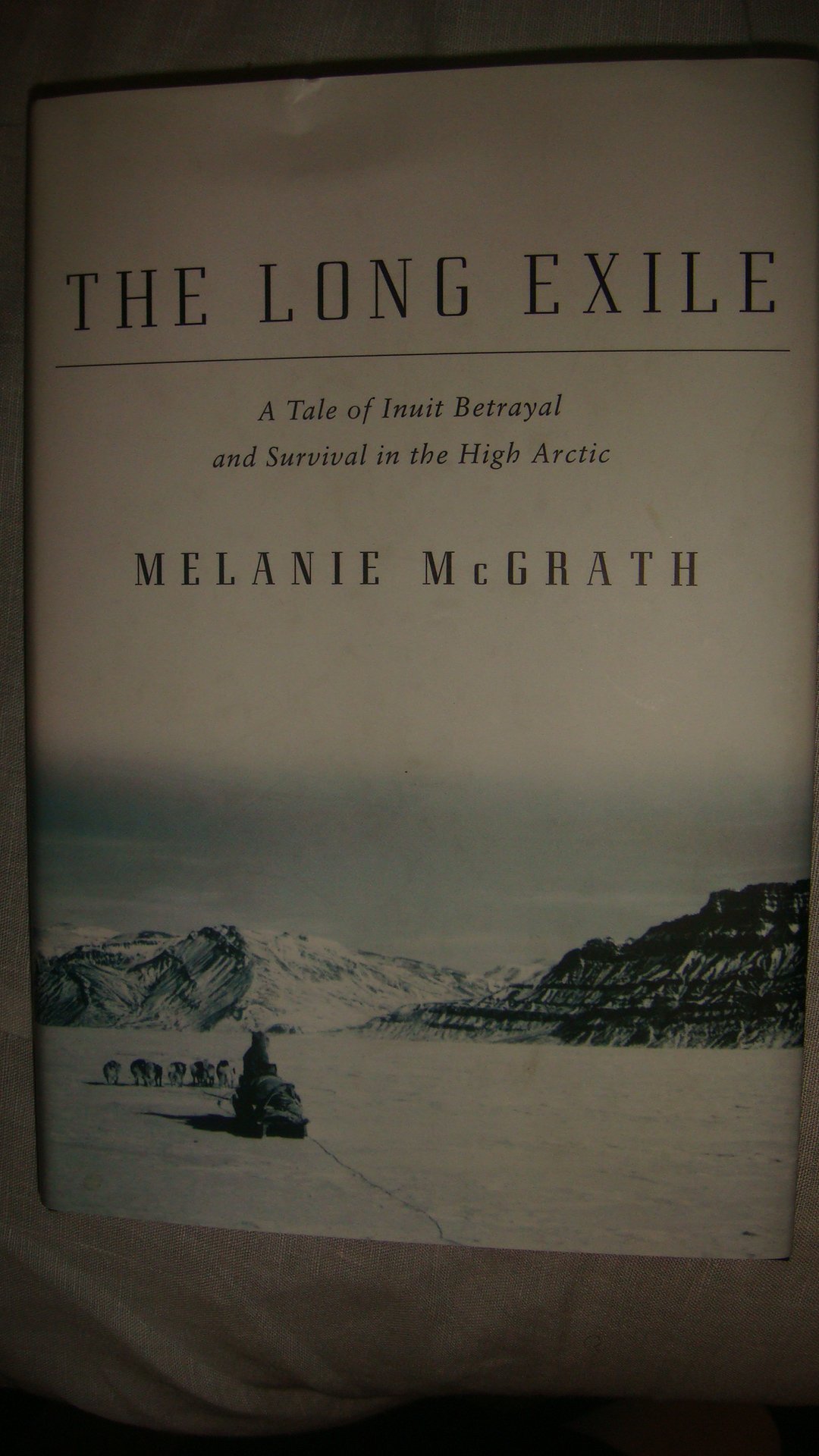
The Long Exile: A Tale of Inuit Betrayal and Survival in the High Arctic
$20.21
by Melanie McGrath



In 1922 an Irish-American adventurer named Robert Flaherty made a film about Inuit life in the Arctic. Nanook of the North featured a mythical Eskimo hunter who lived in an igloo with his family in a frozen Eden. Nanook’s story captured the world’s imagination. Thirty years later, the Canadian government forcibly relocated three dozen Inuit from the east coast of Hudson Bay to a region of the high artic that was 1,200 miles farther north. Hailing from a land rich in caribou and arctic foxes, whales and seals, pink saxifrage and heather, the Inuit’s destination was Ellesmere Island, an arid and desolate landscape of shale and ice virtually devoid of life. The most northerly landmass on the planet, Ellesmere is blanketed in darkness for four months of the year. There the exiles were left to live on their own with little government support and few provisions. Among this group was Josephie Flaherty, the unrecognized, half-Inuit son of Robert Flaherty, who never met his father. In a narrative rich with human drama and heartbreak, Melanie McGrath uses the story of three generations of the Flaherty family—the filmmaker; his illegitimate son, Josephie; and Josephie’s daughters, Mary and Martha—to bring this extraordinary tale of mistreatment and deprivation to life. *Starred Review* McGrath has accomplished significant and riveting work in her investigation into the Canadian relocation of several Inuit families to Ellesmere Island in the 1950s. By focusing primarily on one family, she humanizes what has been called one of the worst human rights violations in Canadian history. Through meticulous research and interviews, McGrath embraces actual events and the greater question of white reliance on misconceptions concerning indigenous peoples. She opens with the 1920s filming of Nanook of the North, then pursues connections the filmmaker had to one Inuit family. By contrasting how the Inuit are perceived by movie audiences versus the treatment they received from government employees, she sets the reader up for the devastating conclusions revealed in the survivors' 1993 testimony before the Royal Commission on Aboriginal Peoples. Because the events and people McGrath portrays had a direct effect on the development of the Nunavut Territory, her book is an excellent example of living history. Highly readable and utterly fascinating, this startling examination of the meaning of the term civilized world is nonfiction literature at its best. Colleen Mondor Copyright © American Library Association. All rights reserved “McGrath is a gifted, passionate and sensitive story-teller, and through her the authentic voice of the Arctic, not the clarion call of great white explorers, rings loud and clear. . . . Her research is meticulous, her touch is light. . . . Her play with language is disarming and original . . . fresh, illuminating and heartbreaking.” – The Sunday Telegraph “[A] poignant and humane book. McGrath . . . tells an impressively researched and often poetic story.” – Observer “McGrath . . . has a wonderful feel for landscape and so the Arctic itself assumes the life of a character. . . . The language is lovely. Modulated, lyrical and beautiful as the stark nature it describes, it makes McGrath’s book more than a fascinating and instructive read. It makes it a joyful one.” – Evening Standard “Gripping. . . . [McGrath] offers a carefully imagined portrait of the appalling lives of the Inuit on Ellesmere Island. This is a story of official wrong-headedness and arrogance and McGrath relays it with compassion.” – Guardian “Her mastery of her subject is so precise and beguiling, so heart-stoppingly eloquent and textured that I defy anybody not to find her book one of the most seductive reads of the decade.” – Daily Telegraph “With startling economy, McGrath races towards . . . the landmark recognition of her protagonists' suffering. . . . This is a beautiful, poetic, gripping book.” – Sunday Times Melanie McGrath’s first book, Motel Nirvana , won the John Llewelyn Rhys Prize. Her third book, Silvertown , was short-listed for the James Tait Black Memorial Prize for Biography. She is a regular contributor to The Guardian , The Times , The Telegraph , and the Evening Standard and has produced and presented television shows for Discovery Channel and the UK’s Channel 4. She lives and works in London. Chapter One In the early autumn of 1920, Maggie Nujarluktuk became a woman with another name. It happened something like this. Maggie was sitting on a pile of caribou skins. She had a borrowed baby in her amiut , the fur hood of her parka. A man was filming the scene. His name was Robert Flaherty. Maggie was about to pull the baby out of the amiut and set him to play beside a group of puppies as Flaherty had instructed, when looking up from his camera, he said, “Smile,” grinning to show Maggie what he was getting at and told her, through an interpreter, that he had decided to change her name. S