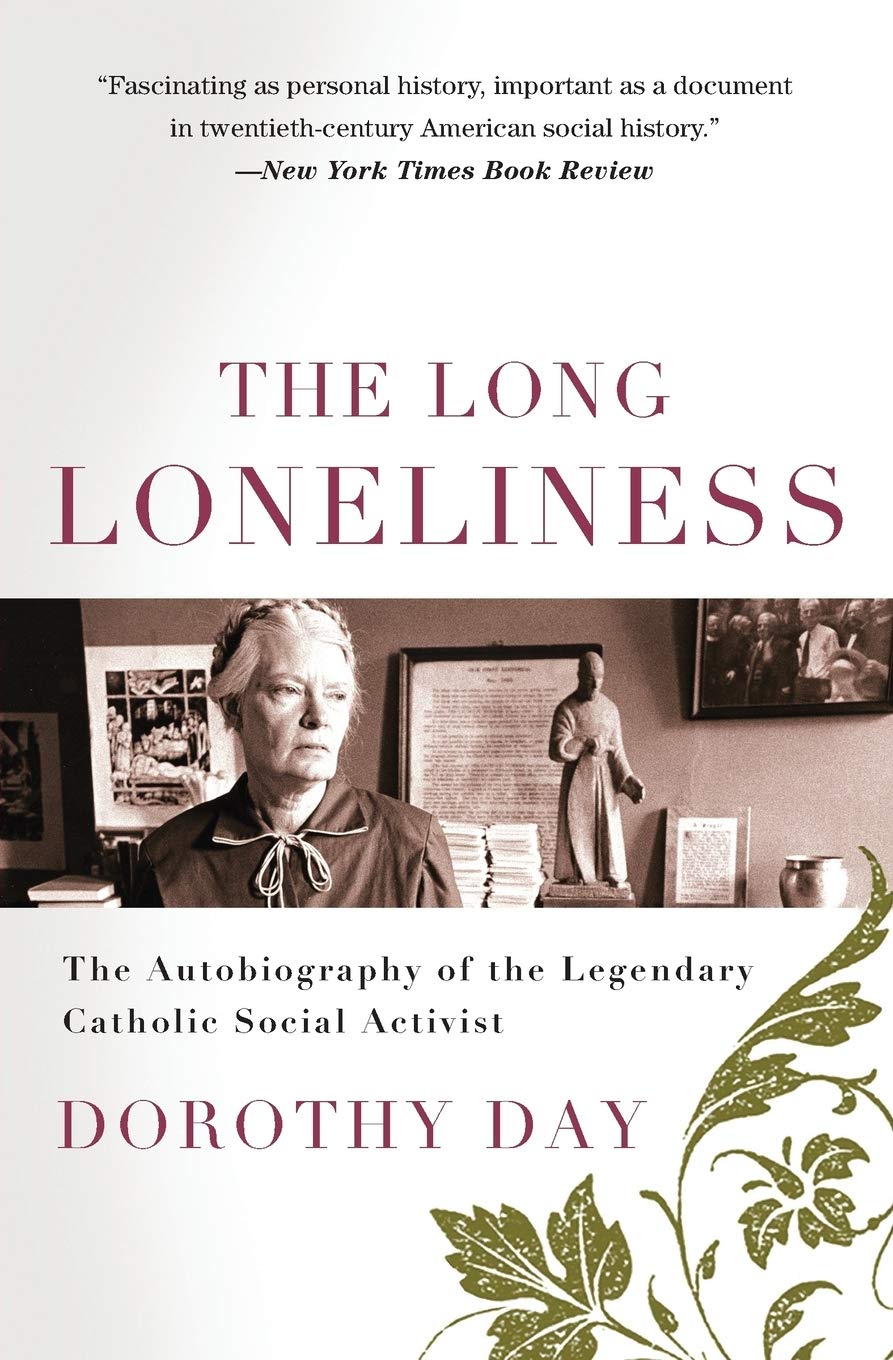
The Long Loneliness: The Autobiography of the Legendary Catholic Social Activist – A Greenwich Village Journalist's Conversion and Commitment to Peace
$9.99
by Dorothy Day



This inspiring and fascinating memoir, subtitled, “The Autobiography of the Legendary Catholic Social Activist,” The Long Loneliness is the late Dorothy Day’s compelling autobiographical testament to her life of social activism and her spiritual pilgrimage. A founder of the Catholic Worker Movement and longtime associate of Peter Maurin, Dorothy Day was eulogized in the New York Times as, “a nonviolent social radical of luminous personality.” The Long Loneliness recounts her remarkable journey from the Greenwich Village political and literary scene of the 1920s through her conversion to Catholicism and her lifelong struggle to help bring about “the kind of society where it is easier to be good.” “Fascinating as personal history, important as a document in twentieth-century American social history.” - New York Times Book Review “Dorothy Day wanted to be good, and not just do good. . . . a fascinating memoir.” - David Brooks in the New York Times A compelling autobiographical testament to the spiritual pilgrimage of a woman who, in her own words, dedicated herself "to bring[ing] about the kind of society where it is easier to be good.'' A compelling autobiographical testament to the spiritual pilgrimage of a woman who, in her own words, dedicated herself "to bring[ing] about the kind of society where it is easier to be good.'' "Dorothy Day, is a modern Catholic saint in the tradition of St. Francis. Her book is an absorbingly well-written series of pictures of her work and that of those she has gathered around her connection with the Catholic Worker, its hospitality house and its community farm. I rejoice with the new hope for mankind because of the kind of work that she and her associates are doing."- Norman Thomas Part One Searching THE GENERATIONS BEFORE When we were little children, my brothers and sister and I, we used to sit around the supper table at night and listen to our mother talk about "when I was a little girl." Our father worked nights on a morning newspaper, so we seldom saw him and our evening meals were leisurely. We never learned much about his family from mother except that he was from Cleveland, Tennessee, and that his people despised her because she was a Northerner. Cleveland is a small town just over the border from Rome, Georgia, where my grandmother, Mary Mee, was born. She married Dr. Sam Houston Day who was a surgeon and served in the Confederate army. My mother's father, Napoleon Bonaparte Satterlee, was from Marlboro, New York, a chairmaker, who went to war very young, was taken prisoner and came home with tuberculosis of the larynx, which made him speak, the remaining years of his life, in a hoarse whisper. My mother recalls bringing him eggnog with whiskey and sipping it on the way, and he used to reward her for her service by gay flattery, calling her Graceful. Her name was Grace. That house in Marlboro still stands on Route 9, and I have driven past it often and past the Episcopal church where my mother was baptized and the churchyard where doubtless my forebears are buried. If I wish to go back still further, on Charity Hummel's side (she was my mother's grandmother), I could go to the cemetery at New Paltz, and on the Washburn side to the Massachusetts branch of the family, since tradition has it that there were nine brothers, all of them captains of whalers, and all lost at sea save a Christian Washburn who married Charity. Tradition! How rich a word that is. To a thinking child it means a great deal. Children all love to hear stories of when their parents were young, and of their parents before them. It gives the child a sense of continuity. Aunt Cassie, my mother's aunt, used to skate down the river from Poughkeepsie to Marlboro to bake a batch of bread and cookies and then skate back again. Was she in love then? And did love give strength to her limbs and wings to her feet? It was a sad love story, the story of her affair with one of the engineers who built the railroad bridge over the Hudson. But Aunt Del was a telegrapher in Baltimore, a Russellite or a Bible Christian, and helped support the family, and Anna, my grandmother, had enough. to do with her five children and her invalid husband. So Aunt Cassie had to stay unmarried to take care of her mother, Charity Hummel Washburn, who had been married herself at fourteen and borne eighteen children of whom only six lived. Charity's husband had been captain of a whaler which sailed up the Hudson with a cargo of whale oil. He fell from a mast and cracked his head and was never quite right after that, running down Delafield Street in his night shirt and finally drowning in a brook. How we loved to hear these stories and how welcome our warm house was as we heard of terrible winters with the Hudson freezing over so that skating and ice-boating were commonplace. Tradition! We scarcely know the word any more. We are afraid to be either proud of our ancestors or ashamed of them. We scorn nobility in name and in fact