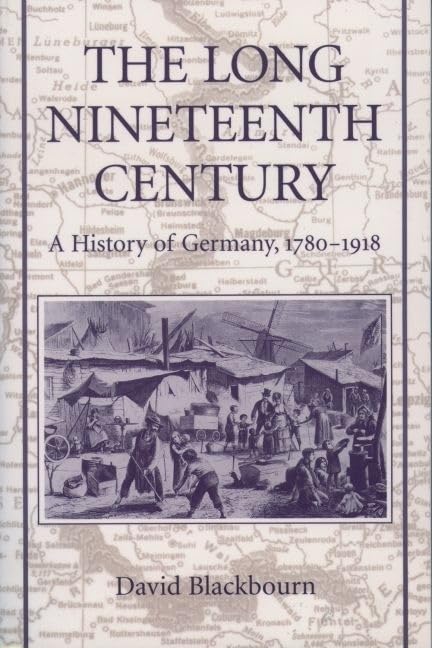



In the late eighteenth century, German-speaking Europe was a patchwork of principalities and lordships. Most people lived in the countryside, and just half survived until their late twenties. By the beginning of our own century, unified Germany was the most powerful state in Europe. No longer a provincial "land of poets and thinkers," the country had been transformed into an industrial and military giant with an advanced welfare system. The Long Nineteenth Century: A History of Germany, 1780-1918, is a masterful account of this transformation. Spanning 150 years, from the eve of the French Revolution to the end of World War I, it introduces students to crucial areas of German social and cultural history -- demography and social structure, work and leisure, education and religion -- while providing a comprehensive account of political events. The text explains how Germany came to be unified, and the consequences of that unification. It describes the growing role of the state and new ways in which rulers asserted their authority, but questions clichés about German "obedience." It also looks at the ways in which the factory, the railway, and the movement into towns created new social relations and altered perceptions of time and place. Drawing on a generation of work devoted to migration, housing, crime, medicine, and popular culture, Blackbourn offers a powerful and original account of a changing society, trying to do justice to the experiences of contemporary Germans, both women and men. Informed by the latest scholarship, The Long Nineteenth Century: A History of Germany, 1780-1918, provides a complete and up-to-date alternative to conventional political histories of this period and is essential reading for undergraduates in German history and political science courses. Many European historians consider the 19th century, at least on their continent, to have lasted over a hundred years, getting a head start on the calendar with the French Revolution of 1789 and extending until the onset of World War I in 1914 (when the "short 20th century" began). During this period, writes David Blackbourn in this fine, compact history, Germany evolved from a confused patchwork of municipalities and principalities with several layers of rulers (one village of 50 families, he notes, answered to four lords) into the most powerful unified nation in Europe. Blackbourn examines the rise of the idea of "Germanness," the development of presumed national traits such as obedience and antimodernism, and the growth of the bureaucratic state, which favored a kind of corporatism that clashed with trade and agrarian associations and paved the way for the class conflict Karl Marx would analyze--as well as what Blackbourn calls "a strong sense of suffocation." --Gregory McNamee "What I've been hoping to find for my advanced undergraduates and for graduate students. Blackbourn combines a readable narrative, attentiveness to recent interpretations, and an examination of the interaction of politics, culture, and social change."--Walter Struve, City College and Graduate Center, City University of New York"Well written and researched and refreshingly up-to-date in matters of interpretation."--Robert Cole, Utah State University"Extremely well written and an excellent text for an undergraduate upper-level course in 19th century German history. Especially welcome are the chapters on society and culture (6 and 8)."--Marion Deshmukh, George Mason University David Blackbourn is Coolidge Professor of History and Director of Graduate Studies in History at Harvard University.