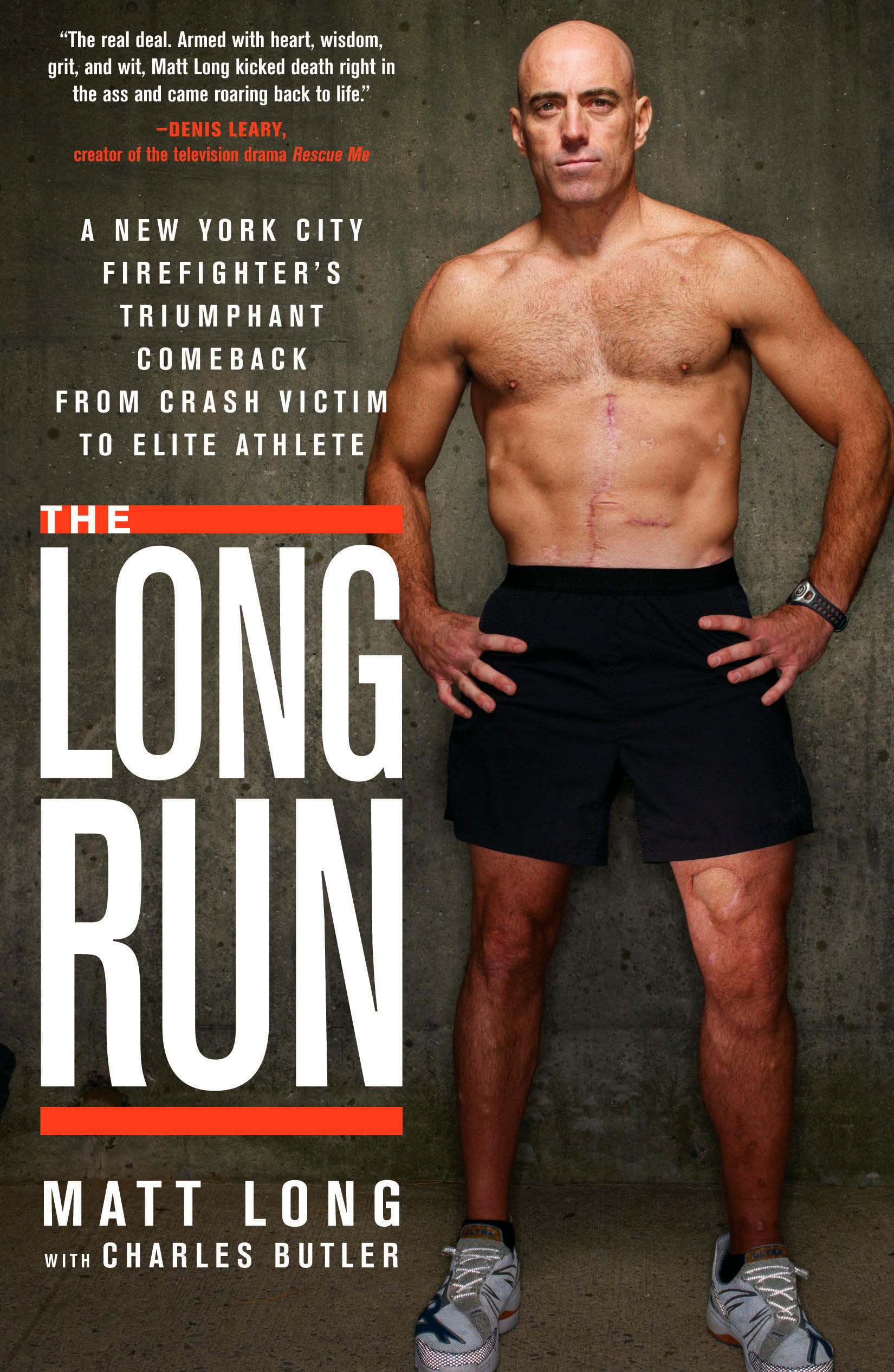



A New York City firefighter's emotional and inspiring memoir of learning to run again after a debilitating accident, based on the wildly popular March 2009 piece in Runner's World . On the morning of December 22, 2005, Matt Long was cycling to work in the early morning when he was struck by and sucked under a 20-ton bus making an illegal turn. The injuries he sustained pushed him within inches of his life. Miraculously, more than 40 operations and months later, Matt was able to start his recovery. In spite of the severity of his injuries, Matt found the psychological consequences of the accident nearly as hard to process. He would no longer be able to compete at the highest level. In the 18 months before the accident, he had competed in more than 20 events including several triathlons and marathons and had qualified for running's most prestigious race, the Boston Marathon. After the accident, his doctor told him he'd be lucky if he could even walk without a cane. The Long Run is an emotional and incredibly honest story about Matt's determination to fight through fear, despair, loneliness, and intense physical and psychological pain to regain the life he once had. The book chronicles Matt's road to recovery as he teaches himself to walk again and, a mere three years later, to run in the 2008 New York City Marathon—a gimpy seven-and-a-half hour journey through the five boroughs. "Running saved my life," Matt says, and his embrace of the running community and insistence on competing in the marathon has inspired many, turning him into a symbol of hope and recovery for untold numbers of others. “The book is open and honest--at times, almost painfully so--and readers will be horrified by Long's ordeal and inspired by his determination to get back as much of himself as he could.” — Booklist Matt Long is the founder of the I Will Foundation, which assists men, women, boys, and girls taking on pursuits they previously thought were beyond their reach. He lives in New York City. Charles Butler is an editor at Runner's World and teaches journalism at Lehigh University. 1 THE CHASE IS ON As I stood there on that unusually warm November morning, looking all around me, everything seemed to say New York. I was a row or so back from the starting line of the 2005 New York City Marathon, with the Manhattan skyline, shrouded in a dank, soupy fog, rising off in the distance beyond New York Harbor. Nearby, my teammates, 150 or so New York City firefighters, were doing their final stretches and giving each other one last command: Beat the cops, okay, beat the NYPD. Any second, Frank Sinatra would be blaring over the loudspeakers, so that every last one of the 37,597 runners about to take off from Staten Island via the Verrazano-Narrows Bridge for a 26.2-mile race through the city's four other boroughs could hear--what else?--"New York, New York." Like I said, everything seemed to say New York. But all I could think about was Boston. Boston? What had gotten into me? I was a New Yorker, born and raised in Brooklyn, with the accent to prove it. When I used to have hair, I combed it like Tony Manero, John Travolta's character in Saturday Night Fever; my sisters, Eileen and Maureen, called me John Revolting. Now I lived in midtown Manhattan, where I was a firefighter with Ladder Company 43 in East Harlem, and on this marathon day, to remember all my fellow firefighters who died on September 11, 2001, I had stenciled "343" on my left arm. I also owned three bars in Manhattan, and if needed I could tell you where to go for the best Manhattan clam chowder, Brooklyn lager, or New York strip in the city. I had nothing against Boston--in fact, I was a huge Bill Buckner fan, and I'd have a beer with Denis Leary any day of the week. But New York was my town. Still, at that moment I couldn't get that other city out of my mind. "Hey, Matty? Matty? How you feeling?" "Shane, I'm good, bro. I'm good. How about you?" "I'm ready. Just keep the pace, Matty, keep the pace." To me it sounded like Shane McKeon, a training partner and another firefighter on the starting line, was saying, "Keep the faith." In a way, he was. He was reminding me to stay steady. Keep the pace. If I could click off 26.2 miles at a pace of about seven minutes and 15 seconds per mile, that would get me to the finish line in Central Park in three hours and 10 minutes. And that would easily beat my best-ever marathon time by nearly 40 minutes. And, if everything went right, that would give me a shot at finishing among the top 10 firefighters running on this day, which would help us in our annual race-within-a-race against the police department.And best of all, that would win me a prized spot in next year's Boston Marathon. And that's why I had Beantown on the brain. I wanted to run the most famous race of all. Boston. They've been staging the Boston Marathon every April since 1897, and for most of those years only a select crowd gets to take part. To earn a