The Longevity Code: Your Personal Prescription for a Longer, Sweeter Life
$17.25
by Zorba Paster



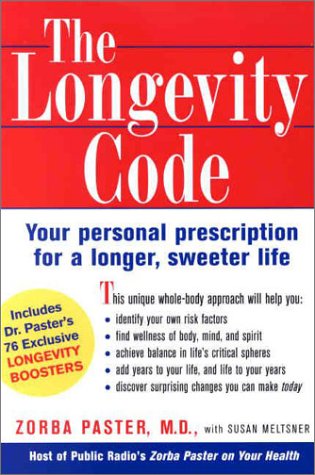
A five-point plan to live longer details the five spheres of wellness--physical, mental, spiritual, kinship/social, and material--and discusses issues beyond the usual advice about diet and exercise, particularly the benefits of stress-relieving activities. Reprint. 35,000 first printing. We're all interested in living a long life, but few of us are willing to sacrifice everything to attain that longevity. After all, what good is living an additional decade at the expense of enjoying the previous ones? In this remarkable book, Dr. Zorba Paster -- host of the public radio show Zorba Paster On Your Health -- takes a detour from the traditional negative, abstinent approach that addresses only physical factors. Instead, Dr. Zorba introduces us to the five "spheres of wellness" that encompass all aspects of life: the physical, of course, but also the mental, kinship/social, spiritual, and material spheres. He reveals well-documented research that indicates that you must address and balance all of these areas, and not just the physical, to achieve optimal longevity -- and also your greatest enjoyment of that longevity. Within each sphere, Dr. Zorba pinpoints the most threatening "busters" -- those lifestyle aspects that will, sooner or later, kill you. And for each buster, he recommends the most advantageous "boosters" -- habits that will counteract the buster and extend your life. Many of these boosters will come as a complete surprise. For example, even the most diet-conscious, performance-oriented athlete may be at risk for heart disease and stroke by ignoring all the other spheres: mentally, with chronic depression; socially, with limited, distant relationships; spiritually, with an uncaring attitude; and materially, with an unsatisfying, underappre-ciated job. To tailor this remarkable booster-and-buster system to you, The Longevity Code includes in-depth exercises to isolate your most urgent needs. Once you've identified the busters you must overcome, you can clip out the booster cards -- summaries of each of the 76 boosters -- to help you focus on your personal prescription for living a longer, sweeter life. DR. ZORBA PASTER, a clinical professor at the University of Wisconsin Medical School and a Fellow of the American Academy of Family Physicians, has practiced family medicine for more than twenty years at the Dean Medical Center. His weekly call-in radio program, Zorba Paster On Your Health, airs in more than one hundred markets. He appears regularly on CBS-affiliate WISC-TV in Madison, Wisconsin, in his Doctor on Call spot and is also the editor of TopHealth, a national newsletter. Dr. Paster lectures extensively throughout the country and internationally on health and wellness. He lives in Wisconsin with his wife, Penelope. SUSAN MELTSNER is the author or coauthor of more than a dozen books, including Hidden Agendas: What's Really Going On in Your Relation-ship s, and has contributed to Cosmopolitan and Business & Health , among many other magazines. She lives in central New Jersey. From Chapter 1, How We Age Today Can We All Live to One Hundred? One-hundred-year-old Alex Hardy grows fresh herbs and glorious perennials in the window boxes of the cottage he shares with his "child bride," Eleanor, a mere youngster at eighty-three. I often see the two of them out for a stroll on warm summer evenings, and I miss them when they head south to Arizona each November. By March I find myself wondering if Alex made it through another winter. But then I drive past his home, spot new seedlings beginning to sprout in his window boxes, and smile. My friend is alive -- and still well enough to continue doing what he loves most. Alex is one of a dozen or so centenarians I've had the good fortune to know. Another is Betty Ellis. At 102 she is by far the oldest of my patients, and a true original. A farmer's daughter who became a farmer's wife, Betty raised five children before she and her husband, Ed, sold their farm and opened a restaurant, which she ran right along with him until 1951. That's when Ed, who was twenty years her senior, died. Betty kept the restaurant going and did most of the cooking for another thirty-plus years. At seventy-five, she sold the place to her nephew but hardly retired. She cooked for and took care of "old folks" (many of them a decade or more younger than she) for the next seventeen years. With her hundredth birthday approaching, Betty briefly considered moving into an assisted-living facility, but not because her ability to handle the tasks of daily living was slipping away. No, Betty was simply tired of cooking. She wanted her meals prepared for her for a change. "Only their food was terrible," Betty grumbled. "And the time went too slowly." So she took a room in the home of a local minister and was soon supervising food preparation for his church's soup kitchen. As of this writing, she's still at it and showing few signs of slowing down. While Alex and Betty are casual