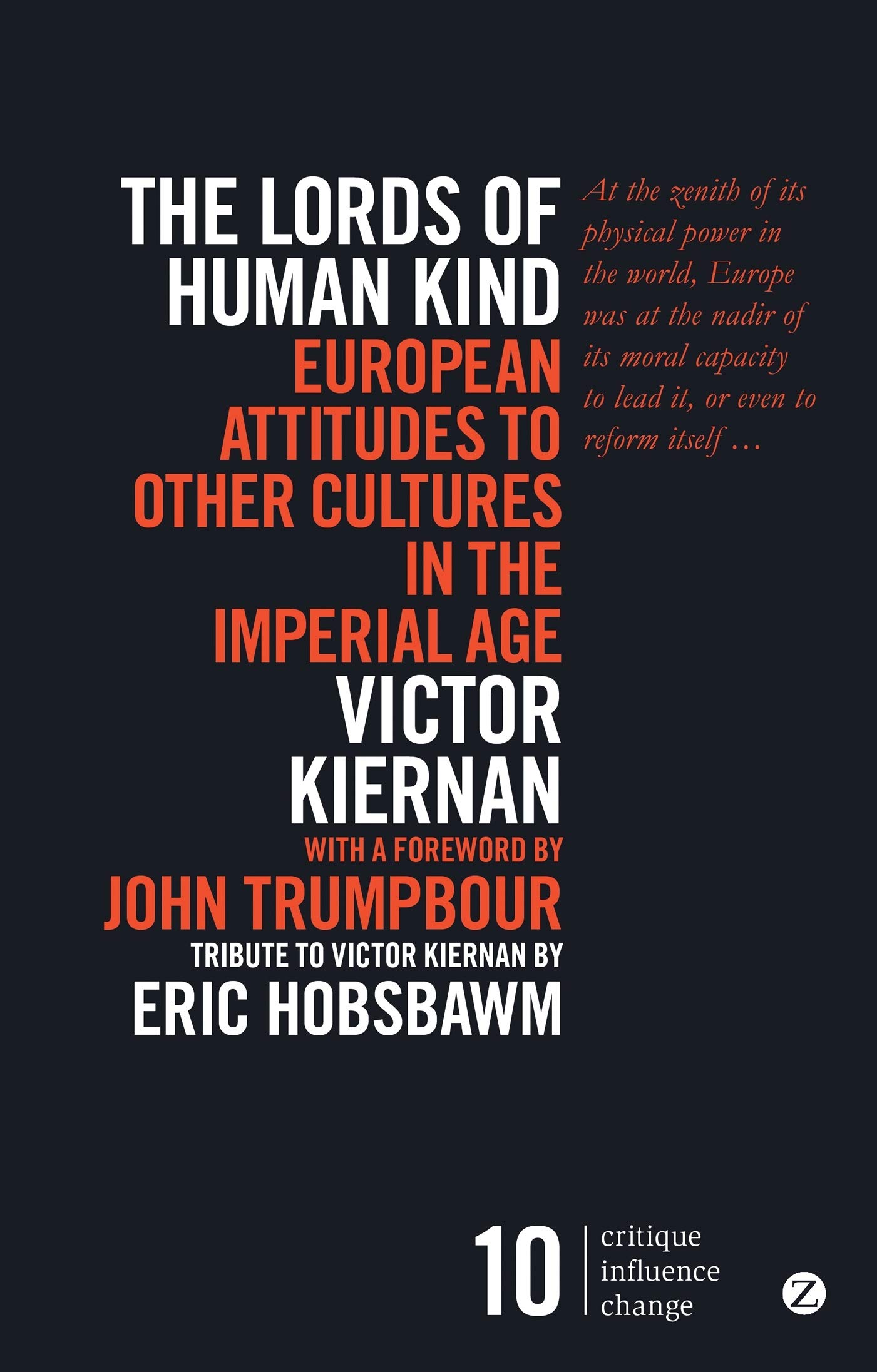
The Lords of Human Kind: European Attitudes to Other Cultures in the Imperial Age (Critique Influence Change)
$29.95
by Victor Kiernan



When European explorers went out into the world to open up trade routes and establish colonies, they brought back much more than silks and spices, cotton and tea. Inevitably, they came into contact with the peoples of other parts of the world and formed views of them occasionally admiring, more often hostile or contemptuous. Using a stunning array of sources - missionaries' memoirs, the letters of diplomats' wives, explorers' diaries and the work of writers as diverse as Voltaire, Thackeray, Oliver Goldsmith and, of course, Kipling - Victor Kiernan teases out the full range of European attitudes to other peoples. Erudite, ironic and global in its scope, The Lords of Human Kind has been a major influence on a generation of historians and cultural critics and is a landmark in the history of Eurocentrism. “The Lords of Human Kind remains an important resource for the history of racism and empire, and is a finely written book, with a frequently sardonic tone at the expense of self-revealing imperialists.” ― Counterfire “[Victor Kiernan is] that great Scottish historian of empire.” ― Edward Said “One of the rewards of my career as a historian is to have once suggested the idea of this book to Victor Kiernan, knowing that no other scholar had the brilliance and global range of learning to write it. It is still a marvellous book, fresh as on the day of first publication and ready for a new generation of readers.” ― Eric Hobsbawm “The Lords of Human Kind provides an essential anti-Imperialist introduction to global history, and remains an indispensible work for understanding the modern world. The new edition is to be unreservedly welcomed.” ― John Newsinger, Author of The Blood Never Dried: A People's History of the British Empire “A wry delight - brilliant, witty and humane” ― Philip Toynbee, Observer “Victor Kiernan's classic work is a marvellous and erudite introduction to the cruelties and absurdities of the European empires and their interaction with the world beyond, the best single volume on the subject there is. With its entertaining style and encyclopaedic range, there is nothing quite like this book. It should be read by every teacher and by every schoolchild.” ― Richard Gott, author of Britain's Empire: Resistance, Repression and Revolt “Absorbing.” ― Shiva Naipaul, The Times Victor Kiernan (1913-2009) ranks among Britain's most distinguished historians. After a fellowship at Trinity College, Cambridge, and a long period spent teaching in India, he joined the History Department at the University of Edinburgh, where he served as professor of modern history from 1970 until his retirement. Over the course of his life he authored such works as European Empires from Conquest to Collapse; The Duel in European History; Shakespeare: Poet and Citizen; Horace: Poetics and Politics and numerous others, as well as translating two volumes of Urdu poetry. Pnina Werbner is professor emerita in social anthropology at Keele University. She is an urban anthropologist who has studied Muslim South Asians in Britain and Pakistan and, more recently, the women's movement and the Manual Workers Union in Botswana. Richard Werbner is emeritus professor of African anthropology at the University of Manchester. Among his books are Tears of the Dead (1991) and Postcolonial Subjectivities in Africa (Zed 2002). The Lords of Human Kind European Attitudes to Other Cultures in the Imperial Age By Victor Kiernan Zed Books Ltd Copyright © 2015 Heather Kiernan All rights reserved. ISBN: 978-1-78360-429-6 Contents Prefatory note HEATHER KIERNAN, A tribute to Victor Kiernan ERIC HOBSBAWM, Foreword JOHN TRUMPBOUR, Preface to the first edition, Preface to the 1995 edition, 1 Introduction, 2 India, 3 Other Colonies in Asia, 4 The Islamic World, 5 The Far East, 6 Africa, 7 The South Seas, 8 Latin America, 9 Conclusion, Index, CHAPTER 1 INTRODUCTION The Oldest Europe and its Neighbours Man's most ancient ancestors have left their bones on three continents, and civilization seems to have begun where Asia and Africa meet, between the river valleys of Mesopotamia and Egypt, with Europe, Asia's extension, close by. Its outward mark was a society divided into classes and ruled by higher classes sometimes for the collective benefit, always for their own benefit. Several such societies were crowded fairly close together, learning from each other but also frequently at war, again for the benefit of their ruling groups; a feature that was to characterize most civilizations through most of history, and Europe's most of all. During the first millennium BC three new civilizations were taking shape, which among them came to rule or influence most of Asia, and which through many changes have lived on to our own day – the Persian, Indian and Chinese. They borrowed from the older ones, in India from the Mohenjodaro or Indus Valley culture, that may have been in its prime about 2000 BC. They differed fro