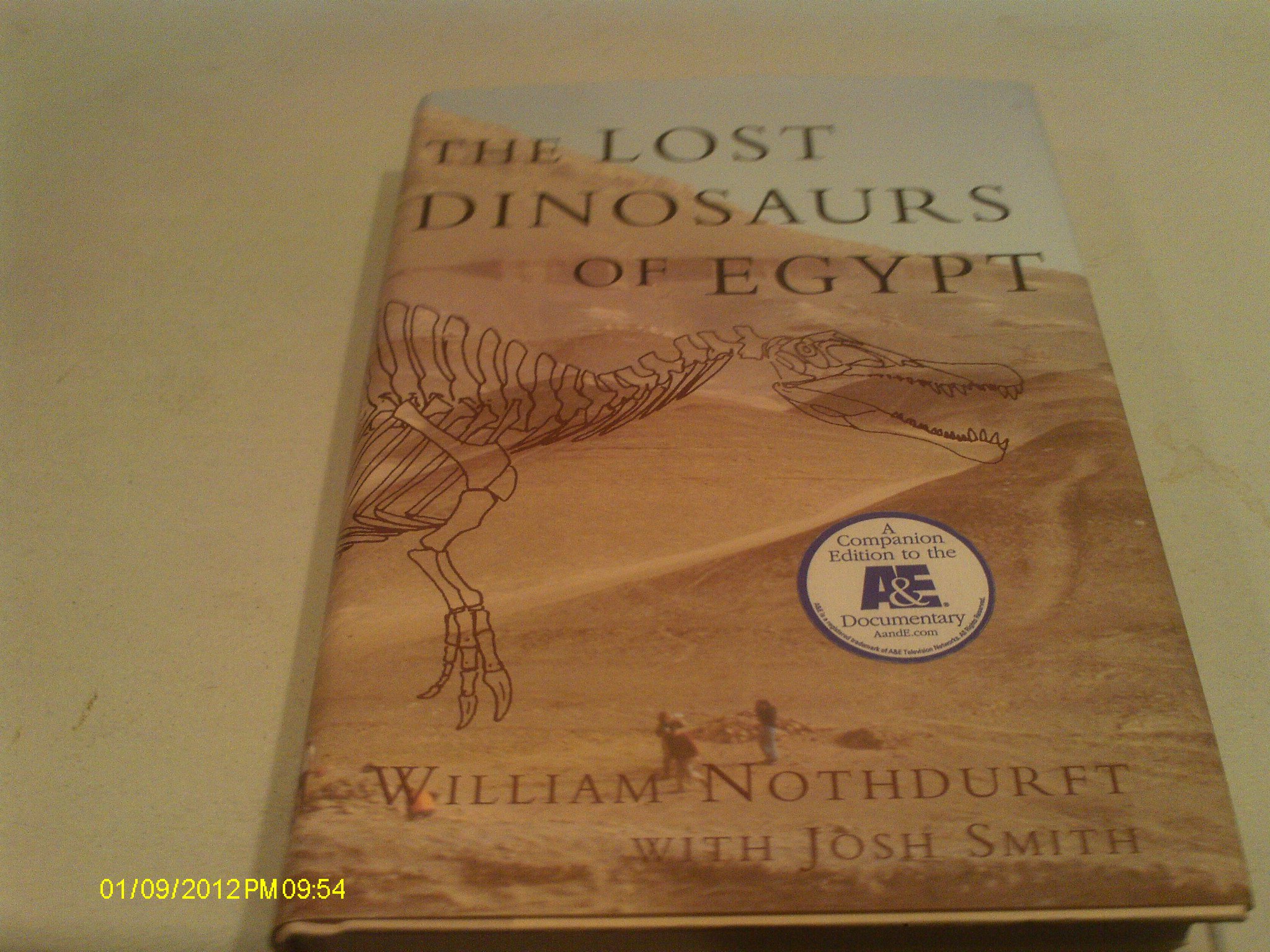



The date is January 11, 1911 . A young German paleontologist, accompanied only by a guide, a cook, four camels, and a couple of camel drivers, reaches the lip of the vast Bahariya Depression after a long trek across the bleak plateau of the western desert of Egypt. The scientist, Ernst Freiherr Stromer von Reichenbach, hopes to find fossil evidence of early mammals. In this, he will be disappointed, for the rocks here will prove to be much older than he thinks. They are nearly a hundred million years old. Stromer is about to learn that he has walked into the age of the dinosaurs. At the bottom of the Bahariya Depression, Stromer will find the remains of four immense and entirely new dinosaurs, along with dozens of other unique specimens. But there will be reversals—shipments delayed for years by war, fossils shattered in transit, stunning personal and professional setbacks. Then, in a single cataclysmic night, all of his work will be destroyed and Ernst Stromer will slip into history and be forgotten. The date is January 11, 2000 —eighty-nine years to the day after Stromer descended into Bahariya. Another young paleontologist, Ameri-can graduate student Josh Smith, has brought a team of fellow scientists to Egypt to find Stromer’s dinosaur graveyard and resurrect the German pioneer’s legacy. After weeks of digging, often under appalling conditions, they fail utterly at rediscovering any of Stromer’s dinosaur species. Then, just when they are about to declare defeat, Smith’s team discovers a dinosaur of such staggering immensity that it will stun the world of paleontology and make headlines around the globe. Masterfully weaving together history, science, and human drama, The Lost Dinosaurs of Egypt is the gripping account of not one but two of the twentieth century’s great expeditions of discovery. This is a great story: grad student Smith joins a team of scientists, led by renowned paleontologist Peter Dodson, that tracks Ernst Stromer's momentous 1911 expedition to the Bahariya Oasis. There they find a new dinosaur called Paralititan stromeri. Copyright 2001 Reed Business Information, Inc. Nothdurft's book reports on the fate of Bavaria's paleontology collection, which was destroyed in a 1944 air raid. One of the world's premier collections at the time, its dinosaur fossils had been excavated in Egypt by Ernst Stromer on expeditions in the 1900s and 1910s, dusty field activities Nothdurft redolently re-creates with imagery of the western desert. In 1999, paleontologists and geologists from Philadelphia returned to the scene of Stromer's success, the Bahariya Oasis, in part inspired to uncover more of his unique finds (of which the only vestige are his monographs). The narrative of what they found, a gargantuan sauropod named in Stromer's honor ( Paralititan stromeri ), is interlaced with explanations of the principles of geology, geologic time, and paleontology, and portrays how the scientific specialties of the Penn team contributed to their project. A well-organized story of past and present that hones in on our fascination with dino hunters. Gilbert Taylor Copyright © American Library Association. All rights reserved “ The Lost Dinosaurs of Egypt recounts an amazing but little-known episode in the history of dinosaur hunting. On the eve of World War I, an amazing cache of strange Cretaceous-age dinosaurs was discovered in the Great Western Desert of Egypt. With considerable difficulty, this collection was brought to Munich, only to vanish in the flames of World War II. A few years ago a young soldier-turned-researcher set out on a quest to rediscover the site and was successful beyond his wildest expectations when his team uncovered bones of one of the largest dinosaurs ever found. This remarkable account of these discoveries relates an exciting story involving dinosaurs, exploration, and the tides of European history. Seldom have I been so captivated by a book on exploration.” — Dr. Hans-Dieter Sues , president elect, Society of Vertebrate Paleon- tology, and vice president, Collections and Research, Royal Ontario Museum “If you loved Indiana Jones , you’ll adore this tale of two dinosaur hunters whose expeditions to Egypt, separated by nearly a century of warfare and mystery, brought to light what may have been the largest creature that ever walked the earth.” — Erik Larson , author of Isaac’s Storm: A Man, a Time, and the Deadliest Hurricane in History “Nothdurft gracefully interweaves the team’s exploits with Stromer’s own Bahariya experiences. . . First-rate popular science.” — Publishers Weekly The date is January 11, 1911 . A young German paleontologist, accompanied only by a guide, a cook, four camels, and a couple of camel drivers, reaches the lip of the vast Bahariya Depression after a long trek across the bleak plateau of the western desert of Egypt. The scientist, Ernst Freiherr Stromer von Reichenbach, hopes to find fossil evidence of early mammals. In this, he will be d