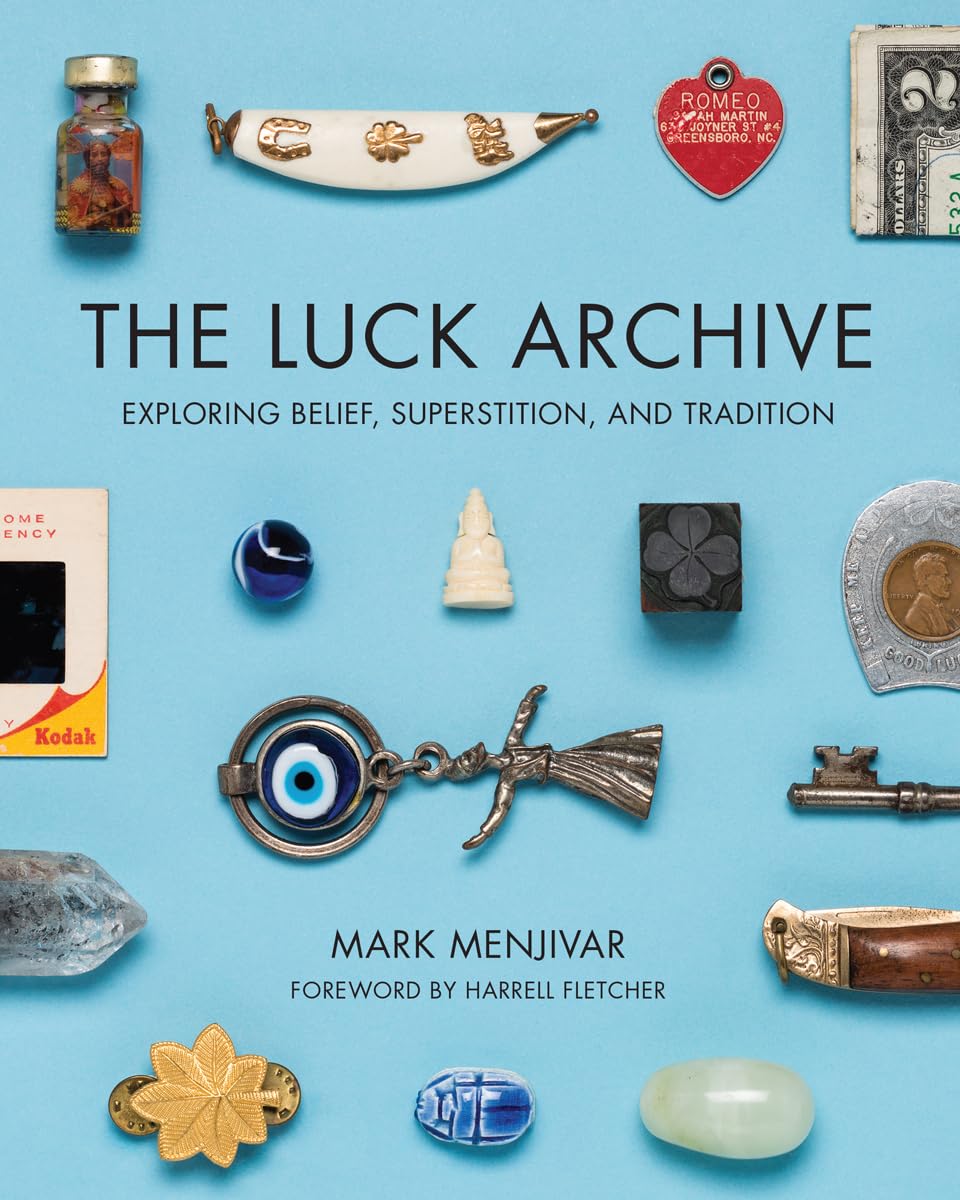



Artist Mark Menjivar was in an antique bookshop in Fort Wayne, Indiana, when he found 4 four-leaf clovers pressed between the yellowed pages of an aged copy of 1000 Facts Worth Knowing . Their discovery beguiled Menjivar so much that he began a multiyear exploration into the concept of luck and its intersections with belief, culture, superstition, and tradition in people’s lives. Menjivar has spent hours and days engaging people in airplanes, tattoo shops, bingo halls, international grocery stores, public parks, baseball stadiums, and voodoo shopsand out on the streets and in their homes. Along the way he documented his findings to create a physical archive that contains hundreds of objects (rings, underwear, food items, clovers, horses, pigs, herbs, rainbows, lottery strategies, seeds, day trader insights, statues, patches, crystals, spices) and the stories and pictures that go with them. Through photographs and first person accounts, The Luck Archive takes the best of these ideas, thoughts, and objects and gives readers a glimpse into the cultures and superstitions of a colorful array of humanity. "Menjivar’s project opens up the possibility, if only for a moment, to reflect on our own beliefs and traditions. And more importantly, it opens the potential to connect, through a tangible object, to the ethereal ideas that tie us and these symbols together." ― Glasstire "In the few years since he started talking to people about their lucky objects and superstitious beliefs, he’s learned about some crazy rituals." ― Slate “This archive collects many dozens of luck beliefs, in quirky little essays written by devoted luck whisperers.”― Foreword Reviews “Dirty Harry put the perfect menacing inflection on it: “You’ve gotta ask yourself one question: ‘Do I feel lucky?’ Well, do ya, punk?” With a far gentler tone and intent, artist-photographer Mark Menjivar of San Antonio has been asking people the same question for the nearly four years to collect his Luck Archive, more than 500 stories, photographs and objects all having to do with that elusive, beguiling, capricious thing called luck.”― Austin American Statesman “The documents and artifacts that make up the book are approachable – they do not seek to answer the lofty, elusive question of whether or not luck actually exists. Rather, they illustrate how our belief in luck manifests itself in our daily lives. Overall, this is a very human book. It explores our quirks and idiosyncrasies designed to ensure our good fortune, our private rituals to protect the things and people we care about, and our beliefs about our level of influence over the unseen forces in our lives.”― Rivard Report “Mark Menjivar began to notice the ubiquity of luck several years ago. The book is the result of several years spent asking people about their concept of luck and photographing objects they relate to the idea. Over the course of the project thus far, Menjivar has photographed numerous talismans -- rabbits' feet, four-leaf clovers -- but also illustrations of other manifestations of luck.”― Huffington Post Mark Menjivar is an artist whose work explores diverse subjects through photography, stories, and found objects while emphasizing dialogue and collaboration. His work has been shown at venues across the country, including the Houston Center for Photography, the San Antonio Museum of Art, the Wignall Museum of Art, the University of WisconsinMilwaukee, Baylor University, the Southwest School of Art, and Central Michigan University. In addition, his work has been featured by TED, NPR, New York Times , New Yorker , Village Voice , Gastronomica , Orion Magazine , and GUP Magazine . In 2009 his series You Are What You Eat won Director's Choice from CENTER and was a Photolucida Critical Mass Top 50 project. In 2011 Menjivar received an artist grant from the Brackenridge Foundation. He lives in San Antonio, Texas. Harrell Fletcher has produced a variety of socially engaged collaborative and interdisciplinary projects since the early 1990s. His work has been shown at San Francisco Museum of Modern Art, the de Young Museum, the Berkeley Art Museum, ArtPace, Yerba Buena Center for the Arts, the Drawing Center, Socrates Sculpture Park, the Seattle Art Museum, Domain de Kerguehennec, and the Royal College of Art, among others. He was also a participant in the 2004 Whitney Biennial. From 2002 to 2009 Fletcher coproduced Learning To Love You More, a participatory website, with Miranda July. He is an associate professor of art and social practice at Portland State University in Oregon.