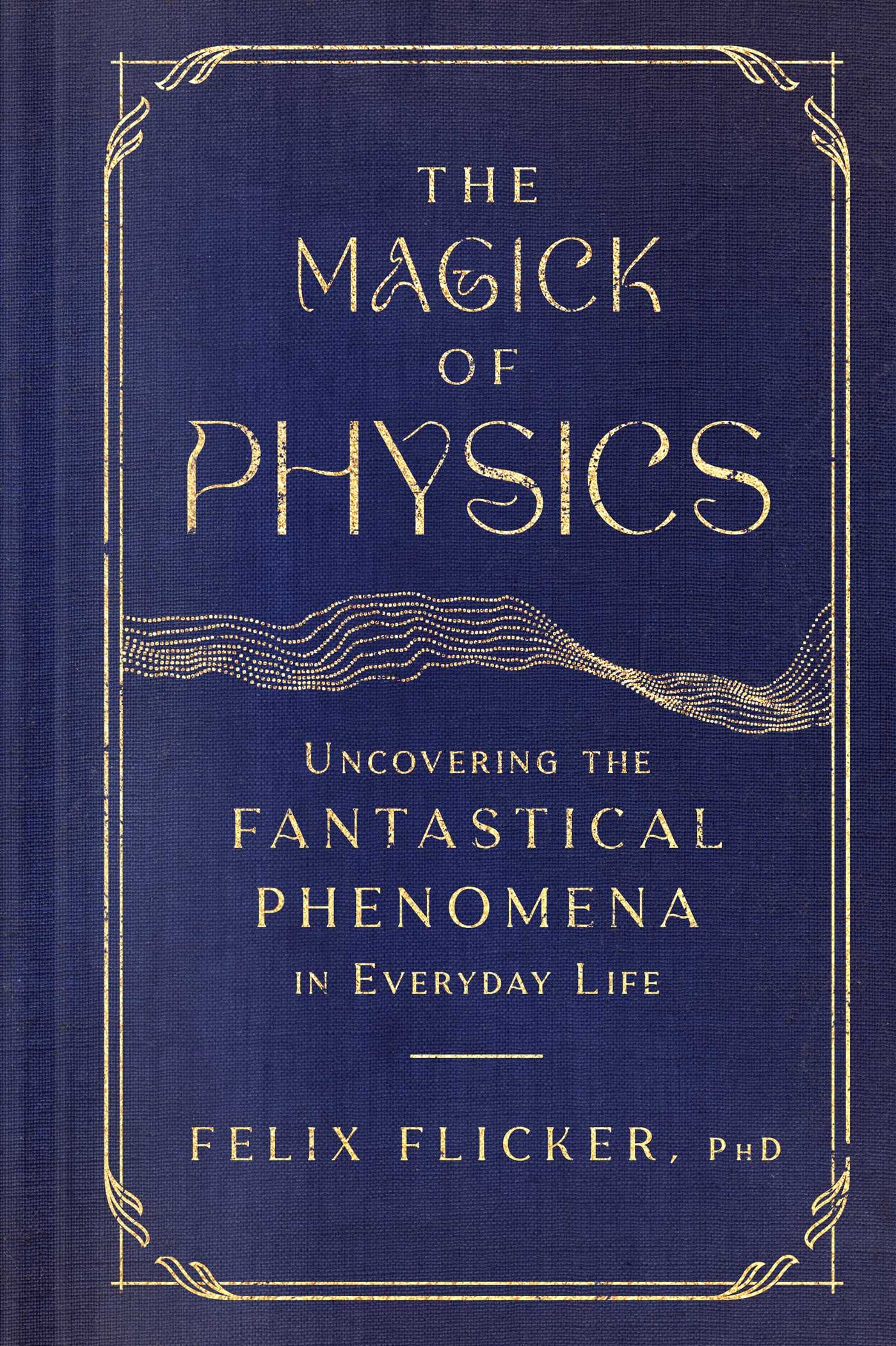
The Magick of Physics: Uncovering the Fantastical Phenomena in Everyday Life
$13.05
by Felix Flicker



An award-winning Oxford physicist draws on classic sci-fi, fantasy fiction, and everyday phenomena to explain and celebrate the magical properties of the world around us. If you were to present the feats of modern science to someone from the past, those feats would surely be considered magic. Theoretical physicist Felix Flicker proves that they are indeed magic—just familiar magic. The name for this magic is “condensed matter physics.” Most people haven’t heard of the field, yet more than a third of physicists identify as condensed matter researchers, making it the most active area in the subject—with good reason. Condensed matter is the solids, liquids, and gasses that surround us—and the more exotic matters—which dictate every aspect of our present existence, and hold the keys to a brighter future, from quantum computing to real-life invisibility cloaks. Flicker teases out the magical threads that run through our daily lives. Condensed matter physics allows you to create anything abiding by the laws of reality—and often, we find that those laws can be bent. Flicker explains how to create new particles which never existed before, how to make crystals shoot out such intense light they can cut through metal, how to separate the poles of a magnet. And more. The book’s endearing conceit is that you, the reader, are an aspiring wizard whose ability to cast spells (i.e. to do science) is dependent on your grasp of the fundamentals of our universe. This book contains no equations or charts—instead, it’s full of owls and mountains and infinite libraries, and staffs and wands, and martial arts and mythical islands ruled by sage knot-makers. Part of the book’s magic is that, for all these fanciful trappings, it still feels practical and applicable. The Magick of Physics will open your eyes to the miracles that surround us. Felix Flicker is a lecturer at Cardiff University in its School of Physics and Astronomy. He holds an MPhys in physics from St Catherine’s College, Oxford, and received his PhD in theoretical condensed matter physics from the University of Bristol in 2015. He won The Neville Robinson Prize for Best Academic Performance in the Final Honours School in his third and fourth years. He has published in both Nature and Science , and has delivered talks at the Royal Institution. Felix has also delivered talks on the mathematics, physics, magic, and superstition of knots. Felix has trained in Kung Fu for twenty years and has been an instructor for fifteen years. He is the former British Champion of Shuai Jiao (Chinese wrestling), and a student of Shodo (Japanese calligraphy) and sailing. Chapter I: The Physics of Dirt I The Physics of Dirt The wizard, Veryan, whispered into her crystal the familiar incantation as she clambered through the cold, dark cavern. With a puff of breath, as if to release the seeds of a dandelion, she awakened in the stone a dazzling red light that illuminated the moss-covered rocks around her. After walking for some time, she found herself at an entrance. Her passage was barred by a vast wooden door held together with wide iron joists. Working in the harsh light of the crystal, she felt her way to the door’s handle, a thick, black iron ring. She pulled, but the ring held: the door was locked. Finding the edge of the wood, she pressed her fingers into the small gap between the door and its surrounding and found the door’s bolt, made of the same rough iron as the handle. She spoke again to the crystal in her practiced, quiet tone and it gradually dimmed. After a few seconds, she found herself once again in perfect darkness. Positioning herself in front of the bolt, she rested the crystal flat on her palm, offering it to the door like grass to a horse and uttering a few syllables of the old tongue, more sharply this time. The light returned as an intense red heat, a focused, narrow beam. Piercing the gap, the stream of light cleaved through the bolt, leaving in its wake the red-orange glow of molten iron, the noxious smell of the blacksmith’s forge cutting through the air. The light vanished as quickly as it had appeared. She pulled again at the ring; with effort, the door eased open. As it did, light and life began to seep in through the widening crack from the dry stone staircase on the other side. Her task was about to begin. This is a book about wizardry. It will reveal the secret ways of the wizard’s art, and how you, too, can learn to follow them. It is also a history of magic, telling how, by a process of observing the world, wizards deduced the spells they cast—and how modern wizards continue to develop new magic to transform the world before our very eyes. The modern name for magic is “physics,” and the name for a wizard’s magic is “ condensed matter physics .” Before we discuss what these names convey, you must understand that this book comes with a warning. Once you have learned how a spell is cast, the effect of the spell will cease to appear to you as