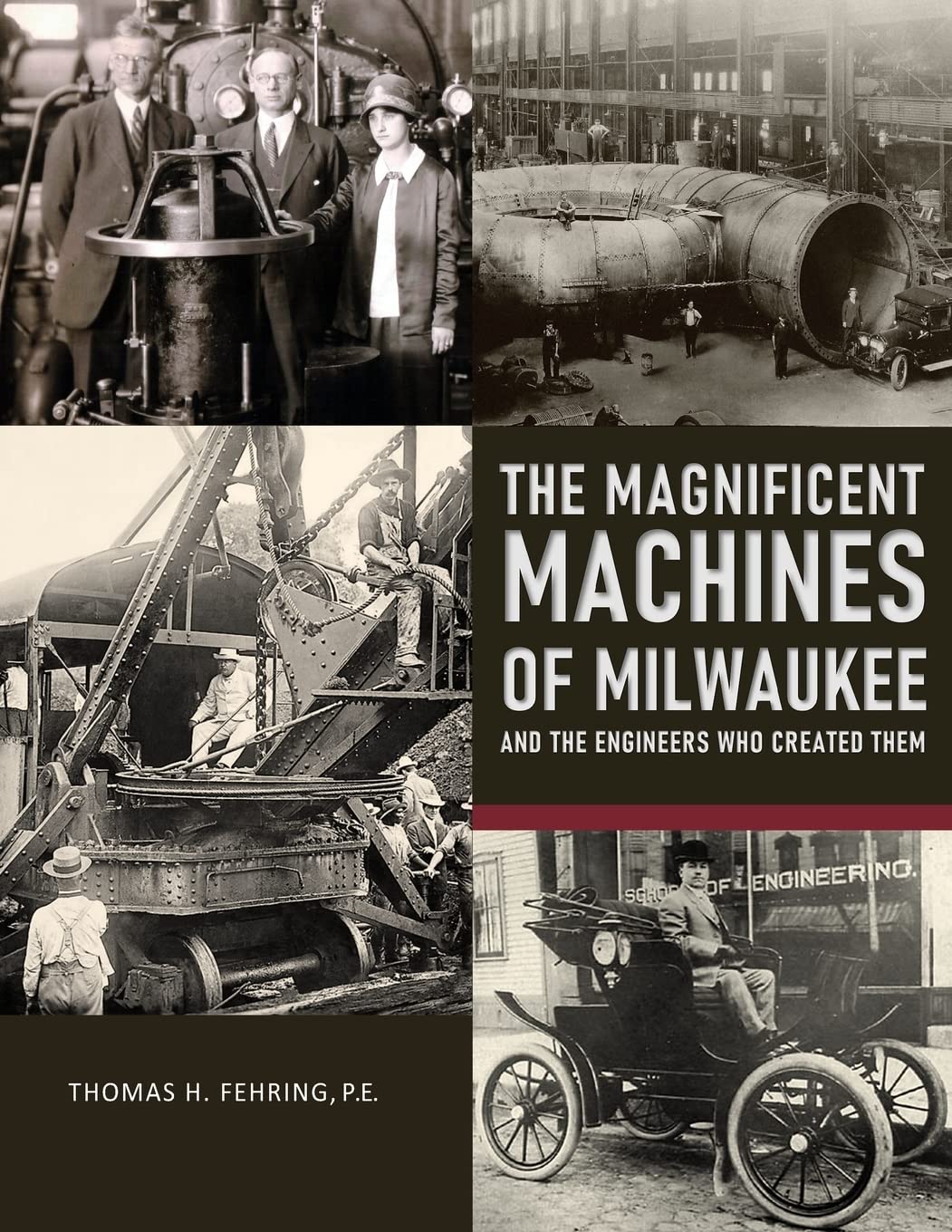
The Magnificent Machines of Milwaukee and the engineers who created them
$28.64
by Thomas H Fehring P.E



The Magnificent Machines of Milwaukee tells the story of innovation and enterprise creation in Milwaukee during the Century of Progress—the hundred years starting after the conclusion of the US Civil War. It was a remarkable era. Milwaukee was one of the principal centers of industrial innovation in the United States and became known as “the Machine Shop of the World.” As the name of the book implies, the book features the incredible machines built in the Milwaukee area during this period. In the process, it highlights the engineers who created these machines and summarizes the history of the numerous companies that helped the greater Milwaukee area achieve prominence in industrial design and manufacturing. In telling the story of Milwaukee’s industrial history, the book discusses over one-hundred engineering accomplishments , summarizes individual stories of over seventy early Milwaukee companies , provides the biographies of dozens of engineering innovators, and discusses the significance of their engineering achievements. Richly illustrated, the book contains hundreds of photographs and drawings to help tell the story of industrial Milwaukee. The stories of industrial Milwaukee are not just of historical curiosity. The engineering innovation that occurred during this period resulted in commerce that was essential to the development of the City and to the livelihood of thousands of its citizens. Many of these companies survive and several have grown to become major international firms. Their stories reveal important characteristics that may help to point the way toward enhanced innovation and commerce in the future. As noted by John Gurda, Milwaukee writer and historian, “Until the Magnificent Machines of Milwaukee, the stories of these innovations and the men behind them had been told largely in fragmentary fashion—an article here, a scholarly reference there. Tom Fehring has assembled the entire cast of characters in a single book that is a testament to talent, an ode to ingenuity, and a singular contribution to the history of American industry.” By examining innovations in proximity to one another, Fehring exposes the linkages between Milwaukee's engineering achievements. In particular, Fehring noticed how in well-established manufacturing areas like Walker's Point and the Menomonee River Valley interactions between companies led to new ideas. People working on similar puzzles often found each other, building off previous work. -- Sarah Hauer , Milwaukee Journal Sentinel, July 14, 2017 Until the Magnificent Machines of Milwaukee, the stories of these innovations and the men behind them had been told largely in fragmentary fashion --an article here, a scholarly reference there. Tom Fehring has assembled the entire cast of characters in a single book that is a testament to talent, an ode to ingenuity, and a singular contribution to the history of American industry. " -- John Gurda , Milwaukee Writer and Historian By assembling the scattered information about Milwaukee's contributions to mechanical technology into a single volume, Fehring has made it abundantly clear that Milwaukee contributed far more to American industrialization than simply the beer that made it famous. He has also, perhaps, staked a claim for Milwaukee as the American industrial city whose contributions have been the most broadly documented. -- Terry S. Reynolds , The Journal of the Society for Industrial Archeology, Vol. 42 Since the late 1970s, I have been exploring the Milwaukee area's rich industrial heritage, concentrating on the numerous engineering accomplishments and innovations that have occurred over the years. I discovered over a hundred and fifty significant engineering accomplishments, and recently started pulling together these discrete individual achievements to help tell the larger story of the incredible innovation that has occurred in the area. The individual accomplishments are like pieces of a puzzle that when assembled together in the correct pattern reveal a larger picture. The book is filled with information and illustrations that highlight the machinery produced during this era . In each case, the book focuses on the engineering accomplishments these machines represent and on the individuals that are credited with their design and manufacture. Finally the book illustrates the "industrial commons" of engineering innovation that existed in Milwaukee and discusses the attributes that contributed to this innovation. COVER ILLUSTRATIONSFRONT (CLOCKWISE FROM TOP LEFT) At the start-up ceremonies in 1926 for a new steamturbine-generator at the Lakeside Power Plant, engineers Fred Dornbook (left)and John Anderson are pictured with Anderson's daughter Miriam. At the time,Miriam was the only woman mechanical engineering student at the University ofWisconsin. The plant was an engineering marvel in its day--a model for powerplants throughout the world that paved the way to modern, efficient, e