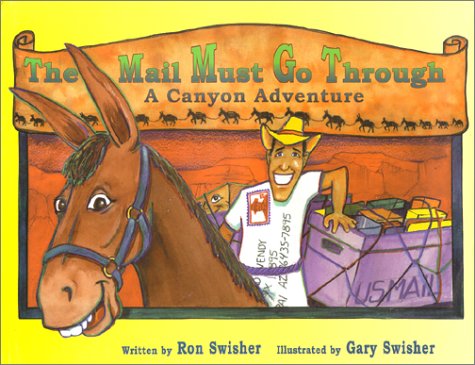



This true story is told in an interesting manor that adds 'life' to the way mail is delivered by mules every day to the most remote Indian village in the United States. A letter narrates, in simple verse, its journey from any city to Supai Arizona, a Havasupai Indian village at the bottom of the Grand Canyon. Along the way it meets other pieces of mail such as Maggie Magazine, Reggie Registered, Chunky and a box of baby chicks. Because the residents of Supai must get their groceries by mule train mail, the letter gets a look at the only walk-in freezer in the US Postal system and meets French Fry Pierre, Henry Hot Dog and Sloppy Joe. After being strapped to the backs of the mules for the 8 mile journey to the bottom of the canyon the mule train encounters a flash flood that threatens the mail, the mules and the humans in charge. A delightful way to learn something new about the mail, mules and the intriguing Havasupai Indian Tribe. ...the book is a bright, cheerful and instructional account of the difficulties of delivering mail by--yes--mule train. -- The AZ TRIBUNE-Mesa/Scottsdale 10-25-99 pages Front, D1&D2 Full of great color illustrations--- Not only for children--- Helpful Glossary and full page of photos--- Great gift idea. -- Postmasters Advocate - National - Sept. 1999 The book is the story of a letter that comes to "life" and narrates its journey through the mail stream... -- Allen T. Lanier, Editor Postmasters Advocate - magazine, Aug/Sept. 1999 The idea might sound ho-hum, the books certainly aren't. -bright, cheerful, instructional account of difficulties delivering mail by----mule train -- THE TRIBUNE - Scottsdale/Mesa/Tempe AZ 10/25/99 This book was first written with the thought of selling it in Post Offices across the nation, it was then decided it best to make it available to the public by offering it over the web and through the mail. The author/publisher mortgaged his home so he could get it in print. It is an important story to be told. A story written with children in mind, but one that grabs the attention of readers of all ages. The book contains a full page Glossary to make it a very important educational tool. I made three trips into Havasu Canyon to visit the village of Supai where the Havasupai Indians live. The first trip was business/pleasure. The second trip was to research and write the book. The third trip was with my son Gary, the illustrator and my two grandchildren who are featured in the book. Any writer with knowledge of the US Mail and who had experienced the Canyon could write this book, but I believe the most outstanding element of the book is the fantastic art work in the 32 pages of 8 1/2 by 11 full color art work inspired by his trek into the canyon to make the sketches and photos during that week he spent in the Canyon. At the time he was Director of Art and Design for Hot Wheels Division of Mattel. He is now making plans to start his own toy company. I am proud of the book, but mostly proud and pleased with the work Gary Swisher did painting each page and providing a full page of photos from our last trip. Ron Swisher worked for the US Postal Service for more than 40 years. He began in Golden Colorado in 1955, but because of Rhumatoid Arthritis from childhood he was forced to transfer to Arizona in 1957. He worked as a clerk, carrier and rural carrier before being promoted to a low level management position in 1964. He was promoted through many management ranks and became Postmaster of Mesa in 1972. In 1986 Ron was elected National President of the National League of Postmasters in Washington DC. It was in that capacity that he first traveled by mule to the remote Indian village of Supai AZ. He wanted to bring to the public's attention how the mail goes everywhere, no matter the remoteness or difficulty in getting there. This is the first in what is meant to be a series on "The Mail Must Go Through". Ron has already researched 3 weeks with an Eskimo family in Alaska and 3 weeks with an Amish family in Lancaster County PA for books in the series. These books will deal with the cultural differences of the children in these locations. Ron has written hundreds of poems, both inspirational and humorous. His days on farms and ranches as a child in Colorado have given him a depth of information coupled with an ever present sense of humor that have caused his works to be popular wherever they are seen or heard. While living in Michigan for 2 years, he became known as the Cowboy Poet of Michigan and gave several public performances in the Detroit/Oakland County area. He and his wife, Karen, now live in a very rural area in the Kona Coffee growing district of the Big Island of Hawaii where they are developing a small tropical fruit and coffee farm while he is designing a new home and working on his next book. Suddenly I hear a peeping sound. I wonder what it is. As best I can I look around to see what I have missed. Then I spot it! A large box addre