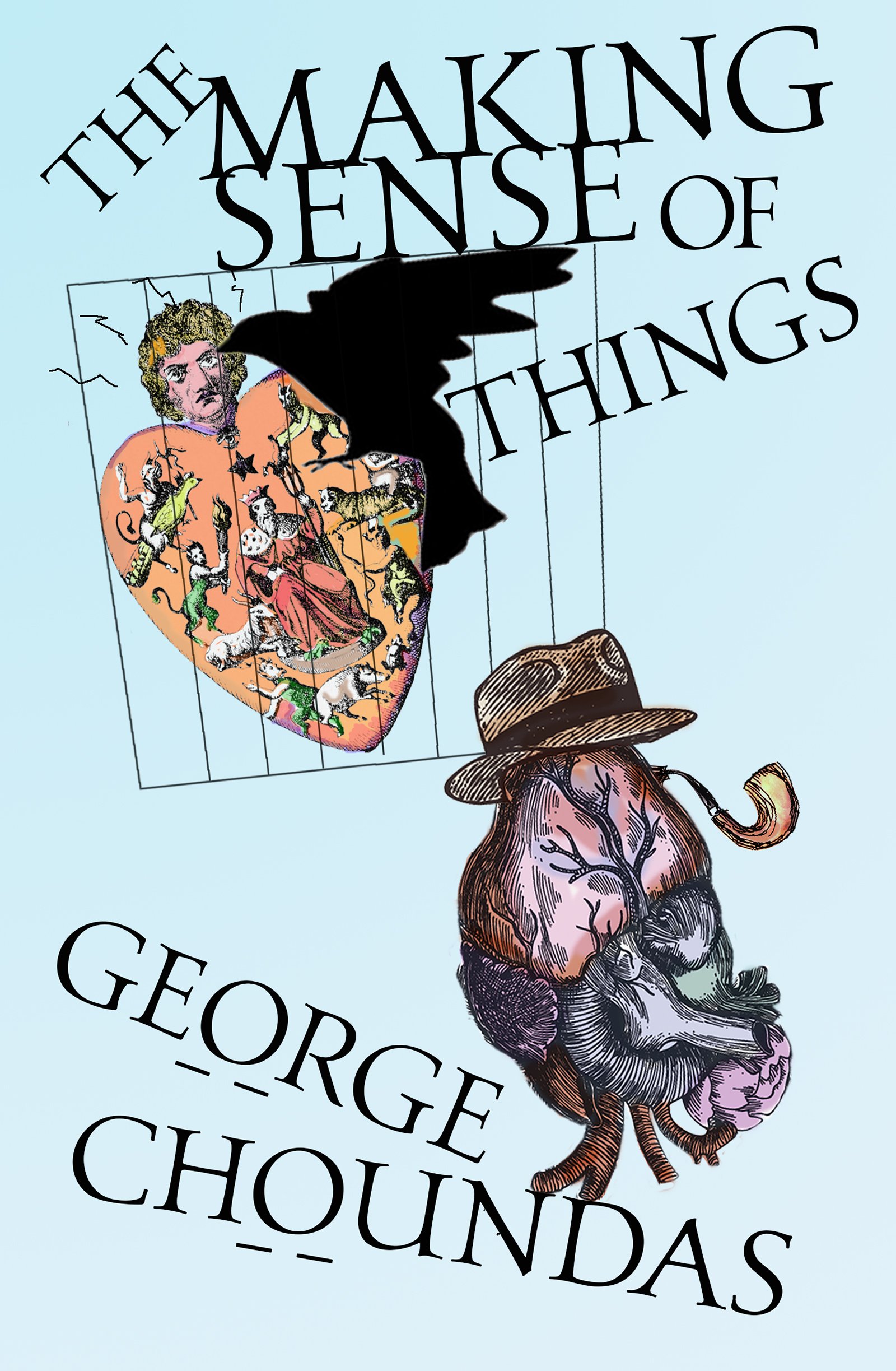



Winner of FC2’s Ronald Sukenick Innovative Fiction Prize A grand tour of the edges of our lives, where glory and significance riot against the logic of living and the pall of tragedy. The Making Sense of Things is a collection of twelve stories that pulse with memory, magic, and myth—all our favorite ways of trying to make sense of things. Readers are treated to vivid and unforgettable characters. A fiercely independent woman puts the man who loves her to unconscionable tests, never guessing that arson, suicide, and canine obesity will yield a magical kind of happiness. A honeymooner in Venice, addled by fever and second thoughts, commits by dumb error a double murder. A brisk lawyer founders when a car wreck claims his son and ex-wife, then discovers that the desperation of grief is a kind of hope. “Reading George Choundas is a bit like watching an archer casually shoot an arrow, hit the bullseye, then draw a second, finer arrow from his quiver and split the first arrow in half. One gets the sense he could do it forever, firing arrow after arrow into the exact center of the heart of the matter. This collection is staggering and brilliant and might have made me a better writer but definitely made me a better person.” —Charles Yu, author of How to Live Safely in a Science Fictional Universe “You want to read this book because you have never before read a book like this one. Inventive, humorous, dark, yes, but also continually outstripping our responses. Choundas may be a genius or someone with something up his sleeve, or both. What’s important is that he gives us twelve fabulous and brilliant stories. The sentences run almost amok on purpose. These stories will open your eyes even wider.” —Kelly Cherry, whose newest book is Temporium: Fictions “These stories are wildly touching, funny in really funny ways, but also flights of mind, image, fantasy, and language telling us that reality is as malleable as love and as changeable as a fire in a forest.” —G.K. Wuori, author of HoneyLee’s Girl George Choundas is a former FBI agent, winner of the New Millennium Fiction Prize, and two-time Pushcart Prize nominee with work in over fifty publications, including The Best Small Fictions 2015 . His fiction has been shortlisted for the Robert C. Jones Prize for Short Prose, the St. Lawrence Book Award for Fiction, and the Katherine Anne Porter Prize in Short Fiction. The Making Sense of Things By George Choundas The University of Alabama Press Copyright © 2018 George Choundas All rights reserved. ISBN: 978-1-57366-065-5 Contents Troth, 94 Selvage Street #1, How Héctor Vanquished the Greeks, Pleasantville, The Duplex and the Scarp, John Tan Can't Play Classical Guitar, Abridged, Of Satisfaction and the Lying Sun, Kennedy Travel, The Girl Who Not Once Cried Wolf, You Will Excuse Me, On the Far Side of the Sea, Acknowledgments, CHAPTER 1 TROTH IT WAS A WORLD EXACTLY LIKE OURS, WITH THREE DIFFERENCES. First, short went first. When two people crossed paths, the taller gave the right of way. Same if they reached a door at the same time. Or bumped into each other. The rule was simple. Even children learned "sky hangs, earth moves" and fumbled past each other in reverse height order. The rule was logical. A taller person could better view and anticipate a crossing situation, then make up lost time with longer strides. With time the rule became custom. It reigned in all cultures, including those where in this world ladies go first, and where the reverse is true, and where age bestows priority, and where strangers' shoulder caps are things for sudden nuzzling because no convention adheres. The time saved in any given encounter was small. Multiplied across the other world's bus stops and vestibules and elevators, it saved days and months. It happens that nine lurching dances of uncertainty in a hallway contain enough moments for a breakthrough in the arts or sciences. The other world was globalizing as relentlessly as ours. The rule accomplished there what the jagged heap of customs in our world cannot. Take for instance the Walloon, the Yemenite, and the Aleutian Islander who converge on the same entrance to the duty-free shop in Charles de Gaulle's Terminal 2A — the narrow entrance, the one to the side. In our world they are destined each to lose three seconds picking at the floor with sheepish feet and blinking. Four, if a mixed-gender assortment. In the other world they moved around each other like breezes in a courtyard. There was another benefit. Persons equipped to navigate physical encounters with ease and poise, even without common language, could not help but feel better about almost everything. There was nourishment in repeatedly confronting a problem, one so fleshy and immediate, and solving it instantly. A steady drip of these small but sure successes made people think of their souls as places where good things happened, rather than sticks that chafed ag