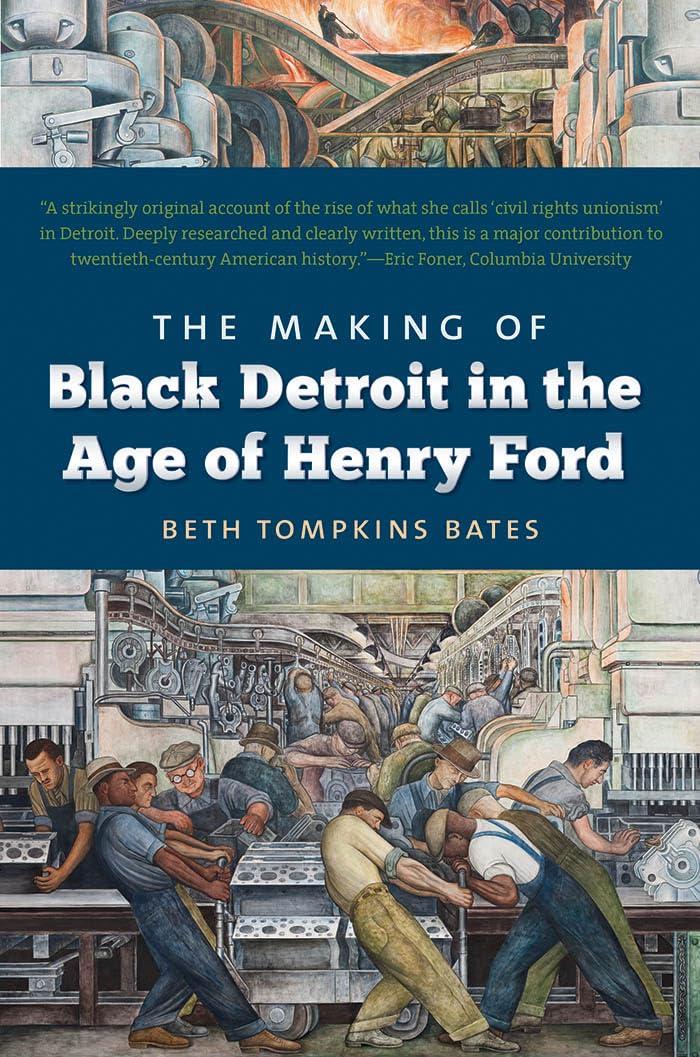



In the 1920s, Henry Ford hired thousands of African American men for his open-shop system of auto manufacturing. This move was a rejection of the notion that better jobs were for white men only. In The Making of Black Detroit in the Age of Henry Ford , Beth Tompkins Bates explains how black Detroiters, newly arrived from the South, seized the economic opportunities offered by Ford in the hope of gaining greater economic security. As these workers came to realize that Ford’s anti-union “American Plan” did not allow them full access to the American Dream, their loyalty eroded, and they sought empowerment by pursuing a broad activist agenda. This, in turn, led them to play a pivotal role in the United Auto Workers' challenge to Ford’s interests. In order to fully understand this complex shift, Bates traces allegiances among Detroit’s African American community as reflected in its opposition to the Ku Klux Klan, challenges to unfair housing practices, and demands for increased and effective political participation. This groundbreaking history demonstrates how by World War II Henry Ford and his company had helped kindle the civil rights movement in Detroit without intending to do so. “Offers a more realistic view of the tensions that existed within the union . . . [and] highlights the role Black organizers played in the UAW drive at Ford." — Against the Current “ Black Detroit includes some remarkable and complicated stories [that explore] changing attitudes and realities within the city in a masterful manner. . . . It is an important addition to the Detroit Story.” — American Historical Review “A detailed and highly readable history of Ford’s industrial goals, his controlling social vision for his workers, and his brutal response to unionization.” — TriQuarterly “Recommended. All academic levels/libraries.” — CHOICE “An engaging book, lucidly presented and approachable to anyone with a curious mind.” — SpeedReaders.info “Offers a clear and compelling account of Ford’s motives for courting blacks.” — Speedreaders.info “Combines the broader political, social and economic life of Detroit with the experiences endured at the Ford Motor Company, as African Americans quickened their pace on the long and seemingly never ending march, to paraphrase Martin Luther King Junior, to be treated according to the content of their characters rather than the colour of their skins.” — Labour History “Beth Tompkins Bates delves further back than others have into the 1920s and extends her critical eye to community formation and the political activities of Detroit’s blacks, many of whom were in the first wave of the Great Migration.” — Historian “[This] very readable study will be of enormous interest to historians of the urban and industrial Midwest, to scholars interested in racial formation in the region, and to those who study African American experiences.” — Middle West Review ""Bates moves beyond shopfloor politics and traditional labor history to explore the complex relationship between Ford Motor Company and its migrant African American employees. She challenges the image of black Detroit as a pliant and politically quiescent community and posits instead that the labor and work-oriented issues they faced were central to early civil rights activism. — Steven Reich, James Madison University The political life of Ford’s black workers In the 1920s, Henry Ford hired thousands of African American men for his open-shop system of auto manufacturing. In The Making of Black Detroit in the Age of Henry Ford, Beth Tompkins Bates explains how black Detroiters, newly arrived from the South, seized the economic opportunities offered by Ford in the hope of gaining greater economic security. As these workers came to realize that Ford's anti-union "American Plan" did not allow them full access to the American Dream, their loyalty eroded, and they sought empowerment by pursuing a broad activist agenda. This, in turn, led them to play a pivotal role in the United Auto Workers' challenge to Ford's interests. In the process, Henry Ford and his company helped kindle the civil rights movement in Detroit without intending to do so. In the 1920s, Henry Ford hired thousands of African American men for his open-shop system of auto manufacturing. In The Making of Black Detroit in the Age of Henry Ford, Beth Tompkins Bates explains how black Detroiters, newly arrived from the South, seized the economic opportunities offered by Ford in the hope of gaining greater economic security. As these workers came to realize that Ford's anti-union "American Plan" did not allow them full access to the American Dream, their loyalty eroded, and they sought empowerment by pursuing a broad activist agenda. This, in turn, led them to play a pivotal role in the United Auto Workers' challenge to Ford's interests. In the process, Henry Ford and his company helped kindle the civil rights movement in Detroit without intending to do so. Beth Tompkins Bat