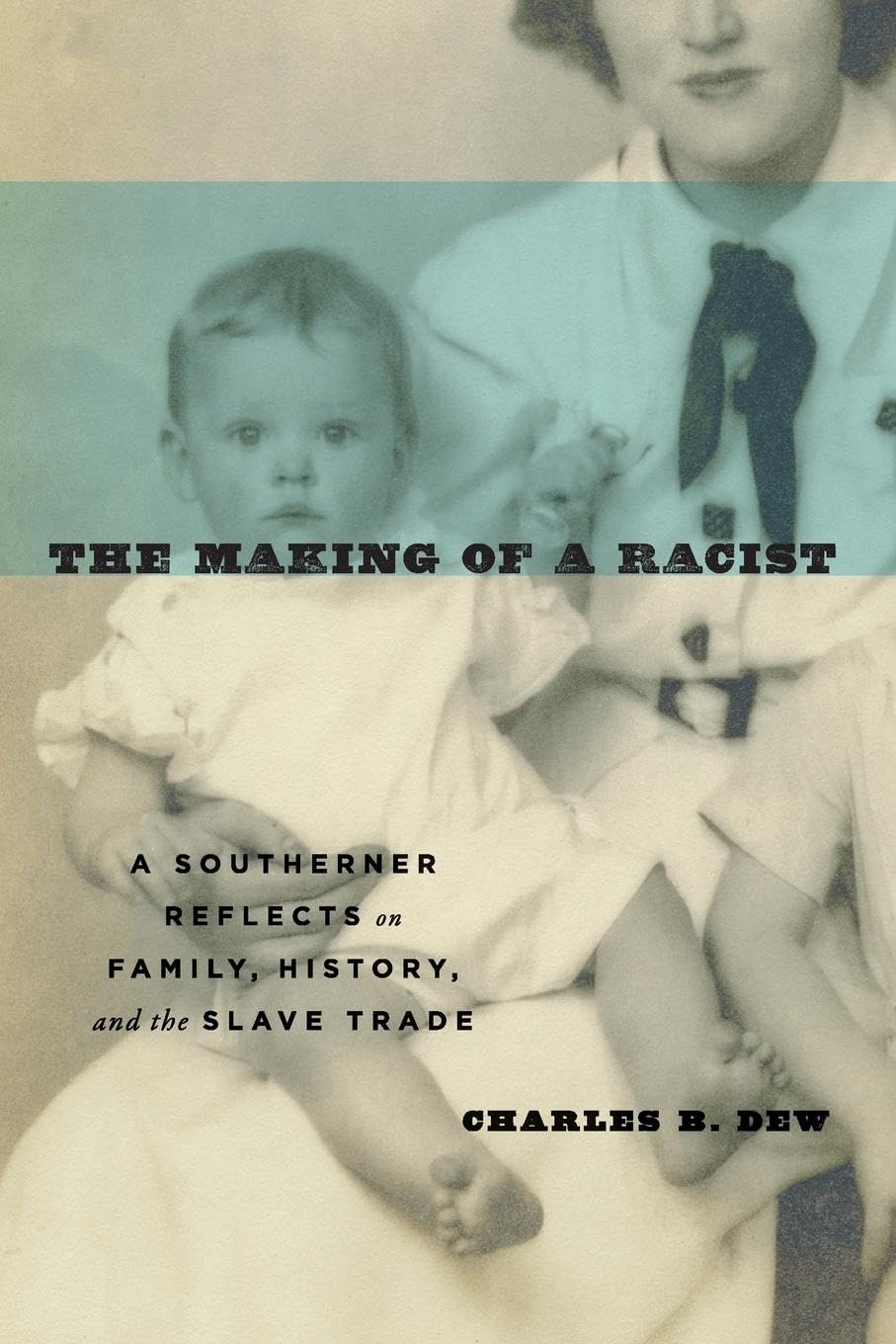
The Making of a Racist: A Southerner Reflects on Family, History, and the Slave Trade
$12.53
by Charles B. Dew



In this powerful memoir, Charles Dew, one of America’s most respected historians of the South--and particularly its history of slavery--turns the focus on his own life, which began not in the halls of enlightenment but in a society unequivocally committed to segregation. Dew re-creates the midcentury American South of his childhood--in many respects a boy’s paradise, but one stained by Lost Cause revisionism and, worse, by the full brunt of Jim Crow. Through entertainments and "educational" books that belittled African Americans, as well as the living examples of his own family, Dew was indoctrinated in a white supremacy that, at best, was condescendingly paternalistic and, at worst, brutally intolerant. The fear that southern culture, and the "hallowed white male brotherhood," could come undone through the slightest flexibility in the color line gave the Jim Crow mindset its distinctly unyielding quality. Dew recalls his father, in most regards a decent man, becoming livid over a black tradesman daring to use the front, and not the back, door. The second half of the book shows how this former Confederate youth and descendant of Thomas Roderick Dew, one of slavery’s most passionate apologists, went on to reject his racist upbringing and become a scholar of the South and its deeply conflicted history. The centerpiece of Dew’s story is his sobering discovery of a price circular from 1860--an itemized list of humans up for sale. Contemplating this document becomes Dew’s first step in an exploration of antebellum Richmond’s slave trade that investigates the terrible--but, to its white participants, unremarkable--inhumanity inherent in the institution. Dew’s wish with this book is to show how the South of his childhood came into being, poisoning the minds even of honorable people, and to answer the question put to him by Illinois Browning Culver, the African American woman who devoted decades of her life to serving his family: "Charles, why do the grown-ups put so much hate in the children?" Each one of Charles Dew’s books has helped shape the conversation on the history of race in this nation. His new book, which combines an honest autobiography of life in the 1950s with a sobering account of archival history and reckoning, is a characteristically eloquent reflection. Dew allows us to understand just how deeply racial thinking saturated white southerners who were otherwise admirable people. Charles Dew is one of our wisest and most humane historians. ― Edward L. Ayers, University of Richmond, author of The Promise of the New South: Life after Reconstruction The Making of a Racist provides a searching and brave account of the honeyed pathway to race hatred, the bracing disorientation of learning better, and the haunting, guilty sense of having been there, and knowing that so many have stayed behind. ― Walter Johnson, Harvard University, author of River of Dark Dreams: Slavery and Empire in the Cotton Kingdom In his compelling new memoir, Professor Charles Dew '58, one of America's most respected scholars on the history of slavery, shares the story of his childhood growing up white in the Jim Crow South and how his consciousness--and conscience--were raised at Williams. ― Williams Magazine Charles Dew’s short book is a memoir with broad cultural reach, an even-handed, cleanly-written overview befitting an historian retiring after a distinguished professional career.... There is nothing theoretical, melodramatic, or confessional about Charles Dews’ remembrances.... Nor does Dew take any personal credit, or express any smug sense of acquired virtue, while recounting his emerging enlightenment about race prejudice. His narrative voice earns trust by its plainspoken honesty. ― The Key Reporter (Phi Beta Kappa) When you consider the sheer inhumanity it took for people ― good Christians all, in their own estimation ― to buy other people, or sell other people, or rape other people, or cheat and restrict other people, or just to kill other people outright with a bestial sadism you wouldn’t inflict on an ailing dog. . . why? What was it in white Southern mores, folkways or history that made this such an indelible ― though not unique ― characteristic of theirs, that allowed so many of them to do such things or simply to stand in complicit silence, without a peep from conscience, as such things were done all around them? Why? It is the triumph of Dew’s book to pose that question at long last. ― Washington Post This book makes for a brief and humane look into racism in the United States. It should prove valuable for students and any citizen who wonders what went wrong. ― Daily Press It’s up to books like [Dew’s] to help educate people so we begin to understand reports coming from the Department of Justice. ― The Diane Rehm Show Atlanta Journal-Constitution: What do you hope this book will accomplish? Dew: I thought that there were not enough white voices in our racial dialogue. We have had some incred