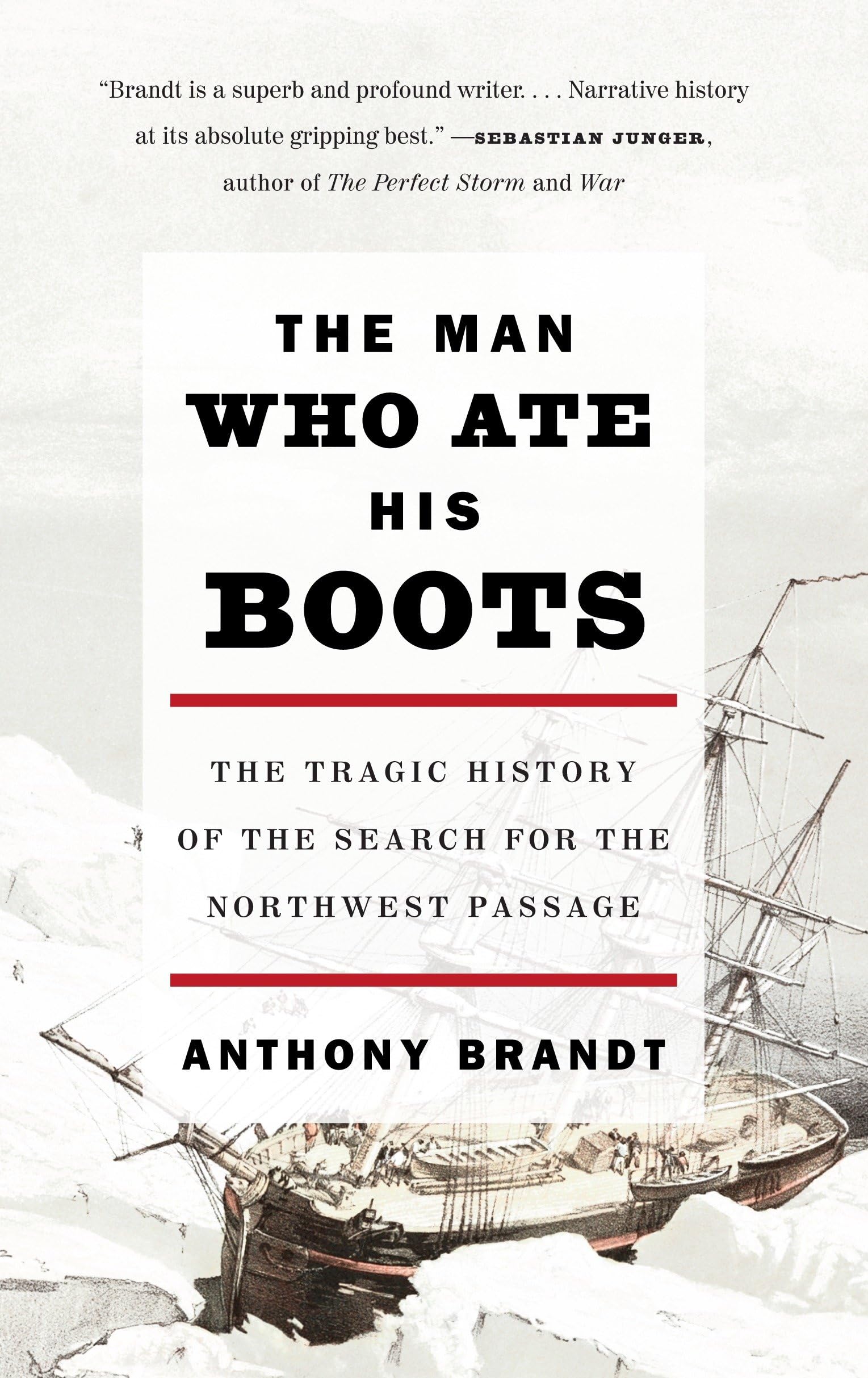
The Man Who Ate His Boots: The Tragic History of the Search for the Northwest Passage
$13.46
by Anthony Brandt



After the triumphant end of the Napoleonic Wars in 1815, the British took it upon themselves to complete something they had been trying to do since the sixteenth century: find the fabled Northwest Passage. For the next thirty-five years the British Admiralty sent out expedition after expedition to probe the ice-bound waters of the Canadian Arctic in search of a route, and then, after 1845, to find Sir John Franklin, the Royal Navy hero who led the last of these Admiralty expeditions. Enthralling and often harrowing, The Man Who Ate His Boots captures the glory and the folly of this ultimately tragic enterprise. “Exotic and thrilling. . . . One of those books that can keep a reader inside for an entire weekend.” — Los Angeles Times “Thoughtful, compassionate and meticulously researched . . . offers readers a vivid, compelling, ultimately heartbreaking history of Arctic exploration.” — The Oregonian “A fascinating, at times thrilling, narrative.” — The Seattle Times “Brandt is a superb and profound writer who leads us through a tale of such hardship you feel as if you’ve been aboard ship with them. It’s no small feat to use a bit of history to illuminate the future, but Brandt pulls it off. This is narrative history at its absolute gripping best.” —Sebastian Junger, author of The Perfect Storm and War “[Brandt is a] powerful storyteller, vividly re-creating the most dramatic episodes of the nineteenth century.” — Washington Post “A robust new history. . . . Brandt tells his story well. . . . [He] achieves a modern synthesis between the hagiography of the old days and the more recent historical revisionism.” — The New York Times Book Review “Brandt is a well-tempered storyteller, both thoroughgoing and agile, who knows what to do with a tale of high color and noble folly.” — San Francisco Chronicle “A rich and satisfying read, and a classic history of Arctic exploration.” —Laurence Bergreen, author of Marco Polo: From Venice to Xanadu “Lively, mischievous, and dryly ironic . . . deeply satisfying fare.” — Arctic Book Review “A well-researched account. . . . Brandt is at his best when he weaves in back stories of the politics and petty feuds that shaped much of the public perception.” — Willamette Week “A splendid, gripping account of an astounding, unbelievable quest. . . . What Brandt brings to this mesmerizing tale is what only fine writing can deliver: fully realized sense impressions that make history come memorably alive, and an informed, sensitive analysis of historical events that puts them in larger context.” — The Independent (Hamptons) “Anthony Brandt’s account of the fatal quest for the Northwest Passage is fascinating, horrifying and inspiring. It is not just a great tale of heroic exploration, wonderfully told, but an epic voyage of discovery into the recesses of the human spirit.” —Piers Brendon, author of The Decline and Fall of the British Empire “Brandt pens a colorful narrative full of gothic horrors, quiet daring, and petty personality clashes, and probes the social meaning of these odysseys. . . . The result is a gripping—and sometimes appalling—tale of heroism and hubris.” — Publishers Weekly Anthony Brandt is the editor of the Adventure Classics series published by National Geographic Society Press, and the books editor at National Geographic Adventure magazine. Formerly the book critic at Men’s Journal, Brandt has written for The Atlantic, GQ, Esquire, and many other magazines, and is the author of two previous books. He lives in Sag Harbor, New York. Introduction When Lieutenant Edward Parry of the Royal Navy climbed a small hill on what he believed to be the southwest corner of Melville Island in the summer of 1820, he gazed out upon an apparently endless sea of ice stretching west to the horizon. The same ice filled up the strait between Melville Island and land he could just make out in what sailors called the offing, far away, to the south, perhaps fifty miles distant. It was August, yet there was no trace of a lane of open water anywhere within sight. The surface of the ice was as hummocky and ridged as the wrinkled surface of a glacier, while the floes close to shore were as thick as a four-story building is tall. If this was the Northwest Passage, he could plainly see, it would never be navigable. Ice that thick, that old, that hard could not possibly melt in the brief Arctic summer, and no ship could penetrate it. In the summer of 2007, for the first time in history, this particular route through the Canadian archipelago, the complex maze of islands lying north of the North American continent and east of the Mackenzie River delta, opened to ship traffic. The following summer it opened again. All that ice was gone. Thanks to global warming it is beginning to seem likely that the Northwest Passage will open for longer and longer periods each year, until, perhaps by the end of this century, ice will have vanished from the world alto