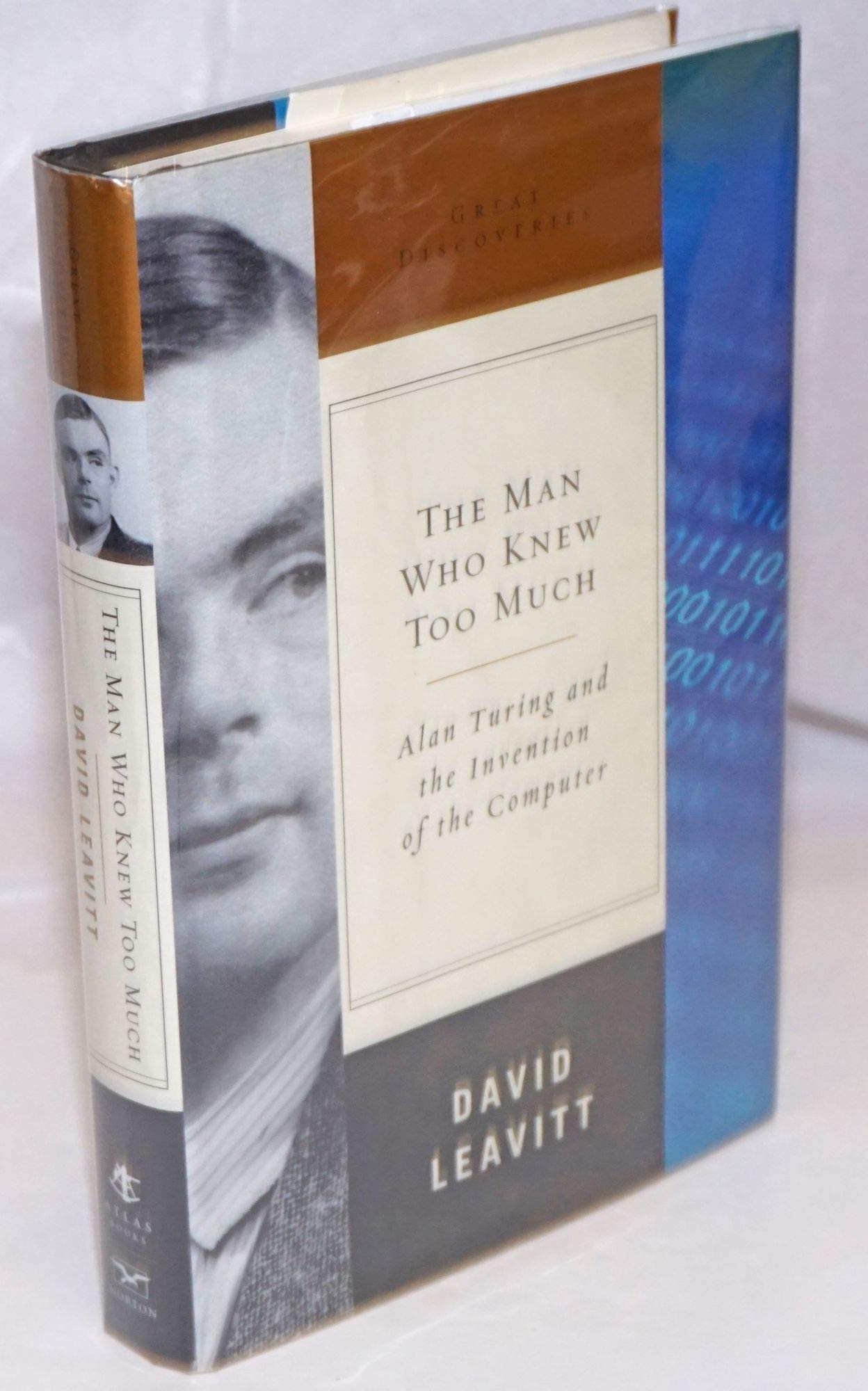
The Man Who Knew Too Much: Alan Turing and the Invention of the Computer (Great Discoveries)
$39.73
by David Leavitt



The story of the persecuted genius who helped create the modern computer. To solve one of the great mathematical problems of his day, Alan Turing proposed an imaginary programmable calculating machine. But the idea of actually producing a "Turing machine" did not crystallize until he and his brilliant Bletchley Park colleagues built devices to crack the Nazis' Enigma code, thus ensuring the Allies' victory in World War II. In so doing, Turing became a champion of artificial intelligence, formulating the famous (and still unbeaten) Turing Test that challenges our ideas of human consciousness. But Turing's postwar computer-building was cut short when, as an openly gay man in a time when homosexuality was officially illegal in England, he was apprehended by the authorities and sentenced to a "treatment" that amounted to chemical castration, leading to his suicide. With a novelist's sensitivity, David Leavitt portrays Turing in all his humanityhis eccentricities, his brilliance, his fatal candorwhile elegantly explaining his work and its implications. Twenty-five years ago the word "Turing" tingled with mystery for the few who knew it. Readers of Douglas Hofstadter learned that Alan Turing belonged with Gödel in exploring minds and logic and knew also of "the Turing test" for artificial intelligence. But others were aware of Turing as a British figure, a Cambridge mathematician, emerging in connection with the huge World War II operation to break the Enigma ciphers. His crucial importance in the battle of the Atlantic was still shrouded by state secrecy. In fact, it was only after this secrecy was lifted that he began to be acknowledged for another great contributionhis role in the origin of the computer. The conspicuously missing feature was the testimony of Alan Turing himself. He had died at age 41 in 1954, apparently killing himself with cyanide and leaving a jagged hole in history. By 1980 rumor told of the prosecution and punishment that he had undergone as a homosexual in 1952. But even then, such a story could no longer serve as a simple explanation of suicide. Turings friends had known him as unashamed and contemptuous of convention. A different suspicion struck those who knew the dark side of the 1950s. The victorious Allies must have been appalled by this revelation of the man who knew their secrets: How could Turings private desires be reconciled with the public demands of state security? But on this question, total silence reigned. Since then, the situation has completely changed. A number of events have made Turings life better known to the public than that of probably any other mathematician. A notable actor, Derek Jacobi, has played Turings drama to millions of viewers in Hugh Whitemores 1986 play Breaking the Code. Little is secret from Google, and computer science students may find themselves expected to assess his life and death. Massive U.S. government releases in the 1990s have made World War II code breaking the subject of detailed scholarship, and conferences and books celebrate Turings continuing influence. Complexity theory and quantum computing build on his analysis of computation, and since the 1980s Roger Penrose has given new life to Turings deepest questions. Above all, Turings reputation is now solidly underpinned by the vindication of his vision. Although John von Neumann led by a few months in creating a computer plan, it was Turing who explained in 1946 how "every known process" could be turned into computer software. Turing had seen this prospect in the simple but revolutionary principle of his Universal Turing Machine, laid out in a paper in 1936, and had thus created an amazing link between the purest mathematics and the most productive industrial applications. But there are always more secrets to unravel and always room for yet another introduction. A series of "great discoveries," such as the current undertaking from W. W. Norton, cannot ignore Turing, and it is interesting to see the story of his contributions attempted by an American novelist, David Leavitt. The story is not simply a question of dates and facts. To use one of Turings own images, it is like the skin of an onion. It calls for a writer who can unpeel it with care and who is unafraid of tears. Intensely private, yet relishing popular writing and broadcasts, fiercely proud and yet absurdly self-effacing, Turing led a strange life intertwined with characteristically odd British puzzles of class and lifestyle. A central paradox is that he asserted the "heretical theory" that the human mind could be rivaled by a computer, whereas his own personality so little resembled the output of a machine. It was willful, individualistic, unpredictable. His struggle to incorporate initiative and creativity in his artificial-intelligence theory is therefore a personal drama. This is a puzzle that goes to the heart of science and yet is also fine material for a novelist of insight. Leavitts focus is elsewhere,