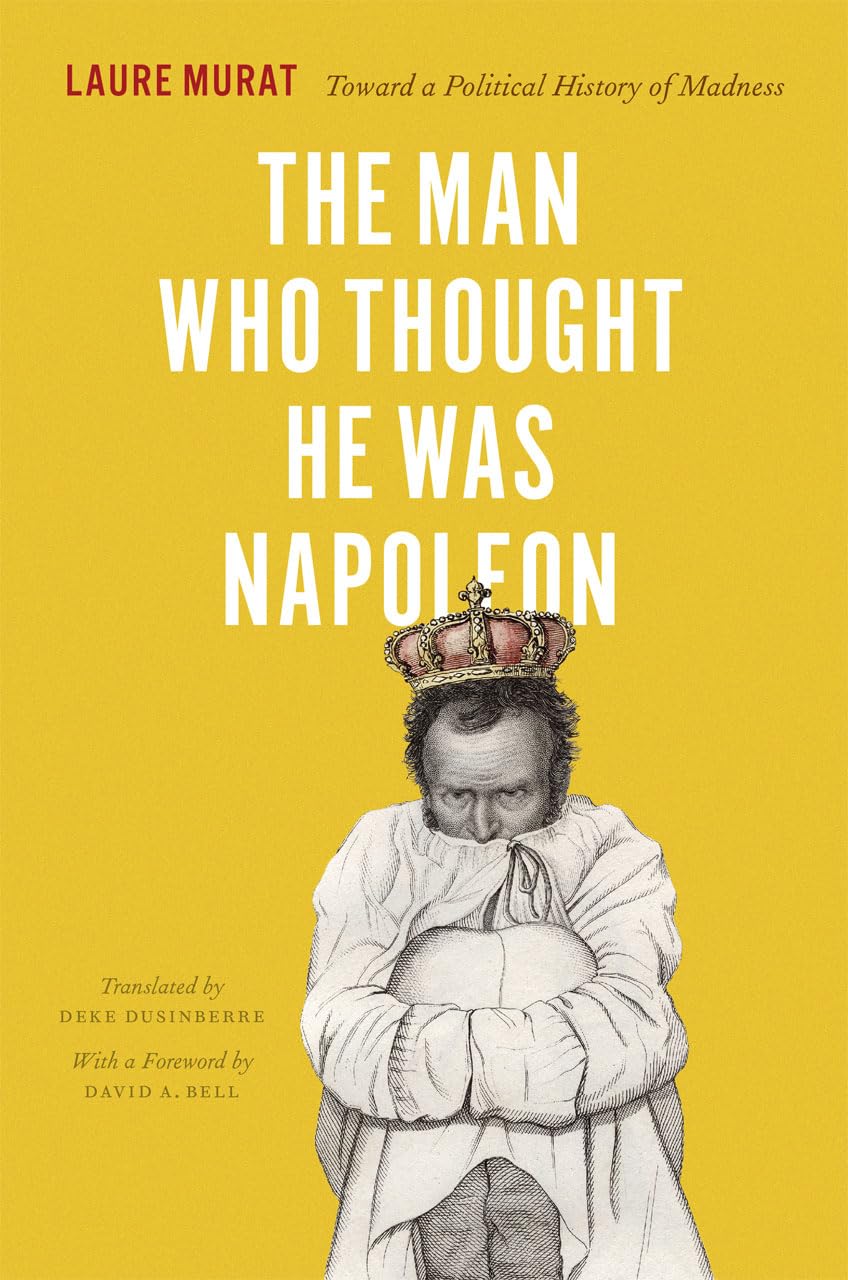
The Man Who Thought He Was Napoleon: Toward a Political History of Madness
$40.00
by Laure Murat



The Man Who Thought He Was Napoleon is built around a bizarre historical event and an off-hand challenge. The event? In December 1840, nearly twenty years after his death, the remains of Napoleon were returned to Paris for burial―and the next day, the director of a Paris hospital for the insane admitted fourteen men who claimed to be Napoleon. The challenge, meanwhile, is the claim by great French psychiatrist Jean-Étienne-Dominique Esquirol (1772–1840) that he could recount the history of France through asylum registries. From those two components, Laure Murat embarks on an exploration of the surprising relationship between history and madness. She uncovers countless stories of patients whose delusions seem to be rooted in the historical or political traumas of their time, like the watchmaker who believed he lived with a new head, his original having been removed at the guillotine. In the troubled wake of the Revolution, meanwhile, French physicians diagnosed a number of mental illnesses tied to current events, from “revolutionary neuroses” and “democratic disease” to the “ambitious monomania” of the Restoration. How, Murat asks, do history and psychiatry, the nation and the individual psyche, interface? A fascinating history of psychiatry―but of a wholly new sort― The Man Who Thought He Was Napoleon offers the first sustained analysis of the intertwined discourses of madness, psychiatry, history, and political theory. “Fascinating. . . . Murat’s analysis, informed by extensive archival research, shows how difficult it is to disentangle the intricate connections that link individual sensibility and imagination to the currents of history. Is our identity entirely shaped by our environment, or do we simply adjust our fears and dreams to external circumstances? And what exactly constitutes a ‘normal’ attitude towards one’s own times? Some of these questions are bound to remain open: this compelling book offers a valuable opportunity to consider them, and to explore some of the answers.” ― Times Higher Education “Murat’s interesting political history of madness . . . is brought to the English-speaking world in Dusinberre's superb translation.” ― Choice “Enthralling. . . . In following Esquirol’s claim through the turbulent history of 19th-century France, Murat is also tracking the institutional revolutions in French psychiatry and the constant redefinition of madness itself.” ― London Review of Books “Impressive. . . . Further cements Laure Murat’s position as one of the preeminent historians of French psychiatry in her generation. . . . Brilliantly translated by Deke Dusinberre. . . . Murat’s stylish prose is transformed into elegant and idiomatic English with all the subtlety of the original French in this highly readable and thought-provoking study.” ― Nineteenth-Century French Studies “[A] wonderful study, seamlessly translated. . . . It is hugely entertaining.” ― Fortean Times “An engaging, beautifully written, and thought-provoking exploration of the intertwining of politics and madness in nineteenth-century France. . . . One of the many virtues of Murat’s book is that it is full of the unexpected. . . . She pushes her readers to embrace the multitude of readings and interpretations that her study allows, all the while revealing endless new facets of the ways in which politics, insanity, and psychiatry could inflect one another.” ― American Historical Review “From a seemingly endless array of crumbling and decomposing damp-infested paper, Murat has brought to life a teeming galaxy of ‘tragedies, funny incidents, entire lives,’ summed up in a handful of words scribbled in the performance of a function. In the hands of a skilled historian, she shows how much we can learn, arguing that when read with suitable care and attention, ‘an archive reads just like its presumed antithesis, a novel.’” ― Times Literary Supplement “Murat is a subtle writer and stylist, able to assimilate a wealth of archival evidence into a forceful narrative. She gives new poignancy to the problem of distinguishing between what patients say and how their doctors represent their voices, and she makes her own process in the archives part of the story she is telling. Her imagination, her curiosity, and her intellectual independence enable her to glean a new understanding of the mark of history on madness―showing, along the way, the pitfalls in too easy an understanding of mental life.” -- Alice Kaplan, author of Dreaming in French “Beautifully crafted and passionately argued, The Man Who Thought He Was Napoleon opens startlingly original perspectives on madness and politics in modern French history. Since French asylum practices have been among the most discussed by philosophers, historians, and activists, Murat’s book is bound to redirect discussions for years to come. Readers will also be thankful for a superb translation that brings this prize-winning book to the attention of the Anglophone world.”