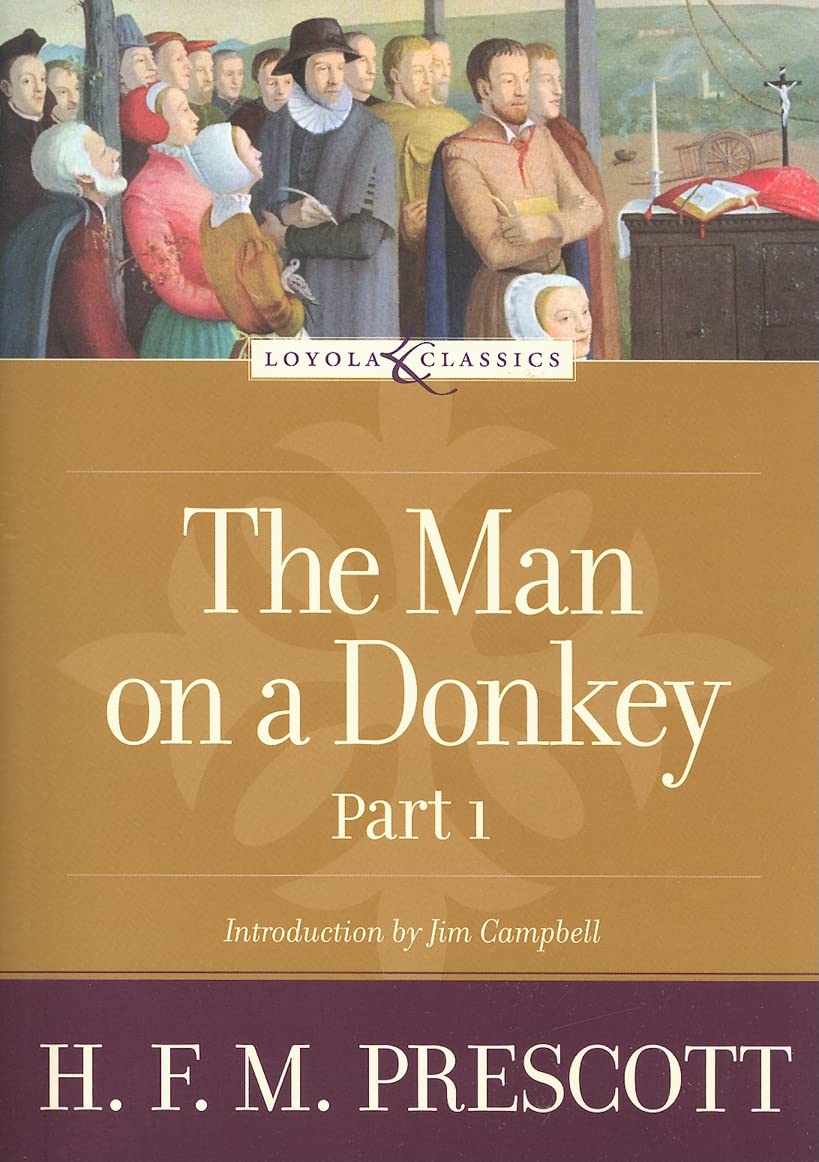
The Man on a Donkey: Part 1: A Chronicle (Loyola Classics)
$13.95
by Hilda Francis Margaret Prescott



As good as a historical novel can be—fresh, imaginative, sensitively written.” — The New York Post The Man on a Donkey is an enthralling, panoramic historical novel that brings to life one of the most tumultuous times in British history—the reign of King Henry VIII. In Part 1, readers are introduced to the world of the Tudors through the lives of five individuals. When King Henry VIII takes his mistress as his new wife, seizes Church property, and declares himself the only supreme head of the Church of England, the lives and fortunes of these five people are shaken—setting the stage for the momentous events in Part 2 of The Man on a Donkey . It’s 1536. England is in turmoil. The arrogant King Henry VIII has seized Church property and is dividing it among royal favorites. In the North, Catholic nobles launch a rebellion, and violence sweeps over the land; Henry is very nearly toppled from his throne. For weeks, the leader of the rebellion holds the fate of the nation in his hands. The Man on a Donkey is an enthralling, panoramic historical novel that brings to life one of the most tumultuous times in British history. H. F. M. Prescott’s gripping masterpiece of storytelling portrays a desperate struggle grounded in ambition, pride, and conflicting spiritual visions. Note: This novel will be released in two parts. “As good as a historical novel can be— fresh, imaginative, sensitively written.” —The New York Post The Man on a Donke y is an enthralling, panoramic historical novel that brings to life one of the most tumultuous times in British history—the reign of King Henry VIII. In Part 1, readers are introduced to the world of the Tudors through the lives of five individuals. When King Henry VIII takes his mistress as his new wife, seizes Church property, and declares himself the only supreme head of the Church of England, the lives and fortunes of these five people are shaken—setting the stage for the momentous events in Part 2 of The Man on a Donkey. H. F. M. Prescott (1896–1972) studied history at Oxford and embarked on a successful writing career in the mid-1920s. She is best known for her historical novels, including Son of Dust and The Man on a Donkey , and for Spanish Tudor: The Life of Bloody Mary , her biography of Mary Tudor. Introduction Jim Campbell We have an ongoing fascination with the story of the Tudor dynasty (1485–1603). The reign of Henry VIII (1509–1547) is filled with spectacle, intrigue, and tensions that led to the separation of the Church of England from Rome. Elizabeth I (1558–1603) faced down her enemies internally and externally, most spectacularly the Spanish Armada in 1588. During the reign of the Tudors, England began to move onto the world stage, setting the foundations that would lead to English dominance at sea for over two hundred years. In the twentieth century, there were some fifty-five movie and television productions dealing with the coming to power of the Tudor dynasty and their colorful careers. Most productions dealt with the reigns of Henry VIII and his daughter Elizabeth I. The larger-than-life character of King Henry VIII has been played by actors of the caliber of Charles Laughton, Richard Burton, Keith Michell, and Robert Shaw. As we moved into the twenty-first century, the fascination continued with a ten-part cable production of the history of the escapades of Henry VIII and a major movie about his relationship with Anne Boleyn. The colorful life of Henry VIII—his six wives, his spectacular divorces, his break with the Catholic Church—naturally attracts attention. Henry VIII’s reign includes the confrontations with Thomas More and Bishop John Fisher, who in conscience could not follow Henry’s plans for the future of the Church and lost their heads as a result. Who Were the Tudors? The Tudor dynasty came into power at the Battle of Bosworth Field in 1485. This was the culmination of the Wars of the Roses, the fratricidal conflict between the noble Houses of York (the white rose) and Lancaster (the red rose). Richard III, the last York king, was killed on the battlefield, leaving Henry Tudor, the last living man representing the Lancaster claim to the throne, the “last man standing.” Henry was crowned as Henry VII. To heal the breach between the Lancaster family and that of York, Henry married Richard III’s niece, Elizabeth of York. She was the daughter of King Edward IV of York (1461–1470, 1471–1483). As far as we can tell, the marriage was a happy one. Henry and Elizabeth had seven children, four of whom survived childhood. Their oldest son, Arthur, the unhealthy heir apparent, was married to Katherine of Aragon, the young daughter of Ferdinand and Isabella of Spain, in 1501. About six months later, in April 1502, Arthur died, possibly of tuberculosis or “sweating sickness.” Not wanting to lose the enormous dowry that came with Katherine, Henry VII proposed that Katherine marry his second son, Henry. Before the marriage coul