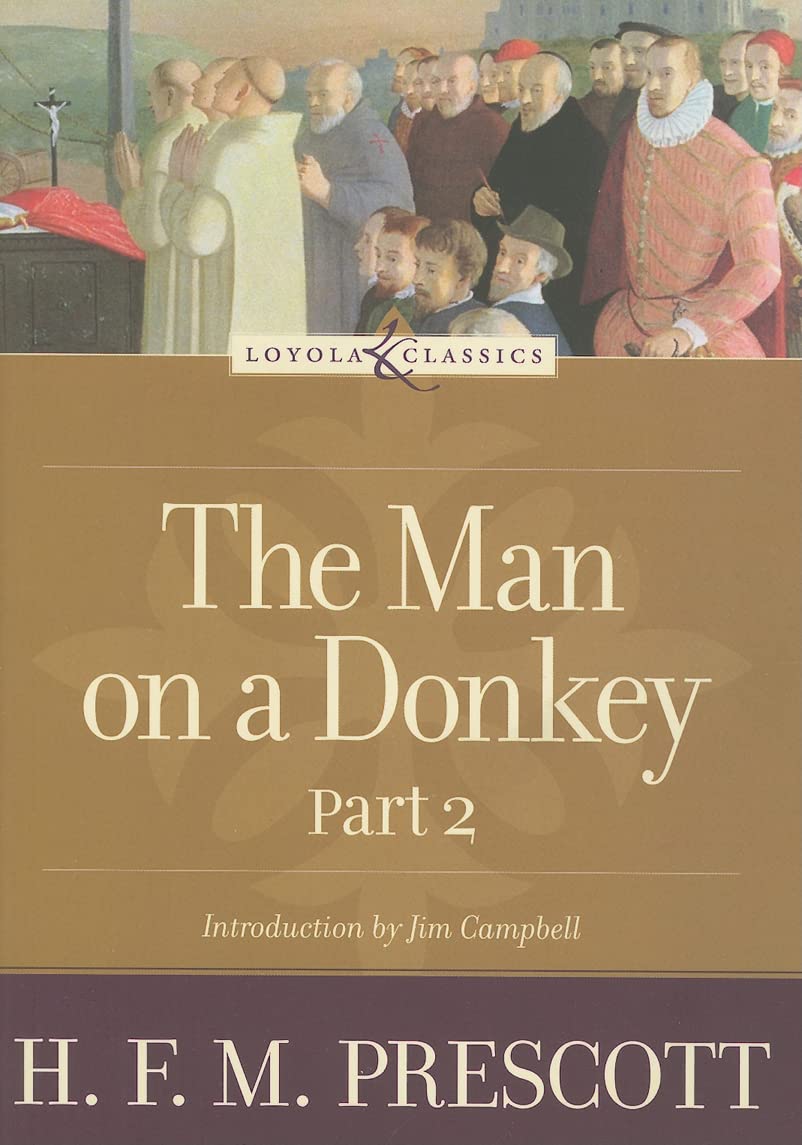
The Man on a Donkey: Part 2: A Chronicle (Loyola Classics)
$13.95
by Hilda Francis Margaret Prescott



“The almost perfect historical novel.” — The New York Times The Man on a Donkey is an enthralling, panoramic historical novel that brings to life one of the most tumultuous times in British history—the reign of King Henry VIII. In Part 1, readers are introduced to the world of the Tudors through the lives of five individuals. In Part 2—as King Henry VIII continues his arrogant rule, Thomas Cromwell closes the monasteries, and rebellion breaks out in the North of England—readers discover the destiny of these five people and, through their stories, learn that God’s love is felt only by those whose hearts are open to mystery and grace. It’s 1536. England is in turmoil. The arrogant King Henry VIII has seized Church property and is dividing it among royal favorites. In the North, Catholic nobles launch a rebellion, and violence sweeps over the land; Henry is very nearly toppled from his throne. For weeks, the leader of the rebellion holds the fate of the nation in his hands. The Man on a Donkey is an enthralling, panoramic historical novel that brings to life one of the most tumultuous times in British history. H. F. M. Prescott’s gripping masterpiece of storytelling portrays a desperate struggle grounded in ambition, pride, and conflicting spiritual visions. Note: This novel will be released in two parts. H. F. M. Prescott (1896–1972) studied history at Oxford and embarked on a successful writing career in the mid-1920s. She is best known for her historical novels, including Son of Dust and The Man on a Donkey , and for Spanish Tudor: The Life of Bloody Mary , her biography of Mary Tudor. Introduction Jim Campbell Henry VII of England (1485–1509) was an economical and prudent man. He was frugal in his expenses and when he died had amassed a personal fortune of 1.5 million pounds. Today the amount left to Henry VIII in 1509 would amount to the equivalent of about 1.5 billion dollars. Henry VIII quickly found many ways to spend the money that his father so carefully saved. He embarked on war with France. Between 1509 and 1515 Henry spent some 1,344,030 pounds on his European wars. His Lord Chancellor, Cardinal Wolsey, spent another 400,000 pounds from 1522 to 1523. Soon Henry’s personal fortune was drained away. For the rest of his reign, Henry VIII had money problems. The sources of his income were fairly static, so he needed another source of ready cash. He found it in the eight hundred monasteries and priories of England. The precedent of closing monasteries to cash in on them was begun by Cardinal Wolsey. Wolsey closed twenty-eight smaller monasteries and used the funds to build colleges. Over the centuries, these religious establishments had also gathered a great deal of wealth in the form of religious artifacts. Wolsey confiscated these artifacts for his personal use. After his fall from grace in 1529, all of Wolsey’s possessions became the property of the King. In The Man on the Donkey, H. F. M. Prescott shows us Henry VIII and Anne Boleyn as they search Wolsey’s palace to examine the inventory of his wealth. 1529 October 24 But the King grew impatient and let the pages go with a run. “Where is the plate of gold and silver?” He found the page. A gold cup of assay . . . a crystal glass garnished with gold . . . a gold salt garnished with pearls and stones and a white daisy on the knop. He shut the book, and, turning, shouted for one of the royal officers who had charge of the stuff. The man’s voice answered him hollowly in the great empty house. “The keys! The keys!” the King cried, and when the keys were brought they went away with them to the chamber where all this most precious stuff had been stored. There it was, set upon benches and cupboards, and overflowing to the floor, the dim light gleaming on the bellies of gold cups, gold salts, silver cups, silver salts, and catching the facets of jewels. “Jesu!” cried Mrs. Anne, and the King said, “Passion of Christ!” at the sight of that sumptuous spectacle. Then they moved about, touching and lifting, here a gilt charger, there a gold cup with a cover and the top-castle of a ship on the knop. “Ah! the pretty thing,” cried Mrs. Anne, and pointed her finger at a bowl of gold with a cover, garnished with rubies, diamonds, pearls, and a sapphire set in a collet upon it. The King stooped to look at it. Just near, upon the bench end, stood a tall gold salt with twined green branches enameled upon the gold, and scrolled letters enlaced together; the letters were K. and H. He gave the salt a shove with the back of his hand and it fell from the bench and clattered to the ground. Mrs. Anne tittered, because she knew that K. stood for Katherine, but the King’s face had reddened with anger. He caught her by the wrist and kissed her roughly and went on kissing. As his mouth lifted from her throat or from her lips he was muttering— “Laugh? You may laugh. And she. And the pope. But none will laugh when it is seen what I shall do.” As we h