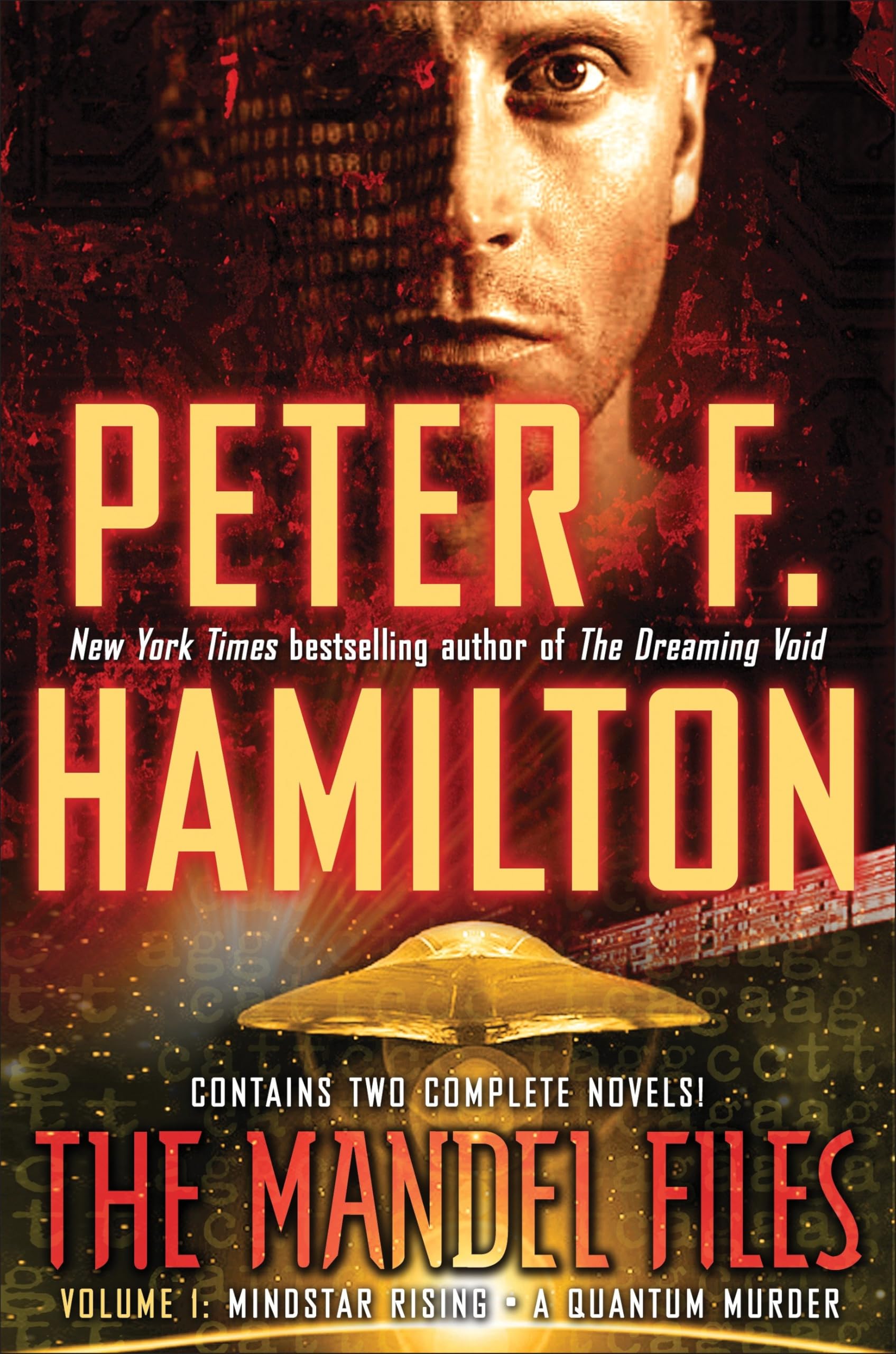
The Mandel Files, Volume 1: Mindstar Rising & A Quantum Murder (Greg Mandel Trilogy)
$18.94
by Peter F. Hamilton



For the first time in a single volume, Peter F. Hamilton’s acclaimed novels— Mindstar Rising and A Quantum Murder —set in a near-future so real it seems ripped from tomorrow’s headlines In Mindstar Rising, Greg Mandel, gifted—or cursed—with biotechnology that makes him a living lie detector, is hired to investigate corporate espionage by Event Horizon, a powerful company about to introduce a technology that will solve the energy problems of a world decimated by global warming. Set two years later, A Quantum Murder once again teams Mandel with Event Horizon and its beautiful young owner, Julia Evans, in a locked-room mystery that combines the ingenuity of an Agatha Christie novel with cutting-edge speculative brilliance. Read together, these novels take on fresh depth and complexity, underscoring the magnitude of Peter F. Hamilton’s creative talent. “Great fun . . . sort of a post-catastrophe techno-thriller.” —The San Diego Union-Tribune, on Mindstar Rising “Reads like a collaboration between William Gibson and Ian Fleming.” —Publishers Weekly, on Mindstar Rising “A taut, suspenseful story . . . full of surprises.” — Poul Anderson, on A Quantum Murder Peter F. Hamilton is the author of numerous novels, including A Night Without Stars, The Abyss Beyond Dreams, Great North Road, The Evolutionary Void, The Temporal Void, The Dreaming Void, Judas Unchained, Pandora’s Star, Misspent Youth, Fallen Dragon, and the acclaimed epic Night’s Dawn trilogy ( The Reality Dysfunction, The Neutronium Alchemist, and The Naked God ). He lives with his family in England. MINDSTAR RISING 1 Meteorites fell through the night sky like a gentle sleet of icefire, their sharp scintillations slashing ebony overload streaks across the image Greg Mandel’s photon amp was feeding into his optic nerves. He was hanging below a Westland ghost wing, five hundred metres above the Purser’s Hills, due west of Kettering. Spiralling down. Wind strummed the membrane, producing near-subliminal bass harmonics. Ground zero was a small crofter’s cottage; walls of badly laid raw stone swamped with some olive-green creeper, big scarlet flowers. It had a thatched roof, reeds rotting and congealing, caked in tidemark ripples of blue-green fungal growths. A two-metre-square solar-cell strip had been pinned on top. Greg landed a hundred metres downslope from the cottage, propeller spinning furiously to kill his forward speed. He stopped inside three metres. The Westland was one of the best military microlights ever built – lightweight, highly manoeuvrable, silent, with a low radar-visibility profile. Greg had flown them on fifteen missions in Turkey, and their reliability had been one hundred per cent. All British Army covert tactical squads had been equipped with them. He’d hate to use anything else. They’d gone out of production when the People’s Socialism Party came to power, twelve years previously. A victim of the demilitarization realignment programme, the Credit Crash, the Warming, nationalization, industrial collapse. This one was fifteen years old, and still functioned like a dream. A time display flashed in the bottom right corner of the photon amp image, spectral yellow digits: 21:17:08. Greg twisted the Westland’s retraction catch, and the translucent wing folded with a graceful rustle. He anchored it with a skewer harpoon. There’d be no danger of it blowing away now. The hills suffered frequent twister-gusts, and this was March, England’s rainy season: squalls abounded. Gabriel hadn’t cautioned him about the wing in her briefing: but Greg always followed routine, engrained by sergeant majors, and way too much experience. He studied the terrain, the amp image grey and blue, smoky. There were no surprises; the Earth-resource satellite pictures Royan had pirated for him were three months old, but nothing had changed. The area was isolated, grazing land, marginally viable. Nobody spent money on barns and roads up here. It was perfect for someone who wanted to drop out of sight, a nonentity wasteland. Greg heard a bell tinkling from the direction of the cottage, high-pitched and faint. He keyed the amp to infrared, and upped the magnification. A big rosy blob resolved into a goat with a broad collar dangling a bell below its neck. He began to walk towards the cottage. The meteorites had gone, sweeping away to the east. Not proper shooting stars after all, then. Some space station’s waste dump; or an old rocket stage, dragged down from its previously stable discard-orbit by Earth’s hot expanded atmosphere. “At twenty-one nineteen GMT the dog will start its run towards you,’ Gabriel had said when she briefed him. ‘You will see it first when it comes around the end of the wall on the left of the cottage.’ Greg looked at the wall; the ablative decay which ruled the rest of the croft had encroached here as well, reducing it to a low moss-covered ridge ringing a small muddy yard. A y