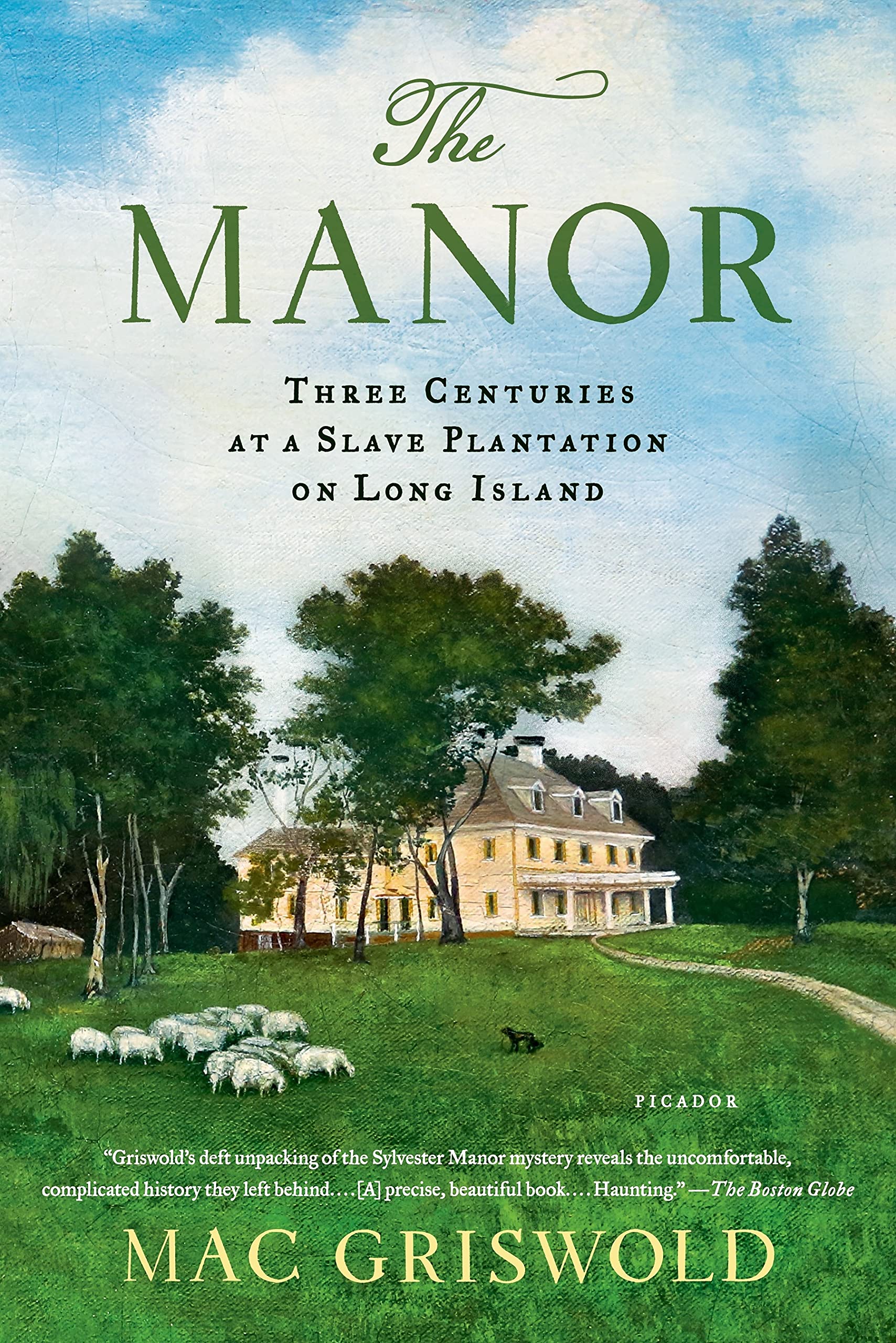



In 1984, the landscape historian Mac Griswold was rowing along a Long Island creek when she came upon Sylvester Manor, a stately mansion guarded by hulking boxwoods. When Griswold went inside, she encountered a house full of revelations, including a letter from Thomas Jefferson and―most remarkable and disturbing―what the aged owner, Andrew Fiske, casually called the "slave staircase." This staircase would reveal the extensive but little-known story of Northern slavery, and in 1997 Griswold returned with a team of archaeologists, uncovering a landscape filled with stories. Based on years of research―and voyages that took her as far as West Africa―Griswold has given us both the biography of a place that has witnessed war and reversals in fortune, and the riveting story of the family that has occupied it for three centuries. A fine-grained account and a sweeping drama, The Manor captures American history in all its richness and contradictions. “Griswold's deft unpacking of the Sylvester Manor mystery reveals the uncomfortable, complicated history they left behind....[A] precise, beautiful book...Haunting.” ― The Boston Globe “Extraordinary...This is an important book, for it is not just about a house. It is about the world and the destruction we have caused in it, all for the sake of making that place called home.” ― Jamaica Kincaid “History buffs will love The Manor , and it tells a story that needs to be told....[The house is] a remarkable relic of American history.” ― The Washington Post “Griswold skillfully weaves a historical tapestry of considerable complexity.” ― Women's Wear Daily “A lively history of early American settlement...Like that Pulitzer Prize-winning work [ The Hemingses of Monticello ], The Manor is American history tightly compressed.” ― The Atlantic Wire Mac Griswold is the author of The Manor: Three Centuries at a Slave Plantation on Long Island and Washington’s Gardens at Mount Vernon , and the coauthor, with Eleanor Weller, of The Golden Age of American Gardens . She has received a Guggenheim Fellowship and has written for The New York Times , The Wall Street Journal , and Travel + Leisure . She lives in Phoenixville, Pennsylvania. 1 T HE D ISCOVERY Boxwood It has taken us about twenty minutes to get into Gardiners Creek from a mooring in the town harbor of Shelter Island, set snugly between two peninsulas, the North and South Forks of Long Island, New York, whose tips stretch out to touch the western edge of the Atlantic Ocean, where the Gulf Stream runs close to the continent as it flows north and east toward Europe. The tide is full as we ease the dinghy through a big pipe that supports a bridge, a bridge so low to the water that we have to flatten ourselves on the thwarts to get through without banging our heads. The pipe acts as an echo chamber, even for a whisper. It is too narrow for us to use the oars, so we brace our hands on the curve of the low ceiling and push. A friend has brought me here to see “something,” but he won’t say what. It is a summer day in 1984. Finally out in the light, we see nothing but woods looming down to the water. Then, about a half mile off, at what seems to be the end of the inlet we have found our way into, phragmites and cattails fringe the shore. On our right are a few roofs, half hidden in the trees. On our left, toward the east, lies only a salt marsh where white egrets stalk in the long grasses. No houses. Not even a dock, a boat, or a mooring. Gulls wheel above a low hill covered with large trees: oak, hickory, walnut. Turning east means seeing land set back in time, so far back it looks as if it had never been inhabited. We blink, feeling tension rise between the modern world we’ve left behind so abruptly and the past we are rowing into. A mudbank lies ahead, lurking under shallow water, and we get stuck, briefly. It is only when we steer into the tide channel, stirring up silty brown clouds in the water as we pole ourselves with the oars, that we first see the big yellow house. From its hip roof and big brick chimneys to its well-proportioned bulk, the house quietly acknowledges its eighteenth-century origins. I’m in a time warp. As we cautiously approach, rowing as quietly as we can, hulking blackish-green boxwoods suddenly loom above the corner of a porch. Buxus sempervirens , or common box, these shrubs look to be an astounding twelve feet tall. Is this an illusion created by looking up from such a small boat? No, it isn’t. They’re gigantic. We’re used to seeing boxwoods as frilly edging around flower beds, or modest green bosses set to either side of a front door. Slow-growing boxwoods do well in this moderate climate, tempered by the surrounding waters of the Atlantic, but they seldom exceed eight feet north of the Mason-Dixon Line. As a landscape historian and a gardener, I feel that these linebacker giants must be very, very old. Boxwoods, one of the few shrubs that in optimum conditions can live for