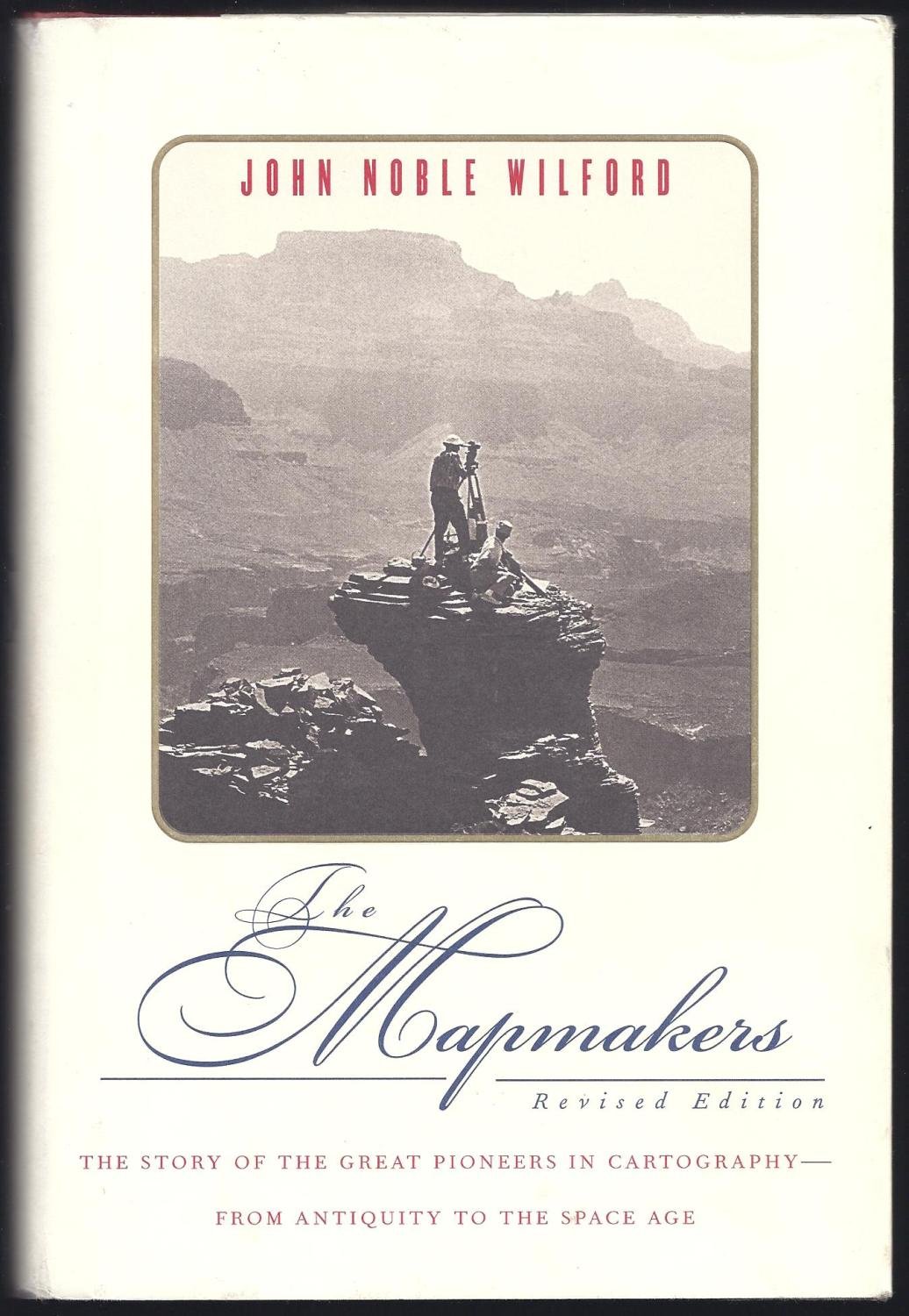



A revised edition of the classic history of cartography spans the period of time from when maps were first made on clay tablets, to the Space Age, when satellites map the universe, and examines the technical ingenuity by which mapmakers charted the surfce of the planet, Earth's interior and the ocean floors, and the moons and planets of the solar system. 15,000 first printing. The Greco-Egyptian emperor Ptolemy III made a shrewd hire when, in about 240 B.C., he appointed a bookworm and poet named Eratosthenes to be the librarian of the great Alexandrian Museum. Eratosthenes, derided by his envious colleagues as a second-stringer, nursed an insatiable curiosity about the natural world. Acting on hunches and sailors' reports, he decided to conduct an experiment to measure the earth's circumference, which he eventually reckoned to be 46,000 kilometers--a little far off the actual mark of 40,000 kilometers but close enough that both Eratosthenes and Ptolemy entered history as founding fathers of the modern science of cartography. In this vigorous history of maps and their creators, New York Times science writer John Noble Wilford recounts the accomplishments of dozens of cartographers from many cultures and times, among them Gerardus Mercator, Francis Beaufort, Charles Mason, and Jean Fernel. Ranging from ancient Chinese scrolls to the latest satellite images of distant planets, he renders a history full of "heroics and everyday routine, of personal and national rivalries, of influential mistakes and brilliant insights." He also reviews key scientific and technological advances that have accompanied the rise of modern maps, among them the development of fractal geometry, geosynchronous displays, remote sensing, and ever more accurate surveying instruments and techniques. --Gregory McNamee Preface Who has not spread out a map on the table and felt its promise of places to go and things to see and do? Ah, so that's Zanzibar, a real place, as real as Dar es Salaam across this stretch of blue or Timbuktu up there in the emptiness of the Sahara. Let's see, we could cross at Dunkerque, here (so this is where it happened, the glorious retreat), and be in London, there, first thing the next morning. Now, here's the plan: we sail from Philipsburg, here, out across the Anegada Passage and put in at Road Town, over here on Tortola. Look at these names, will you -- Oodnadatta, Ilbunga, Rumbalara, Bundooma, Rodinga, Alice Springs -- you can almost see the lonely cattle stations, the dingoes and kangaroos, the dusty ringers drinking beer at some forlorn pub known as the Southern Cross. And look at this speck of land, Bouvet Island, several thousand kilometers from the tip of South Africa, where no one lives and few people have ever set foot; yet here it is on the map, inviting dreams, speculations, perhaps exploration. Joseph Conrad understood this feeling. In Heart of Darkness, Conrad has Marlow saying: "Now when I was a little chap I had a passion for maps. I would look for hours at South America, or Africa, or Australia, and lose myself in all the glories of exploration. At that time there were many blank spaces on the earth, and when I saw one that looked particularly inviting on a map (but they all look that) I would put my finger on it and say, 'When I grow up I will go there.' " Who does not have etched in the mind images of countries and of the world based on maps? Until recent times, indeed, the world was more familiar to us as a map than in reality. As he approached the end of his flight in Earth orbit in 1962, John H. Glenn remarked: "I can see the whole state of Florida just laid out like on a map." A number of astronauts, and then all of us who saw the photography from space, marveled at how much the Florida peninsula, the meandering Mississippi, the islands of Britain, the boot of Italy, or any of the geographical shapes resembled the maps everyone had grown up with. We had taken it for granted that maps were faithful reflections of reality; yet we were somehow amazed when reality turned out to be true to the maps. This reaction is an unspoken tribute to the mapmakers, past and present. Speak of any beckoning new land, and there have always been people setting forth, the Lewises and Clarks and the Frémonts, to map and incorporate the new world into the mind of the old. Speak of the remaining unknowns, and there are the ships setting out to take a seismic or sonic measure of the ocean floor and thereby map it, or the spaceships embarking to map the Moon, Venus, Mars, and the satellites of Jupiter. Speak of anything spatial, and there was, is, or will be a mapmaker seeking to make it more understandable through a mosaic of points, symbols, lines, shadings, and coloring -- that is, through a map. But who are these people who make the maps that touch the little chap in us all? How did the art and science of mapmaking evolve? Who were the important pioneers in developing the map as one of the most useful f