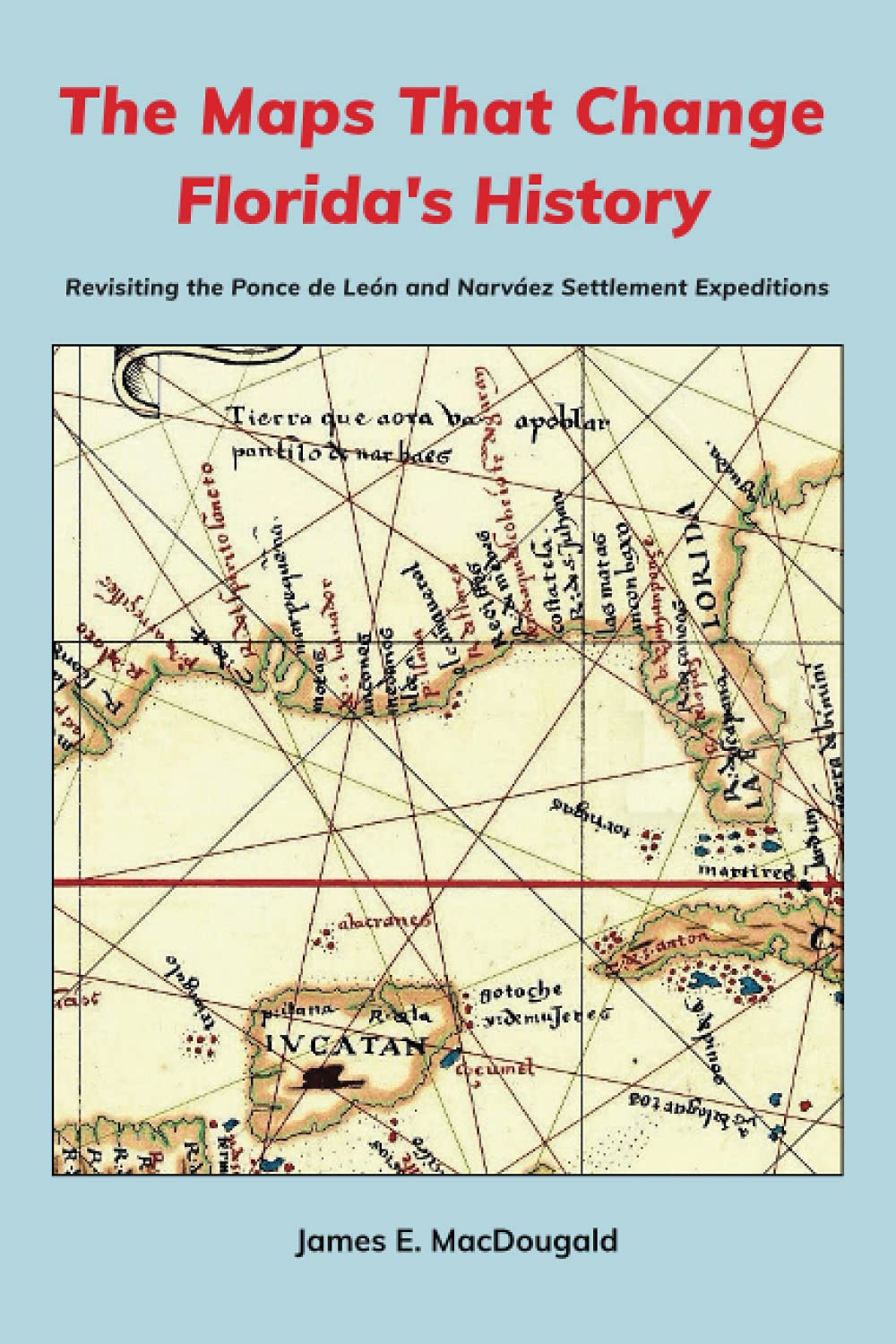
The Maps That Change Florida's History: Revisiting the Ponce de León and Narváez Settlement Expeditions
$27.95
by James MacDougald



The First European Colony in the United States Juan Ponce de León, the discoverer and first governor of La Florida, established the first European colony in the United States on the west coast of Florida in 1521. Although its location has never been determined, historians have theorized that it likely occurred somewhere in the Charlotte Harbor area. The settlement is believed to have lasted only three to four months. It was abandoned when conflict with the local Indians resulted in Juan Ponce being mortally wounded. The survivors took him to Cuba where he died of his wounds. In 1528, seven years after the Ponce de León settlement had been abandoned, Pánfilo de Narváez landed just north of the entrance to Tampa Bay with an expedition of 400 men and 10 women. On one of their first inland expeditions they encountered the Tocobaga Indians at their main village in today’s Safety Harbor, where they found many cargo boxes and European artifacts that may have been remnants of the Ponce de León settlement. The inland exploration by Narváez and three hundred of his men, seeking a non-existent large bay to their north, resulted in the deaths of all but four, who became the first to explore inland North America, finally reaching the Pacific eight years later. Rare and seldom-seen Spanish maps produced by the royal mapmakers in Seville in 1527 show the location and latitude for the Bay of Juan Ponce. MacDougald produces compelling evidence that Narváez was seeking the Bay of Juan Ponce, and that the first European colony established in the United States occurred in Tampa Bay, likely in the area known today as Safety Harbor in Old Tampa Bay, the site of the Tocobaga village visited by Narváez. MacDougald demonstrates that the harbor the Spanish called the Bahia de Juan Ponce is certainly Tampa Bay. Why is that important? It equates Juan Ponce de León with Tampa Bay. MacDougald's recognition that the Bay of Juan Ponce is Tampa Bay suggests that rather than Charlotte Harbor being the location of Ponce's 1521 attempted settlement it was instead Tampa Bay. I am especially intrigued by the suggestion that Ponce de León's 1521 attempted settlement on Florida's Gulf coast was on Old Tampa Bay among the Tocobaga Indians, exactly where Narváez found himself seven years later. - Jerald T. Milanich, Ph.D., Curator Emeritus of Archaeology, Florida Museum of Natural History at the University of Florida Author of Florida Indians and the Invasion from Europe . MacDougald presents the results of his meticulous, well-documented research and analysis in The Maps That Change Florida's History . He tells how the toponym "Bay of Juan Ponce" at what is today named "Tampa Bay" prompted him to examine large-scale detailed official maps of the period for evidence that Ponce's 1521 settlement attempt took place on its shores. The author also carefully revisits Cabeza de Vaca's Relación for an eyewitness account from 1528 when members of the Pánfilo de Narváez expedition came upon shipping boxes and a few items from Castile on the shores of Old Tampa Bay and posits these as remainders of Ponce's hasty retreat in 1521. Throughout, MacDougald combines his familiarity with the area, his extensive sailing experience, and his findings to provide a cohesive and persuasive argument for locating Ponce's 1521 settlement on the shores of Old Tampa Bay. A real contribution to the study of early Spanish expeditions to Florida and a "must-read" for anyone interested in the field. - Martin A. Favata, Professor Emeritus, University of Tampa Co-author of The Account: Álvar Núñez Cabeza de Vaca's Relación As we approach the quincentennial of Juan Ponce de Leon's attempt to establish the first Spanish settlement in Florida, MacDougald presents new insight and documentation regarding the settlement's location. Charlotte Harbor in Southwest Florida has long been thought to be the settlement's most likely site. Combining his personal knowledge of the Gulf waterways and nautical navigation skills, penetrating reexamination of the historical record, and rediscovery of an historic map, MacDougald builds a strong case for location of this first settlement endeavor on Tampa Bay. The Maps That Change Florida's History represents an important new contribution to our understanding of the Spanish Entrada in Florida. - Will Michaels, Ph.D., Retired Director of the St. Petersburg Museum of History Author of The Making of St. Petersburg. James MacDougald is a Florida researcher and historian. His years of study of the early Spanish exploration of the west coast of Florida led to the 2018 publication of The Pánfilo de Narváez Expedition of 1528 . Questions lingering after the publication of his book let to additional research and the publication of The Maps That Change Florida's History in 2021, and For God, Glory, and Gold in 2024. MacDougald has followed his avocation of historical research since retiring as president of ABR Information Services,