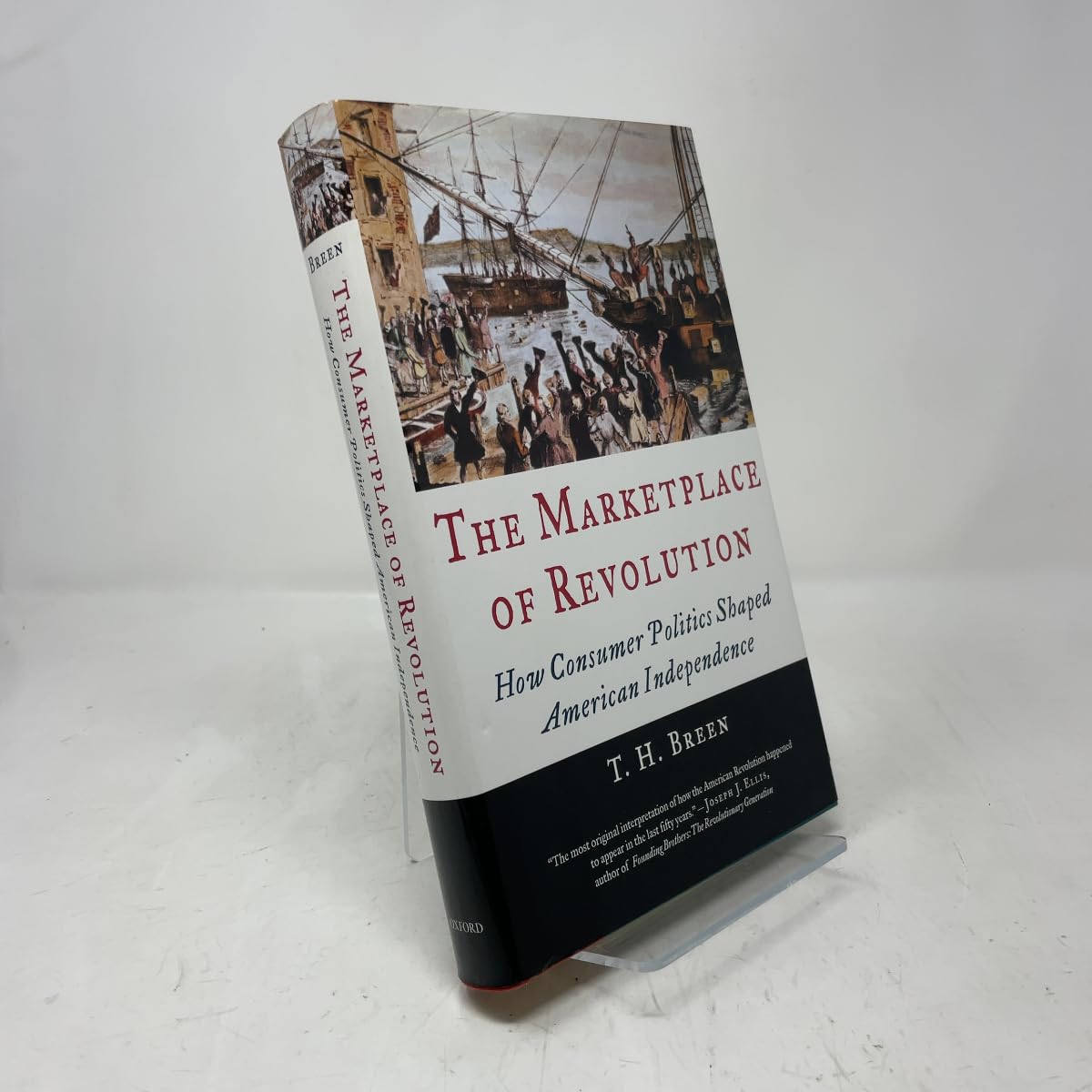
The Marketplace of Revolution: How Consumer Politics Shaped American Independence
$42.19
by T. H. Breen



The Marketplace of Revolution offers a boldly innovative interpretation of the mobilization of ordinary Americans on the eve of independence. Breen explores how colonists who came from very different ethnic and religious backgrounds managed to overcome difference and create a common cause capable of galvanizing resistance. In a richly interdisciplinary narrative that weaves insights into a changing material culture with analysis of popular political protests, Breen shows how virtual strangers managed to communicate a sense of trust that effectively united men and women long before they had established a nation of their own. The Marketplace of Revolution argues that the colonists' shared experience as consumers in a new imperial economy afforded them the cultural resources that they needed to develop a radical strategy of political protest--the consumer boycott. Never before had a mass political movement organized itself around disruption of the marketplace. As Breen demonstrates, often through anecdotes about obscure Americans, communal rituals of shared sacrifice provided an effective means to educate and energize a dispersed populace. The boycott movement--the signature of American resistance--invited colonists traditionally excluded from formal political processes to voice their opinions about liberty and rights within a revolutionary marketplace, an open, raucous public forum that defined itself around subscription lists passed door-to-door, voluntary associations, street protests, destruction of imported British goods, and incendiary newspaper exchanges. Within these exchanges was born a new form of politics in which ordinary man and women--precisely the people most often overlooked in traditional accounts of revolution--experienced an exhilarating surge of empowerment. Breen recreates an "empire of goods" that transformed everyday life during the mid-eighteenth century. Imported manufactured items flooded into the homes of colonists from New Hampshire to Georgia. The Marketplace of Revolution explains how at a moment of political crisis Americans gave political meaning to the pursuit of happiness and learned how to make goods speak to power. What was the role of "ordinary" people in preparing the path to independence between 1763 and 1775? In examining the role of the masses, in what was truly a mass movement, some historians have focused on groups with a penchant for dramatic, even violent action, such as the Sons of Liberty. History professor Breen has chosen to emphasize the less spectacular but probably more important role of common economic action. Despite the vast cultural and economic differences between the colonial regions, most colonists were participants in an emerging consumer society based upon use of British manufactured goods. This was, in essence, an open market, in which goods, services, and ideas flowed freely. American participation in this imperial market created economic and even emotional bonds between colonists that transcended regional and religious differences. So when the time for resistance arrived, these bonds provided a network for communication and organized protest, including the startlingly effective use of boycotts of goods produced in Britain. This interesting work offers an original perspective and some provocative conclusions. Jay Freeman Copyright © American Library Association. All rights reserved "With his new book T.H. Breen, who is one of the most imaginative and productive of early American historians, has carried scholarly interest in consumption in the eighteenth century to a new level.... By the time he is halfway or so through his book, Breen has succeeded admirably in proving the widespread availability of imported British consumer goods in the eighteenth-century colonies. This part of the book is a model of careful historical reconstruction. No one has ever demonstrated as fully and as exhaustively the nature and extent of American buying in the eighteenth century."--Gordon S. Wood, The New York Review of Books "The most original interpretation of how the American Revolution happened to appear in print in the last fifty years."--Joseph J. Ellis, author of Founding Brothers: The Revolutionary Generation "The author of this profoundly important book achieves what most historians only dream of. He propels forward to a new stage of understanding a subject--the origins of the American Revolution--that is large, complex and vexed by controversy."-- Publishers Weekly (starred review) "A powerfully argued book. Not only does it offer a detailed account of the workings of the eighteenth-century Atlantic economy--tracing the movement of an increasing variety of manufactured goods from Great Britain into the hands of an ever growing number of colonial consumers--but it also contains an imaginative interpretation of the origins of the American Revolution, transforming the Americans' extraordinary consumer power into political power."--Gordon S. Wood,