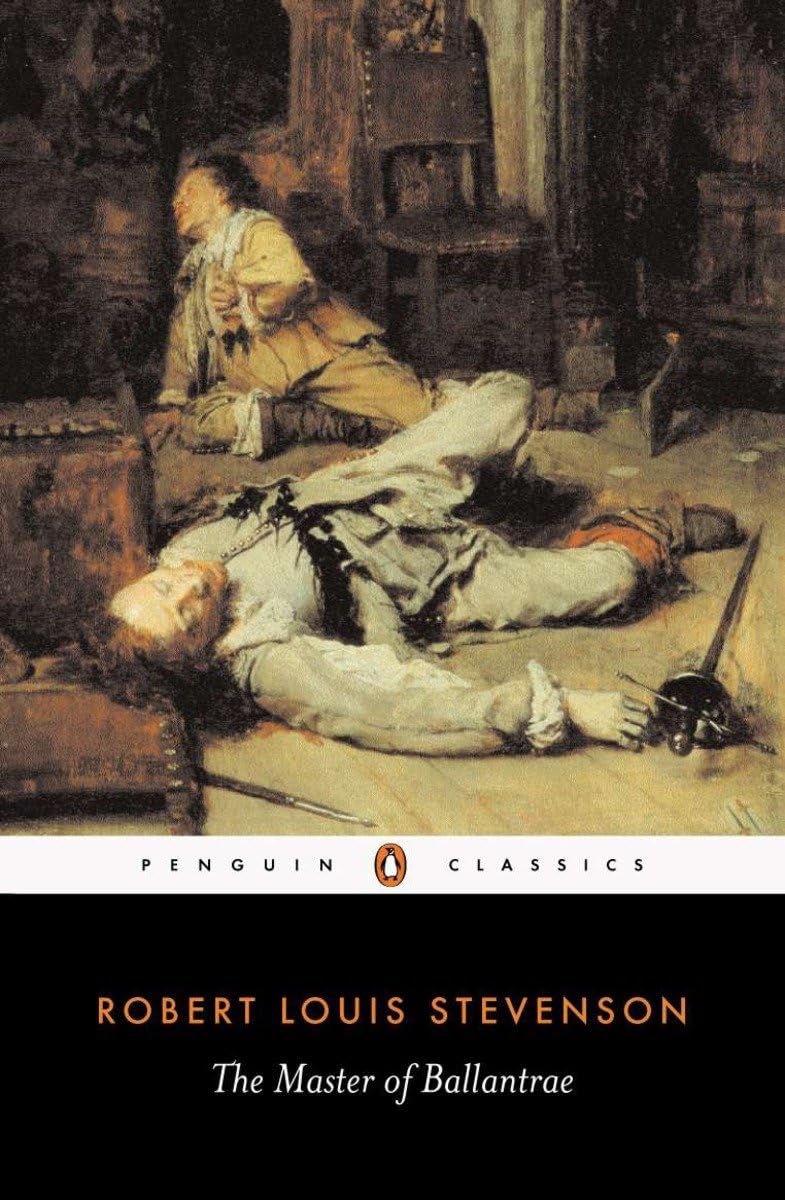
The Master of Ballantrae: A Winter's Tale (Penguin Classics)
$15.00
by Robert Louis Stevenson



Set at the time of the Jacobite uprising, The Master of Ballantrae tells of a family divided. James Durie, Master of Ballantrae, abandons his ancestral home to support the Scottish rebellion—leaving his younger brother Henry, who is faithful to the English crown, to inherit the title of Lord Durrisdeer. But he is to return years later, embittered by battles and a savage life of piracy on the high seas, to demand his inheritance. Turning the people against the Lord, he begins a savage feud with his brother that will lead the pair from the Scottish Highlands to the American Wilderness. Satanic and seductive, the Master was regarded by Stevenson as "all I know of the devil"; his darkly manipulative schemes dominate this subtle and compelling tragedy. This edition takes as its text the Edinburgh Edition of the novel, the last approved by the author. The introduction considers the novel's inspiration and its place as one of Stevenson's greatest studies in cruelty. For more than seventy years, Penguin has been the leading publisher of classic literature in the English-speaking world. With more than 1,700 titles, Penguin Classics represents a global bookshelf of the best works throughout history and across genres and disciplines. Readers trust the series to provide authoritative texts enhanced by introductions and notes by distinguished scholars and contemporary authors, as well as up-to-date translations by award-winning translators. “If a strong story, strongly told, full of human interest, and absolutely original in its situations, makes a masterpiece, then this may lay claim to the title.”— Arthur Conan Doyle Robert Louis Stevenson was born in Edinburgh in 1850. He is well known for his novels of historical adventure, including Treasure Island (1883), Kidnapped (1886), and Catriona (1893). Preface Although an old, consistent exile, the editor of the following pages revisits now and again the city of which he exults to be a native; and there are few things more strange, more painful, or more salutary, than such revisitations. Outside, in foreign spots, he comes by surprise and awakens more attention than he had expected; in his own city, the relation is reversed, and he stands amazed to be so little recollected. Elsewhere he is refreshed to see attractive faces, to remark possible friends; there he scouts the long streets, with a pang at heart, for the faces and friends that are no more. Elsewhere he is delighted with the presence of what is new, there tormented by the absence of what is old. Elsewhere he is content to be his present self; there he is smitten with an equal regret for what he once was and for what he once hoped to be. He was feeling all this dimly, as he drove from the station, on his last visit; he was feeling it still as he alighted at the door of his friend Mr. Johnstone Thomson, W.S., with whom he was to stay. A hearty welcome, a face not altogether changed, a few words that sounded of old days, a laugh provoked and shared, a glimpse in passing of the snowy cloth and bright decanters and the Piranesis on the dining-room wall, brought him to his bed-room with a somewhat lightened cheer, and when he and Mr. Thomson sat down a few minutes later, cheek by jowl, and pledged the past in a preliminary bumper, he was already almost consoled, he had already almost forgiven himself his two unpardonable errors, that he should ever have left his native city, or ever returned to it. “I have something quite in your way,” said Mr. Thomson. “I wished to do honour to your arrival; because, my dear fellow, it is my own youth that comes back along with you; in a very tattered and withered state, to be sure, but—well!—all that’s left of it.” “A great deal better than nothing,” said the editor. “But what is this which is quite in my way?” “I was coming to that,” said Mr. Thomson: “Fate has put it in my power to honour your arrival with something really original by way of dessert. A mystery.” “A mystery?” I repeated. “Yes,” said his friend, “a mystery. It may prove to be nothing, and it may prove to be a great deal. But in the meanwhile it is truly mysterious, no eye having looked on it for near a hundred years; it is highly genteel, for it treats of a titled family; and it ought to be melodramatic, for (according to the superscription) it is concerned with death.” “I think I rarely heard a more obscure or a more promising annunciation,” the other remarked. “But what is It?” “You remember my predecessor’s, old Peter M‘Brair’s business?” “I remember him acutely; he could not look at me without a pang of reprobation, and he could not feel the pang without betraying it. He was to me a man of a great historical interest, but the interest was not returned.” “Ah well, we go beyond him,” said Mr. Thomson. “I daresay old Peter knew as little about this as I do. You see, I succeeded to a prodigious accumulation of old law-papers and old tin boxes, some of them of Peter’s hoarding, some of his father