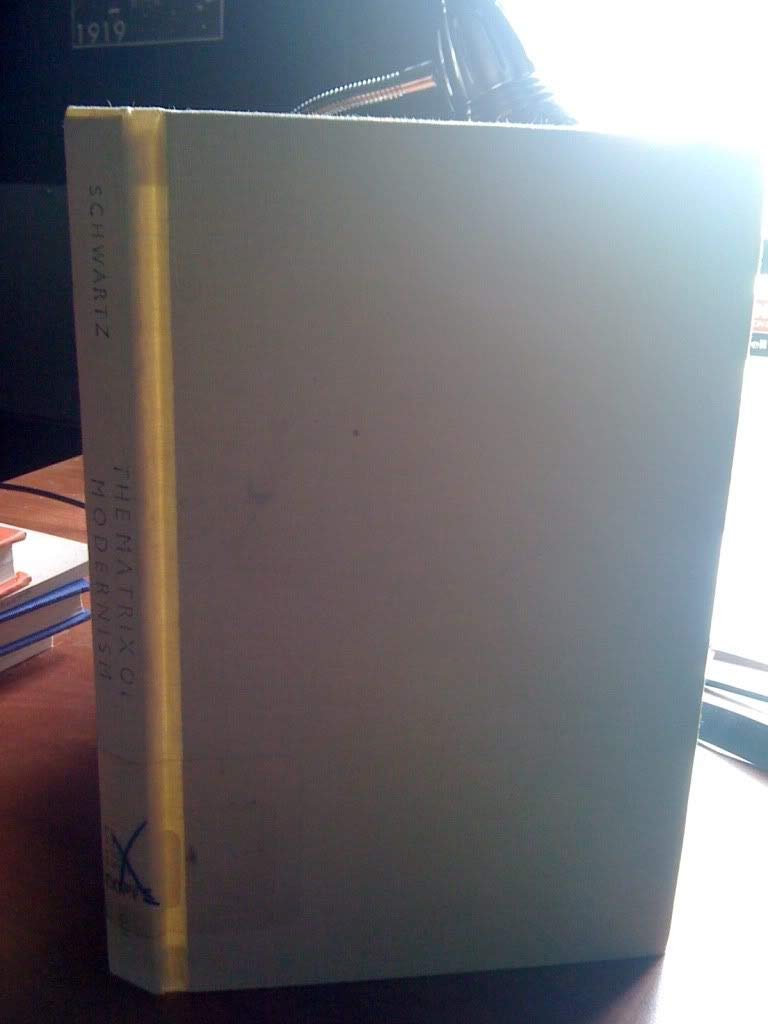
The Matrix of Modernism: Pound, Eliot, and Early Twentieth-Century Thought
$37.00
by Sanford Schwartz



Sanford Schwartz situates Modernist poetics in the intellectual ferment of the early twentieth century, which witnessed major developments in philosophy, science, and the arts. Beginning with the works of various philosophers--Bergson, James, Bradley, Nietzsche, and Husserl, among others--he establishes a matrix that brings together not only the principal characteristics of Modernist/New Critical poetics but also the affiliations between the Continental and the Anglo-American critical traditions. Originally published in 1985. The Princeton Legacy Library uses the latest print-on-demand technology to again make available previously out-of-print books from the distinguished backlist of Princeton University Press. These editions preserve the original texts of these important books while presenting them in durable paperback and hardcover editions. The goal of the Princeton Legacy Library is to vastly increase access to the rich scholarly heritage found in the thousands of books published by Princeton University Press since its founding in 1905. "Schwartz explores several oppositions that underlie the thinking of the early modernists, and uses them as a frame for original analysis of individual essays and poems. The result is that many cliches of early literary modernism--Pound's ideogrammic method, Eliot's objective correlative--are refreshed by being placed in a larger context. One of this book's great virtues is that it uncovers the philosophical assumptions behind the new poetry without turning the poetry into philosophy." ― A. Walton Litz, Times Literary Supplement "This book makes a strong case for a radical revision of current views of the philosophy of modernism and also of the relation of that philosophy to the post-phenomenological fashions of the present time. . . . I am very impressed." ―Frank Kermode "This book makes a strong case for a radical revision of current views of the philosophy of modernism and also of the relation of that philosophy to the post-phenomenological fashions of the present time. . . . I am very impressed." --Frank Kermode The Matrix of Modernism Pound, Eliot, and Early Twentieth-Century Thought By Sanford Schwartz PRINCETON UNIVERSITY PRESS Copyright © 1985 Princeton University Press All rights reserved. ISBN: 978-0-691-06651-6 Contents ACKNOWLEDGMENTS, ix, INTRODUCTION, 3, CHAPTER I "This Invented World": Abstraction and Experience at the Turn of the Century, 12, CHAPTER II Elements of the New Poetics, 50, CHAPTER III Ezra Pound: Cultural Memory and the Visionary Imagination, 114, CHAPTER IV Incarnate Words: Eliot's Early Career, 155, CONCLUSION The New Criticism and Beyond, 209, NOTES, 216, INDEX, 225, CHAPTER 1 "This Invented World": Abstraction and Experience at the Turn of the Century Knowledge as Representation At the turn of the century, many philosophers believed that they were forging a fundamentally new theory of knowledge. Announcing a major "inversion of Platonism" in Western philosophy, they claimed that reality lies in the immediate flux of sensory appearances and not in a rational order beyond it. Our conceptual systems, they argued, are not copies of eternal forms underlying the sensory flux; they are instrumental constructs that overlie an experiential stream irreducible to rational formulation. Despite the extraordinary progress of natural science in this era, philosophers (as well as certain scientists) denied that our knowledge reflects the essential structure of the external world. Indeed, the shifting attitude toward science — once the preserve of incontrovertible fact — provided the most conspicuous sign that a major change was taking place. The new attitude toward science was a sharp break with that of the previous generation. During the third quarter of the nineteenth century, scientists believed that they would soon possess an exhaustive description of the physical universe. Building on the secure principles of Newtonian mechanics, physicists could rightfully boast of the spectacular advances they had made in thermodynamics, atomic chemistry, and electromagnetism in a single generation. Perhaps the supreme achievement was James Clerk Maxwell's field theory, which brought electricity, magnetism, and light into a unified framework and dramatized the remarkable power of modern physics to integrate an expanding range of natural phenomena. Most scientists believed that only a few minor problems blocked the way toward a definitive account of the physical world. Only a handful challenged the assumption that the laws of mechanics would eventually explain all physical processes. The very success of the natural sciences, however, raised questions about the certainty of scientific knowledge. Well before relativity and quantum mechanics undermined the foundations of classical physics, philosophers and scientists were beginning to doubt that there is a one-to-one correspondence between scientific formulation and the ex