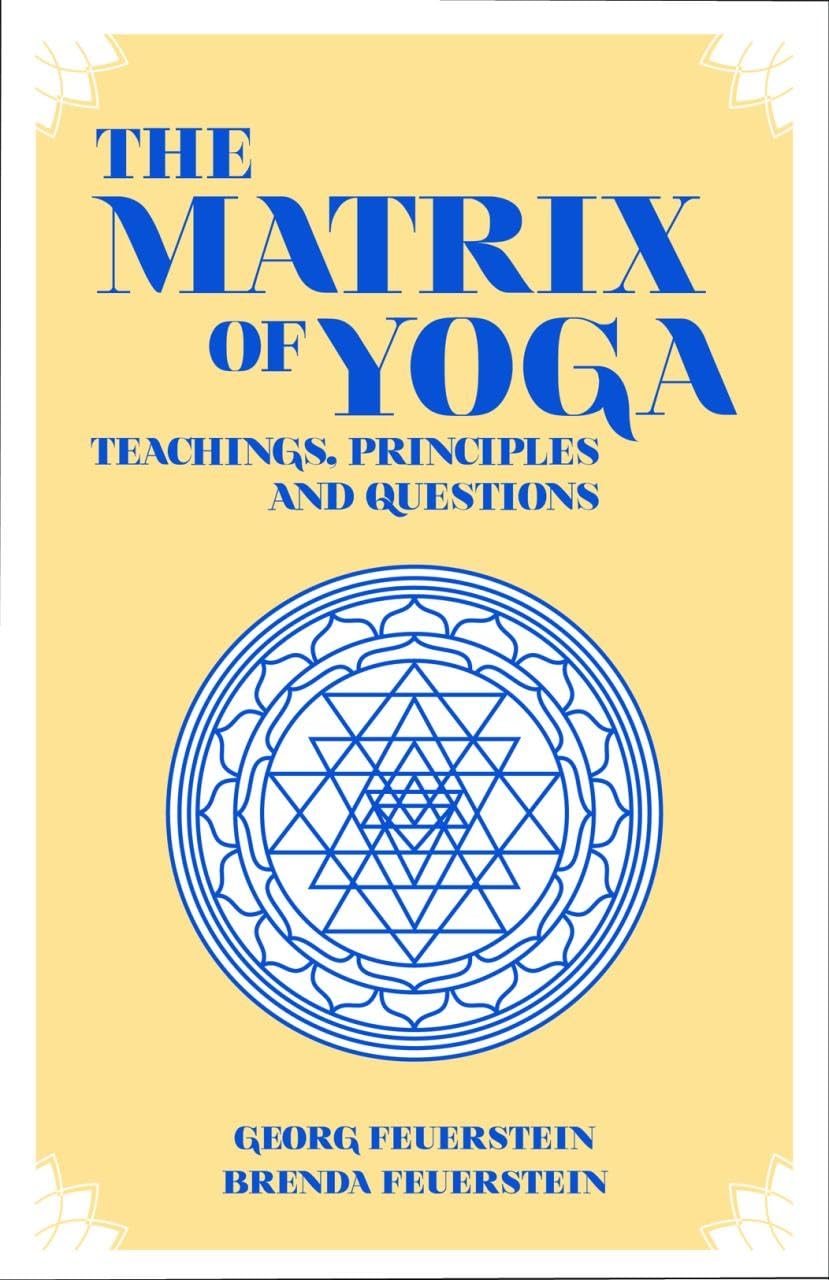



This book offers novice Yoga practitioners a solid foundation on which to begin or build their personal practice. Written by two highly-respected Yoga teachers and scholars in the West–Georg Feuerstein and his wife Brenda Feuerstein–the book will also augment Yoga teacher trainings, and provide current Yoga teachers with an invaluable text to use with or recommend to their new students. Yoga stands for spiritual discipline, as it was developed in India over thousands of years. This is the focus and purpose of The Matrix of Yoga: to provide as simple an introduction to the authentic teachings of Yoga as possible. While Yoga traditionally included physical postures, this was just one aspect of practice. Mental discipline was counted as far more important. Above all, Yoga was wrapped into an overall spiritual framework. Every single discipline had the purpose of helping the practitioner to grow toward inner (or spiritual) freedom. This reader-friendly handbook is divided into two sections. In Part 1 the authors establish the substructure of Yoga, with short essays that cover basic principles: the meaning of Yoga, the practice, the types, the deeper commitment and levels. They go on to explain practical applications of Yogic philosophy to all aspects of life, including: diet, working with the mind, livelihood, and the transcendence of ego. In Part 2, presented in a unique question and answer format, they address 30 of the most important and widely-asked questions by newcomers to this path. Their straightforward and highly-authoritative responses will give any practitioner a more direct understanding of the issues involved in adopting Yoga as a practice, a lifestyle, a spiritual philosophy. Rather than requiring research through numerous and complicated texts to find answers, newcomers will appreciate having wise elders to guide them along the way. Some of the relevant issues include: Can one be a Christian and still practice Yoga? Does Yoga require the need for a guru, and if so how to find one? Is the market appeal of Yoga today an asset or a detriment to the serious practitioner? Without denying that modern practitioners of the physical postures of Yoga are significantly helped by them, the Feuersteins emphasize the "so much more!" The core power of Yoga–which is in its spiritual and ethical wisdom–remains untapped in so many contemporary approaches. This book seeks to address that lack. Georg Feuerstein, Ph.D. (1947-2012), was one of the leading voices in East-West dialogue since the 1960s and one of the foremost writers and teachers on the topics of Yoga and Indian philosophy. He has authored over 50 books, distance learning courses, and a hugely successful Yoga Philosophy Teacher Training Manual. He founded the educational foundation Traditional Yogi Studies to promote the tradition of Yoga based in solid scholarship, and scriptural and oral transmission. Brenda Feuerstein, Georg's wife, studied Yoga, meditation, Buddhism and Sanskrit, and now serves as the educational and spiritual director of Traditional Yoga Studies, founded by Georg. She is a tutor and mentor for Yoga courses, and also conducts Yoga classes, workshops, retreats and trainings worldwide. She coauthored Green Yoga and Green Dharma with Georg Feuerstein and contributed to his book entitled The Bhagavad-Gita: A New Translation. She is the author of The Yoga-Sutra from a Woman's Perspective. Yoga evolved on the Indian subcontinent over the course of several millennia. Its physical exercises continue to be developed today, partly in response to the physical limitations and also the mental challenges (notably the lack of concentration) of modern people. The difference between now and then is this: In the past, Yoga was developed by accomplished masters, who had a spiritual interest first and foremost. Today, imaginative Yoga instructors invent physical postures and styles that they think will benefit or excite their students. It is fair to say that by no means all of these new-fangled approaches would have passed the critical eye and wisdom of a master from long ago. What, one wonders, would they have made of Hiphop Yoga, Disco Yoga, Nude Yoga, Nude Hot Yoga, Ganja (Marijuana) Yoga, and so on? Our brains reel. Since we will use the word spiritual often in this book, let us explain what we mean by it up front. Spiritual suggests a quality that relates to the luminous core of our being, however you may understand it or whatever you may call it. That core goes beyond language and the mind. Yet, it is not religious as commonly understood. Yoga as a whole also ought not to be equated with religion. It developed by trial and error on the part of thousands of practitioners. Its goal is inner freedom–which is freedom from the compulsions of our limited personality; above all, freedom from the habit of self-centeredness. Yoga wants us to become as transparent as glass, or as clear as a mountain lake on a windless day, so that we can be prese