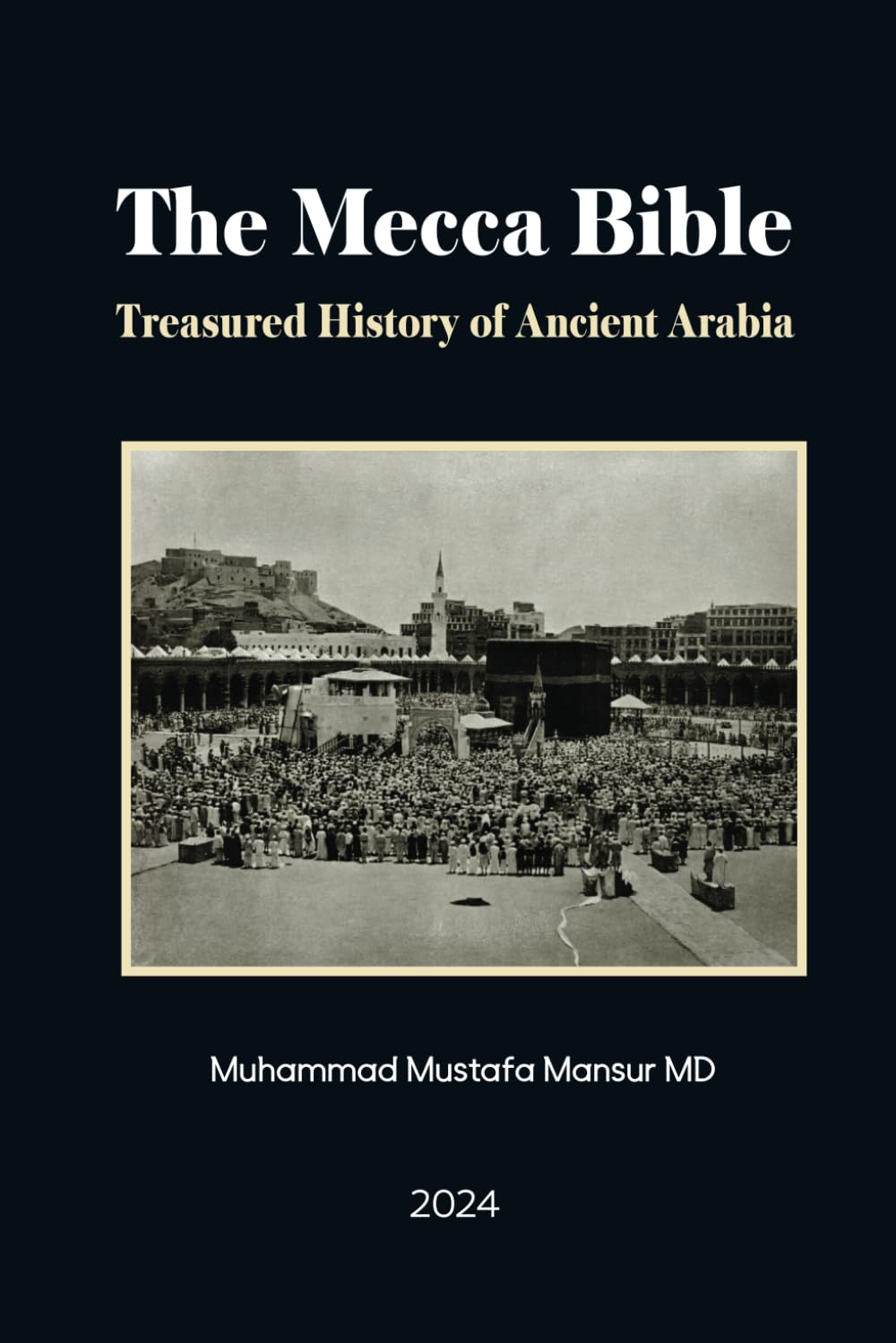



The Mecca Bible The Mecca Bible book is the culmination of 38 years of research, yielding the following major findings: The Holy Land promised to Abraham was not Palestine but the Mecca region of Arabia. - The Israelites were originally from ancient western Arabia, with a significant population still present during the emergence of Islam, forming an important part of Saudi Arabia's population today. - The original Old Testament was written in the old Arabic of the 2nd millennium BCE. According to this research, the Garden of Eden was situated in the lush green mountains of western Arabia during the Savannah period following the last Ice Age. The four rivers mentioned in the old Testament are identified as four valleys in this region. Noah's clan resided near Tayif to the North. The Ark of Noah is said to have landed in the mountain area of Al- Arid in East Arabia, leading to the repopulation of Arabia after the Deluge. The homeland of the first Semitic clan, the Ghubarah/Hebrews was the Riyadh region, from where Abraham's clan migrated to the Dawasir valley, and then he himself and Lot to the Mecca region. Two distinct eras emerge from this research: A-The Israelite Era: Jacob and his children left for Mizraim (modern-day Ethiopia) from Idhim, 170 km south of Mecca. The Exodus under Moses is said tp have occurred from Axum, with the Red Sea crossing at Bab el Mandeb, leading to a 40-year wandering in the Tihama region of Al-Qunfuda in Saudi Arabia. Joshua is credited with leading the conquest of the Holy Land of Mecca, and King David established a kingdom with Jerusalem/U'ra es-Salam/Mecca as its capital. King Solomon is believed to have built the Temple to encompass the Kaaba in the location of the holy mosque of Mecca. Following Solomon, the kingdom was divided, with Samaria/A'sfan in the north, and U'ra es-Salam/Mecca in the south falling to the Assyrians and Chaldeans, respectively. B-Jewish Era: After Babylon fell to Cyrus the Great, the Israelites gradually returned to U'ra es-Salam/Mecca, albeit facing opposition from surrounding tribes. The Achaemenid Empire guaranteed religious freedom to its subjects. Alexander the Great's conquest in 332 BCE did not extend to Arabia, allowing Arabs to regain their independence. Believers faced pressure from heathen Arab tribes, leading to a choice between abandoning their monotheistic beliefs or leaving. While the majority integrated with local beliefs, a minority moved to Greek-dominated lands. In Alexandria, the Hebrew Old Testament was translated to Greek, and Hashemite Meccans (Hasmonean Maccabees in Greek) led Jews in Palestine. Under pro-Greek influence, the community started to disconnect from western Arabia. Scriptures were translated from Greek to Aramaic, defining Canaan as Palestine, Aram as Syria, and Mizraim as Egypt. The gentile Edomites/Adnanites emigrated from Arabia, and were favored by Romans for their lack of allegiance to the Greeks. King Herod modernized the Temple in the Palestinian Neo Jerusalem, which existed during Jesus Christ's time and was destroyed by the Romans in AD 70. The 2nd century witnessed the deportation of Jews from Palestine. In Palestine, liturgy was conducted in Aramaic, with Hebrew largely forgotten. In the 5th century AD, efforts to read square Aramaic texts began in Galilee and Babylonia, which were previously copied from old Aramaic script texts commissioned by Ezra. This research posits that the texts must be reread in the full 28-letter Semitic format and in the context of their place of origin, ancient western Arabia. When interpreted as such, geographic and historical contradictions can be resolved. Recent Y-DNA genetic studies support these findings, with high compatibility found between the Y-DNA of the Cohen family, the royalty members from Jordan and Morocco, and the Shareefs of Mecca.