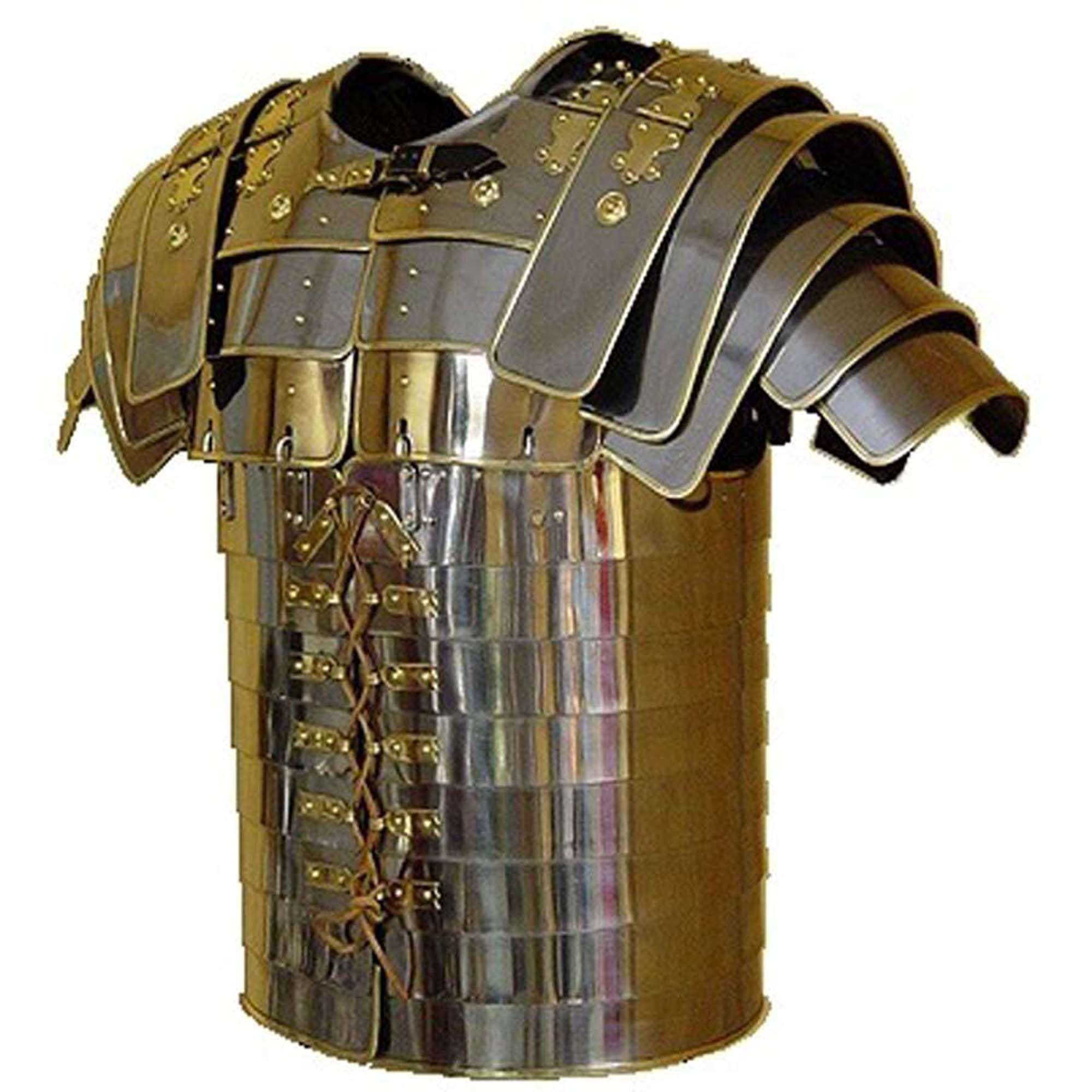
The Medievals Brass Trimmed Roman Lorica Segmentata Plate Armor Breastplate 18g Steel Reenactment Roman Body Armour Wearable Costume with Free Roman
$209.00
by THE MEDIEVALS



Lorica segmentata, body armor, roman armor ,lorica, plate armor reenactment, lorica lamminata, 4th century BC , Manica, gladiators, 18G mild steel plate joint through leather strip and brass hinges , steel plate edge covered with brass beeding best fit for chest size 38 inches to 54 inches , adjust through leather strips place below arm pit Roman Lorica Segmentata Armor Brass Trimmed steel polished The plates in the lorica segmentata armor were made by overlapping ferrous plates that were then riveted to straps made from leather. It is unknown what animal was used to make the leather and if it was tanned or tawed. The plates were made of soft iron on the inside and rolled mild steel on the outside. This made the plates hardened against damage without making them brittle. This case hardening was done by packing organic matter tightly around them and heating them in a forge, transferring carbon from the burnt materials into the surface of the metal.The plates were made from beating out ingots. The strips were arranged horizontally on the body, overlapping downwards, and they surrounded the torso in two halves, being fastened at the front and back. Additional strips, shoulder guards, breastplates, and backplates were used to protect the upper body and the shoulders. The form of the armor allowed it to be stored very compactly, since it was possible to separate it into four sections, each of which would collapse on itself into a compact mass. The fitments that closed the various plate sections together through leather buckle lobate hinges, hinged straps, tie-hooks, ring were made of brass. In later variants dating from around 75–80 C.E., the fastenings of the armor were simplified.