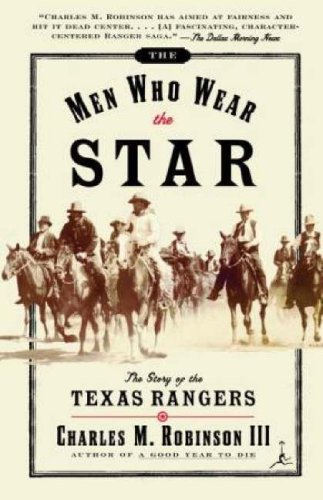
The Men Who Wear the Star: The Story of the Texas Rangers (Modern Library Paperbacks)
$29.00
by Charles Robinson



Here is the first full telling of the most colorful and famous law enforcers of our time. For years, the Texas Rangers have been historical figures shrouded in myth. Charles M. Robinson III has sifted through the tall tales to reach the heart of this storied organization. The Men Who Wear the Star details the history of the Rangers, from their beginnings, spurred by Stephen Austin, and their formal organization in 1835, to the gangster era with Bonnie and Clyde, and on through to modern times. Filled with memorable characters, it is energetic and fast-paced, making this the definitive record of the exploits and accomplishments of the Texas Rangers. "Charles M. Robinson... deftly balances the Rangers' more admirable exploits with darker tales of revenge, looting, and lynching... There is much to admire..." -- The New York Times Book Review "Well done and richly documented, with an impressive bibliography." -- The Washington Post Here is the first full telling of the most colorful and famous law enforcers of our time. For years, the Texas Rangers have been historical figures shrouded in myth. Charles M. Robinson III has sifted through the tall tales to reach the heart of this storied organization. The Men Who Wear the Star details the history of the Rangers, from their beginnings, spurred by Stephen Austin, and their formal organization in 1835, to the gangster era with Bonnie and Clyde, and on through to modern times. Filled with memorable characters, it is energetic and fast-paced, making this the definitive record of the exploits and accomplishments of the Texas Rangers. Praise for A Good Year to Die "Charles M. Robinson has aimed at fairness and hit it dead center...[A] fascinating character-centered ranger saga." -- The Dallas Morning News "[Told] with scrupulous fairness to both sides...Histories of the Indian wars formerly described events from the government's point of view only, and Mr. Robinson's use of Indian accounts to portray life inside the Sioux government's camp is part of a welcome trend to write a more complete and balanced history." -- The New York Times "A provocative analysis of the Plains War of 1876 by an established scholar in the field...making sophisticated use of Native American accounts." - -Publishers Weekly "A record of mutual intolerance, rage, fear, deceit, good intentions and perfectly human blundering. Charles Robinson has done his homework as well as the field work....A book of permanent value to Western history fanatics." -- Los Angeles Times Book Review "Charles M. Robinson... deftly balances the Rangers' more admirable exploits with darker tales of revenge, looting, and lynching... There is much to admire..."-- The New York Times Book Review "Well done and richly documented, with an impressive bibliography." -- The Washington Post Charles M. Robinson III is a native of Texas and graduate of St. Edward's University and the University of Texas Pan American. He is the author of several books on the Old West, including A Good Year to Die . He won the T. R. Fehrenbach Book Award in 1993. Robinson lives in San Benito, Texas. Chapter 1 Life and Death in a Harsh Land "Texas Ranger" is a blanket term that has meant different things at different times. Since 1874, it generally has described a full-time, professional state peace officer, originally charged with protecting the citizens from Indians and desperadoes, and later with investigating crime in the modern sense. Prior to 1874, however, the term was, in the words of one nineteenth-century writer, "somewhat vague when sought to be historically applied to the various volunteer and irregular organizations that have figured in the frontier service of Texas."' The earliest ranger-style forces in Texas often were minutemen--much like those of colonial America-who agreed to hold themselves ready and come together under the authority of the Texas government when necessary, after which they would return home and resume their normal lives until needed again. Other times they might be volunteers who served for a specific length of time, electing their own officers, much the same as the ninety-day volunteers of the Union Army. Occasionally, they were ad hoc companies formed with the sanction of the local community to handle a specific emergency-and on the frontier at that time, the sanction of the local community was all the authority they needed. During the period of the Republic through the Civil War, which is to say from 1836 to 1865, Rangers often served as auxiliaries for the military, and sometimes they were even incorporated into the army-at least theoretically. Yet the Texas Ranger always retained his separate identity and was never a soldier in the classic sense. He belonged to a unique group of men-neither military nor civil-banded together in an official or semiofficial capacity to defend the frontier. As Sgt. James B. Gillett, one of the outstanding Rangers of the nineteenth century, exp