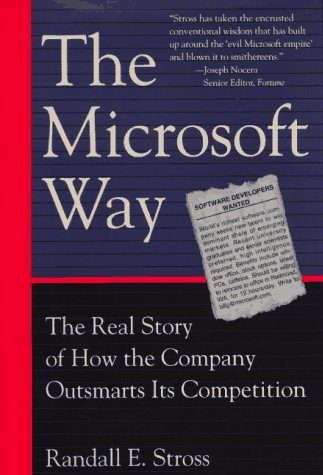
The Microsoft Way: The Real Story Of How The Company Outsmarts Its Competition
$25.00
by Randall E. Stross



Argues that the secret behind the extraordinary success of Microsoft is not predatory marketing tactics, but rather an approach that includes staying eager for ideas and being responsive to markets, and discusses the company's ever-changing plans for an online world. Stross, an academic business historian, was given unlimited access to interview Microsoft employees and managers and to rifle through most of Microsoft's corporate records. His main conclusion? That Microsoft's phenomenal success is due in large part to its consistent insistence on hiring the smartest people, and that much Microsoft bashing is reflective of an anti-intellectual strain in American culture. Whether you idolize or despise Microsoft, this book is well worth reading--especially if you are in any way responsible for hiring the best and the brightest for your company. Business historian Stross follows up his Steve Jobs and the Next Big Thing (LJ 12/93), which was critical of Jobs, with this favorable portrait of Bill Gates and Microsoft's business strategies in the 1990s. Filling a gap in the literature on Microsoft and Gates by focusing on relatively recent Microsoft strategic corporate successes with CD-ROMs, the "Information Superhighway," and overcoming Department of Justice antitrust concerns (which continue, however), Stross's work will nonetheless disappoint both Gates and computing aficionados. Unlike Jobs, Gates and Microsoft top executives cooperated with Stross, who defends his pro-Microsoft tone, claiming nothing else was possible given his findings. Stross discusses only the beginnings of the Netscape-Microsoft browser rivalry, the most serious challenge to Microsoft today. The last section argues interestingly that much of the animosity toward Gates and Microsoft is the result of "our collective reaction to [Gates's wealth]." Despite drawbacks, this is recommended for business collections.?Michael Neubert, Library of Congress, Washington, D.C.--." Despite drawbacks, this is recommended for business collections.?Michael Neubert, Library of Congress, Washington, D.C. Copyright 1996 Reed Business Information, Inc. An offbeat overview of Microsoft, the Johnny-come-lately enterprise that dominates the widening world of PC programming and is now laying careful plans to make itself a force to be reckoned with in the as yet undefined field of multimedia. Granted open access to the company's files and staff, Stross (Steve Jobs and the Next Big Thing, 1993) eschewed a traditional corporate history in favor of a four-part audit that puts fast- growing Microsoft and the aspirations of Bill Gates (its quirky cofounder) in an appreciably clearer perspective than that to be found in the grumbling of green-eyed rivals or the clueless complaints of would-be trustbusters. The author (Business/San Jose State Univ.) first examines the company's personnel policies and operational practices; he concludes that hiring brainy people for financially rewarding as well as professionally challenging assignments, and a willingness to commit sizable sums to R&D, rank among the principal secrets of Microsoft's continuing success. Stross goes on to review how this Washington State firm with global reach has conducted a patient campaign to break into consumer outlets (most notably, with a CD-ROM encyclopedia dubbed Encarta), and the stiff competition it faces from Intuit in personal-finance software. Covered as well are Microsoft's efforts to develop a commercial stake in interactive TV (an endeavor the company's chief scientist likens to playing a game of 500-card stud), its late start in the Internet sweepstakes, and the unwelcome attention of Justice Department attorneys whose predecessors watched the high- tech marketplace do what they could not in over a decade of trying: downsize and dismember IBM. Stross finishes with a jarring chapter on the philanthropic purposes to which a still young Gates might eventually put his billions. Apart from this, a perceptive briefing on a consequential corporation that arguably qualifies as a national treasure. -- Copyright ©1996, Kirkus Associates, LP. All rights reserved. Randall Stross' wonderful book . . . combines clear mastery of the relevant technology with great storytelling skill. -- James Fallows , The New York Review of Books Randall E. Stross is a professor of business at San Jose State University and a research fellow at the Center for East Asian Studies at Stanford University.