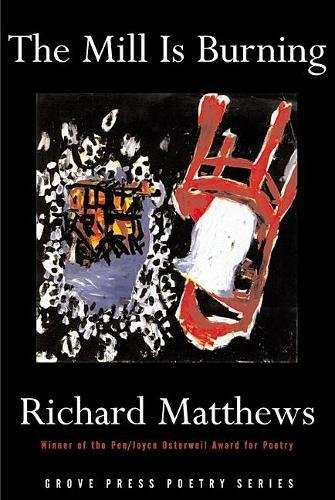



In his first collection of poems, The Mill Is Burning, 2001 Pen/Joyce Osterweil Award winner Richard Matthews brings to bear an astonishing range of poetic modes and voices to explore landscape internal and external, light and dark, real and fanciful, near and remote. These are poems distinctive in both their lyrical and emotional urgency and their intelligence and craft. Matthews does not flinch from difficult subjects. In "Cavafy Suite," he re-imagines and relocates poems by the celebrated Greek poet to create a harrowing tour of the labyrinths of depression. The sequences "Ad Astra" and "Tenebrae" are beautiful but painful portraits of D. H. Lawrence and the poet's mother, respectively, approaching their deaths. Yet he also gives us poems of celebration -- of redemption through music in "Of Mere Virtuosity," of a distant lover intimately conjured near in "Cloister" -- and poems of wonder, as a dragon drops from the sky in medieval France, moths blanket Penelope's Ithaca, and a Rothko painting morphs into a lush Korean landscape. Challenging and moving, Matthews's poems enlarge our intellectual and sensory engagement with the world. This is a rich and original debut. "[Matthews's] delightful poems rove the world and its history and move us...into a distinctive sensibility." -- Billy Collins "...the general effect is one of passionate mastery...gratitude and enjoyment are the sole residue." --Richard Howard "A very assured, and, I think, auspicious debut." -- J. M. Bockman, Literal Latté "In these poems one receives the purest sense of emotion,a glimpse inside that reflects the face of the human condition." -- Andrew R. Clark, Bookslut "Remarkable .Matthews manages the feat of assimilating Asian culture as thoroughly as any Western poet since Arthur Waley -- Benjamin Ivry, The Denver Quarterly Richard Matthews was born and lives in New York City. He is a graduate of the writing program at Columbia University. His poems have appeared in The Paris Review, Drunken Boat, Western Humanities Review, and PEN America, and his reviews have appeared in Newsday. He is the editor of the newly revived Translation magazine. Die Mühle Brennt Richard (After a painting by Georg Bazelitz) When the red chair suspended in air grazes the top of your head and the white pitcher that rests on the chair neither falls nor spills, you will move to the window, or the empty space in the wall left by the guns on the hill just outside the city, and be amazed at the mill ablaze in the distance, the loud report of dry beams knuckled under heat, the carousel of shadows spun around the orange center of the flames, because you know this cannot happen here or because you know the mill s been on fire for so long that the city s been consumed entirely, and the heat from the mill has blistered the red paint on the chair and dried the water from the pitcher, and, if you wait one more instant, afraid that it is too late, it will be too late, and the chair and pitcher will drift through your hair as ash. Copyright © 2002 by Richard Matthews. Reprinted with permission from Grove Atlantic, Inc. All rights reserved. Used Book in Good Condition