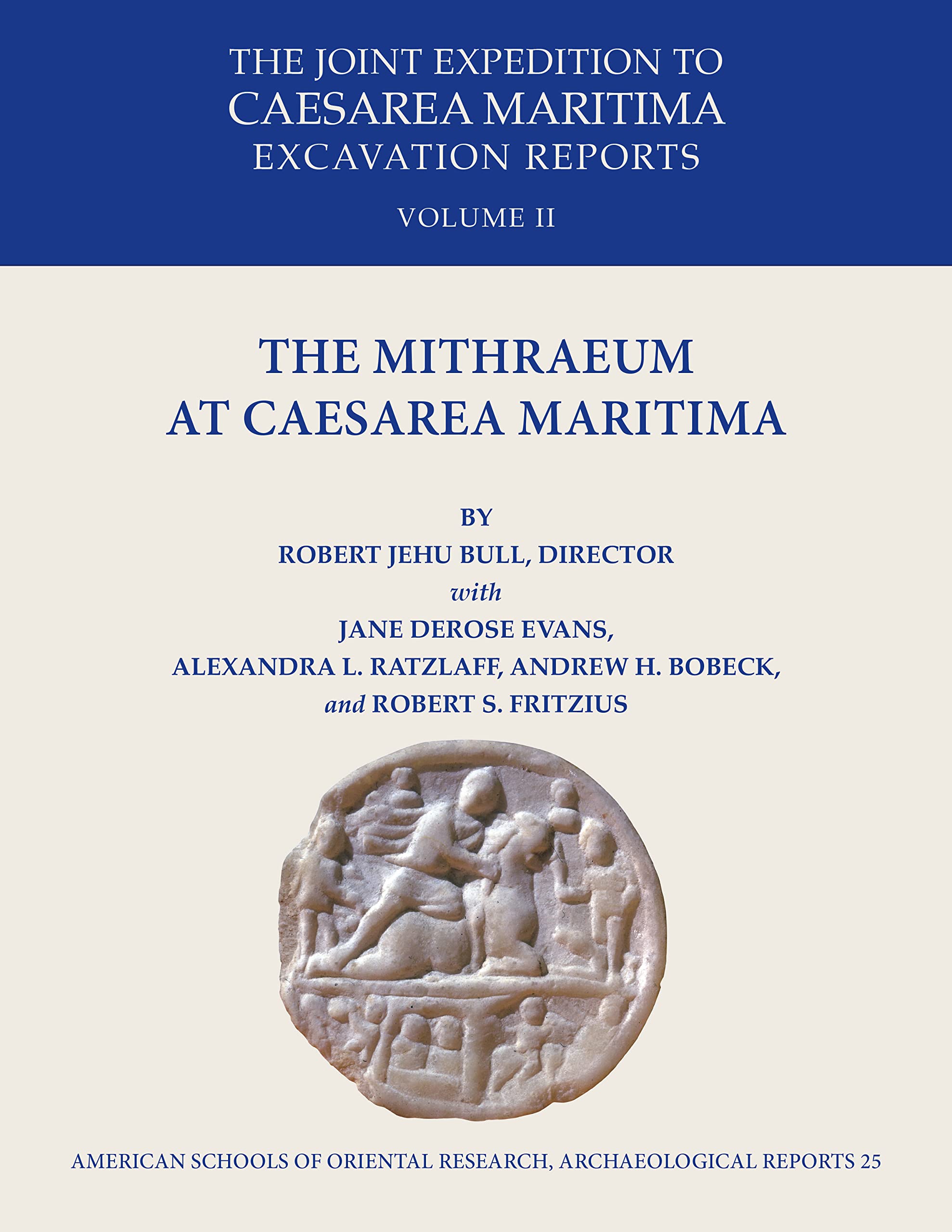



In 1973, Robert J. Bull began the excavation of a vault on the south side of the Inner Harbor of Caesarea Maritima, Israel. The vault was one of a row of warehouses built to store goods unloaded from the harbor built by Herod the Great. This monograph begins with an introduction by Bull and Jane DeRose Evans of the excavation process. The study of the stratigraphy takes into account the later excavations of the adjoining vault, and publishes new photographs, plans, and section drawings. The original construction phase, the vault's transformation into a Mithraeum, its abandonment, and its final use as a "charnel house" are meticulously discussed and analyzed. The monograph also includes detailed studies on the frescoes and the medallion found inside the vault. Alexandra Ratzlaff offers an exhaustive study of the medallion and the fragmentary wall paintings depicting Mithraic iconography. The Caesarea Mithraeum is only one of two excavated from the eastern half of the Empire, and Ratzlaff places the decoration and finds from the Mithraeum in the context of the practices of Mithraism in the ancient world. Bull and Robert Fritzius discuss their reconstruction of the ceiling splay and their interpretation in terms of astrological symbolism important to Mithraism. Andrew Bobeck explains the technical processes used to recover information about the frescoes. Two appendices by Evans catalog the small finds from the vault and explain the phasing of the probes in a diagram. The Joint Expeditions to Caesarea Maritima: Volume 2. The Mithraeum Vault will be the final publication of this "legacy excavation" directed by Robert J. Bull describing the structure and the material culture found. "The authors are to be highly commended for assembling this volume under challenging circumstances. The book, most appropriate for a specialized audience, makes an important contribution to the study of the cult of Mithras in the eastern empire and serves as an appropriate tribute to Robert Bull's many years dedicated to study of the remains of Caesarea Maritima." --Caroline Downing, American Journal of Archaeology, Vol. 122, No. 3 (July 2018) Robert Jehu Bull was the emeritus director of the Drew University's Institute for Archaeological Research, later the Joint Expeditions to Caesarea Maritima (JECM), where he excavated from 1971 to 1996, exposing major parts of the city's street plan, warehouse complex, a residential quarter, and parts of the hippodrome. His work enlightened over one thousand volunteers from around the world who excavated with him, along with many more who saw the exhibit "The Search for Herod's City," heard him lecture or read reports of his excavations in Acta Iranica, the Bible and the Spade, Biblical Archaeologist, Biblical Archaeology Review, the Bulletin of the American Schools of Oriental Research, Israel Exploration Journal, King Herod's Dream: Caesarea on the Sea and in the JECM Excavation Reports. He was a much-beloved teacher of church history at Drew University's Theological School, from which he retired as Professor emeritus in 1991. Before excavating at Caesarea, he excavated and led excavations at Shechem, Balatah, Ai, Pella, Tell er-Ras, and Khirbet Shema'.