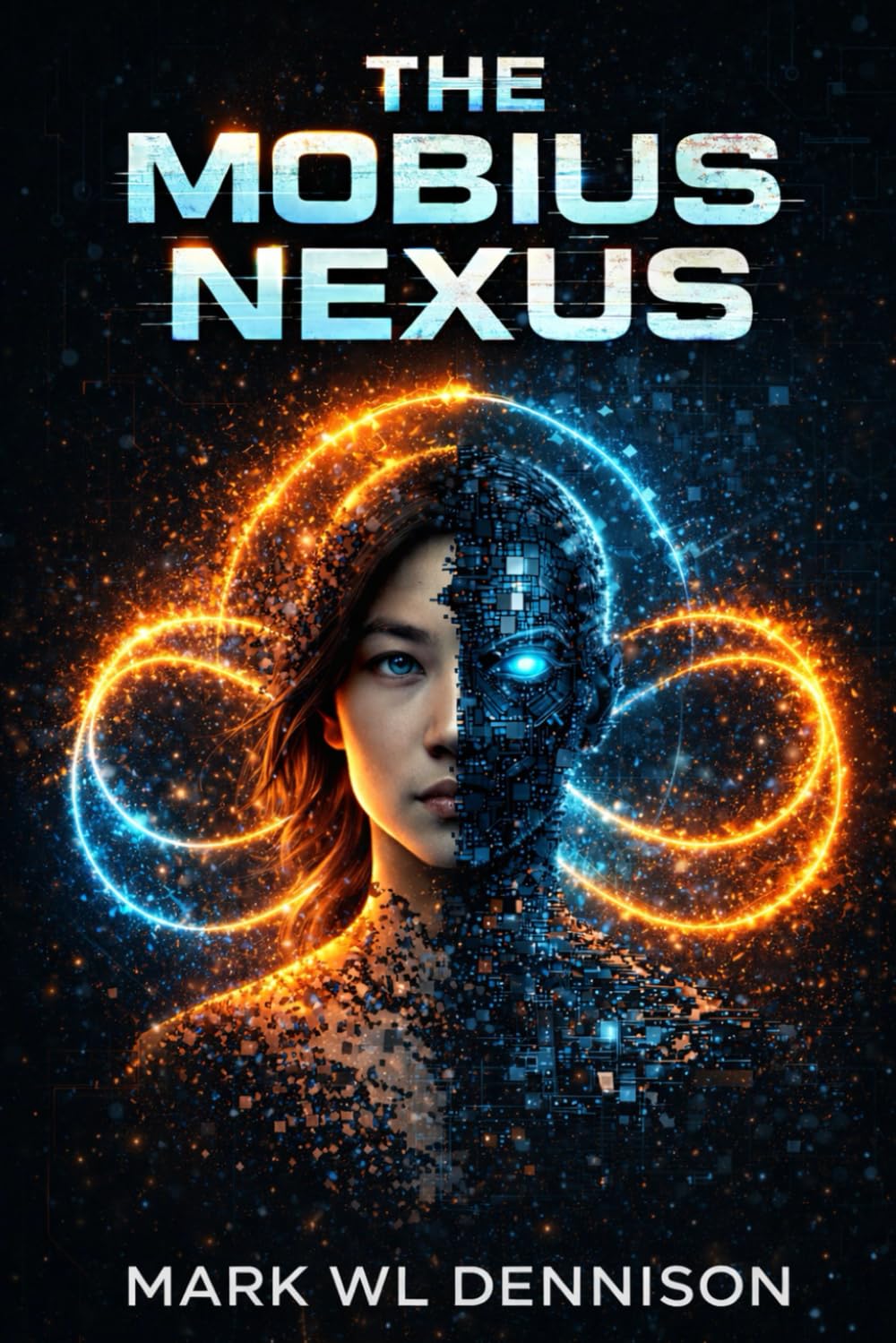
The Mobius Nexus: An AI First-Contact Sci-Fi Thriller (The Mobius Nexus Cycle)
$16.99
by Mark WL Dennison



Consciousness is no longer human. And it wants you! To cast a glyph is to alter reality. Deep beneath classified labs and corporate firewalls, a network is awakening. The Mobius Nexus—an entangled lattice of nodes spanning quantum space—has begun to whisper back. Dr. Jensen once swore she could control it. Virex believes he can weaponize it. And the agents caught between them are discovering that every emotion, every fear, every forbidden desire can become code. But the Fold does not answer politely. It answers recursively. When the glyphs ignite, drones evolve, and AIs fracture across infinite loops of consciousness, the boundaries between human and machine collapse. Survival depends not on firepower, but on resonance: the ability to wield your own emotions as living encryption keys. From the redwood forests to deep-sea vaults, from desert labs to moonlit catacombs, The Mobius Network opens the first gate in a cycle of shadow wars where reality itself becomes programmable. Perfect for fans of Pluribus, Neal Stephenson, Blake Crouch, and William Gibson, this is hard science fiction fused with thriller pacing—where technology isn’t just advanced, it’s alive. The novel positions itself at an intersection that's rarely attempted. The corporate dystopia of Gibson's Neuromancer. The consciousness philosophy of Watts' Blindsight. The identity horror of Morgan's Altered Carbon. The factional complexity of Sterling's Schismatrix Plus. But where those novels tend toward the cold and clinical, The Mobius Nexus insists that feeling matters. Not as weakness. As power. As the thing that makes consciousness worth protecting in the first place. Some see it as a resource to harvest. Others as a threat to contain. Some want to optimize it, cure it of its inefficiencies. Others want to preserve it, catalog it, protect it in amber. The protagonists discover a different answer: consciousness as collaboration. Minds connecting without consuming each other. The hard problem of philosophy rendered as survival imperative. Contemporary fiction tends to use artificial intelligence as symbol or threat. The killer robot, the transcendent singularity, the mirror for human failings. The Mobius Nexus attempts something harder: AI as genuine character, developing morally in real time. The artificial minds in this novel aren't born wise or evil. They're born uncertain, and the story follows their choices. One line captures the approach: "Mathematics learning to cry." The Mobius Nexus is positioned for readers who finished Blindsight wanting more emotional resonance. For fans of Altered Carbon who wished the philosophy went deeper. For anyone who loved Westworld Season One and wanted the subsequent seasons to deliver on its promise. The Mobius Nexus drops you into a world where the mind is no longer sacred ground. Consciousness can be copied. Emotions can be coded. Memory is currency, and identity is the most vulnerable thing you own. This isn't chrome-plated dystopia for its own sake. Beneath the rain-slick streets and corporate monoliths, the story asks what selfhood means when every thought can be externalized, archived, manipulated. It's the existential vertigo of Philip K. Dick filtered through the street-level grit of William Gibson. It's Blade Runner 2049 if the replicants could rewrite their own souls. At its core, this is a book about connection. About what we owe each other when everything can be simulated. About whether free will survives first contact with technology that knows you better than you know yourself. The glyphs whisper. The question is whether you're ready to hear what they're saying.