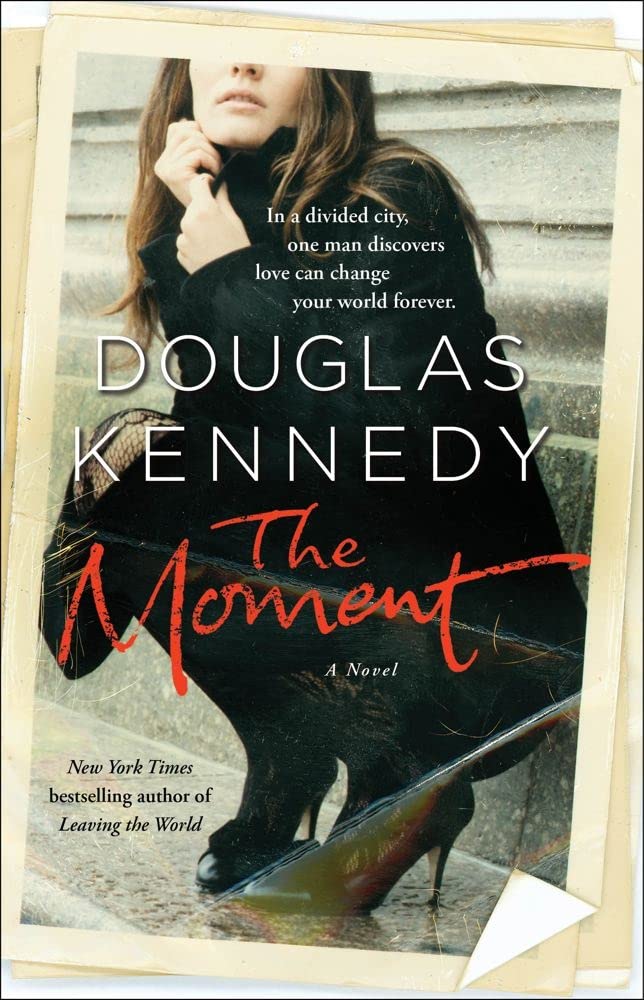



#1 International Bestseller “ The Moment is utterly engrossing...Kennedy is astonishing at communicating his characters’ emotional turmoil, the complexity of their situation, and the coldness of the Cold War…Highly recommended for all types of fiction readers.” — Library Journal (starred review) Thomas Nesbitt is a divorced writer in the midst of a rueful middle age. Living a very private life in Maine, in touch only with his daughter and still trying to recover from the end of a long marriage, his solitude is disrupted one wintry morning by the arrival of a box that is postmarked Berlin. The name on the box—Dussmann—unsettles him completely, for it belongs to the woman with whom he had an intense love affair twenty-six years ago in Berlin at a time when the city was cleaved in two and personal and political allegiances were frequently haunted by the deep shadows of the Cold War. Refusing initially to confront what he might find in that box, Thomas nevertheless is forced to grapple with a past he has never discussed with any living person and in the process relive those months in Berlin when he discovered, for the first and only time in his life, the full, extraordinary force of true love. But Petra Dussmann, the woman to whom he lost his heart, was not just a refugee from a police state, but also someone who lived with an ongoing sorrow that gradually rewrote both their destinies. A love story of great epic sweep and immense emotional power, The Moment explores why and how we fall in love—and the way we project on to others that which our hearts so desperately seek. “An observant, compassionate, and romantic portrait.” — Publishers Weekly “Kennedy is astonishing at communicating his characters’ emotional turmoil . . . and he tosses tough ethical questions our way as he ponders the ‘moment’ that could change everything—and the very nature of love.” — Library Journal (starred review) “Kennedy’s narrative virtuosity drives a story that blends romance and thrills in the right proportion. . . . The sense of place is palpable.” — Pittsburgh Post-Gazette “The revelation in the middle is the kind of gut-punch that subverts everything its narrator has found out so far—without destabilizing the rich, dark novel in progress.” — The Onion’s A.V. Club “The denouement will have you feeling about as intense as printed words can make you.” — The Times (UK) “A passionate love-story-cum-spy-thriller set amid the secrets and shadows of Cold War–era West Berlin.” ― People “Douglas Kennedy vividly re-creates the tense atmosphere of a Berlin cut into two by the Wall. As the book moves between times and narrators, we too can marvel at the changes that have taken place since reunification – and understand the long-lasting effects of the evils that were perpetrated by both sides under the old regime.” — Historical Novel Society Douglas Kennedy is the author of eleven previous novels, including the #1 international bestseller Five Days . His work has been translated into 22 languages, and in 2007 he received the French decoration of Chevalier de l’Ordre des Arts et des Lettres. Born in Manhattan, he divides his time between London, New York, and Montreal and has two children. Find out more at DouglasKennedyNovelist.com. ONE I was served with divorce papers this morning. I’ve had better starts to the day. And though I knew they were coming, the actual moment when they landed in my hand still threw me. Because their arrival announced: this is the beginning of the end. I live in a small cottage. It’s located on a back road near the town of Edgecomb, Maine. The cottage is simple: two bedrooms, a study, an open-plan living/kitchen area, whitewashed walls, stained floorboards. I bought it a year ago when I came into some money. My father had just died. Though broke by the time that his heart exploded, he still had an insurance policy in place from his days as a corporate man. The policy paid out $300,000. As I was the sole child and the sole survivor—my mother having left this life years earlier—I was also the sole beneficiary. My father and I weren’t close. We spoke weekly on the phone. I made an annual three-day visit to his retirement bungalow in Arizona. And I did send him each of my travel books as they were published. Beyond that, there was minimal contact—a long-ingrained awkwardness always curtailing any ease or familiarity between us. When I flew out alone to Phoenix to organize the funeral and close up his house, a local lawyer got in touch with me. He said that he’d drawn up Dad’s will, and did I know I was about to receive a nice little payoff from the Mutual of Omaha Insurance Corporation? “But Dad was hard up for years,” I told the lawyer. “So why didn’t he cash in the policy and live on the proceeds?” “Good question,” the lawyer said. “Especially as I advised him to do that myself. But the old guy was very stubborn, very proud.” “Tell me about it,” I said. “I tried sending him some money