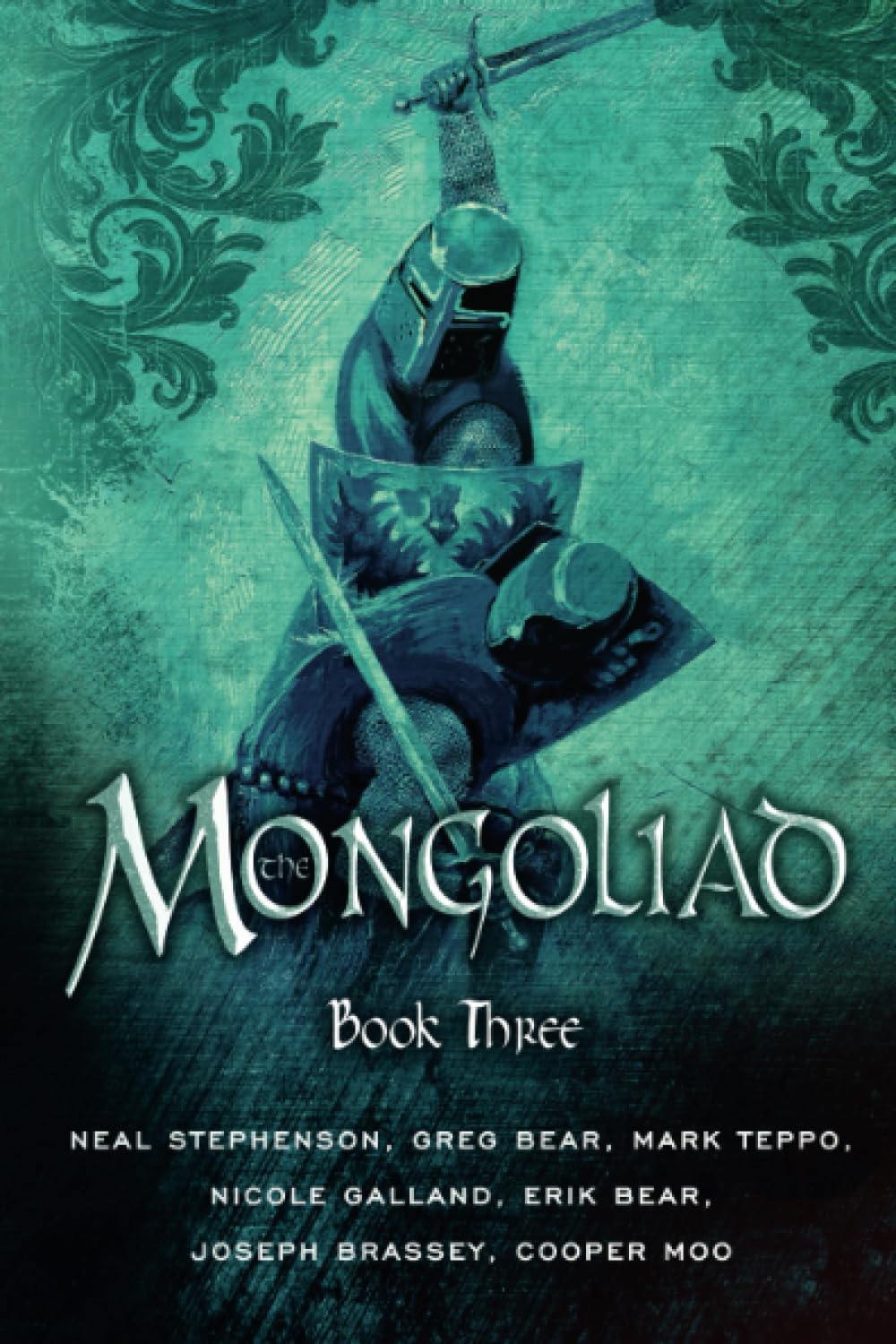



The final book of the Mongoliad trilogy from Neal Stephenson and company tells the gripping personal stories of medieval freedom fighters to form an epic, imaginative recounting of a moment in history when a world in peril relied solely on the courage of its people. The shadow of Holy Roman Emperor Frederick II hangs over the shattered Holy Roman Church as the cardinals remain deadlocked, unable to choose a new pope. Only the Binders and a mad priest have a hope of uniting the Church against the invading Mongol host. An untested band of young warriors stands against the dissolute Khan, fighting for glory and freedom in the Khan’s sadistic circus of swords, and the brave band of Shield-Brethren who set out to stop the Mongol threat single-handedly race against their nemesis before he can raise the entire empire against them. Veteran knight Feronantus, haunted by his life in exile, leads the dwindling company of Shield-Brethren to their final battle, molding them into a team that will outlast him. No good hero lives forever. Or fights alone. The third and final volume of the Mongoliad saga is nearly as long as the first two volumes combined, but it’s as fast paced and page-flippingly exciting as its two forerunners. For the uninitiated, The Mongoliad—a mammoth epic set in a sort of alternate-reality version of the thirteenth century, around the time of the Mongol invasion of Europe—was originally an online serial. It was restructured and rewritten for its print appearance (which its seven authors, led by Neal Stephenson and Greg Bear, now consider to be the “definitive edition”), and what you get in book form is, in places, substantially different from the serialized version. But the broad strokes are the same: a small group of warrior-monks, the Shield-Brethren, desperately fight to repel the Mongols before the invaders eradicate their way of life. The Mongoliad grew out of its authors’ (particularly Stephenson’s) interest in the history of sword fighting and the Western martial arts, but it’s more than that; it’s also a ripping good alternate-history saga, a story of devotion and determination in the face of seemingly insurmountable odds. Setting the epic in an alternate version of the thirteenth century allows the authors to step outside of recorded history and let their imaginations run wild, to create characters that could not have existed in the “real world” and relate events that never actually happened. It’s not absolutely necessary to have read volumes one and two, but that would definitely help, as there is an assumed familiarity with the story’s characters and with what has gone before. But there’s plenty of time to pick up the essentials as you go along, even if this is your first trip to the Mongoliad. --David Pitt “ The Mongoliad was inspired in part by the authors’ interest in medieval combat techniques, and the meticulously choreographed fight scenes are among the story’s greatest highlights. Another band of Shield Brethren, stationed at the Polish village of Hünern, are involved in a plot to overthrow the Mongol general there; the uprising they orchestrate with Japanese and Korean prisoners of war plays out like a dazzling action movie.” ― Shelf Awareness “…The series is wonderfully crafted…If you’re a fan of epic fiction, or historical fiction (which tends to be epic), you’ll be doing yourself a disservice by not reading this series. It may soon be remembered as the Wheel of Time of historical fiction.” ― Novelnaut “The final book in the Mongoliad trilogy is incredible…I am a big fan of the sprawling epic, like Game of Thrones and The Lord of the Rings , so when my favorite novelist and six other authors got together to write an epic, I was sold…The action is exciting and feels more real than anything I have read before. The characters are all multi-layered and sympathetic, even when they are trying to kill each other. The pacing is perfect. This might be the easiest recommendation I make all year. Go and read The Mongoliad …Five Perfectly Executed Parries out of Five” ― Fanboy Comics “The Mongoliad was inspired in part by the authors' interest in medieval combat techniques, and the meticulously choreographed fight scenes are among the story's greatest highlights. Another band of Shield Brethren, stationed at the Polish village of Hünern, are involved in a plot to overthrow the Mongol general there; the uprising they orchestrate with Japanese and Korean prisoners of war plays out like a dazzling action movie.” -Shelf Awareness "…the series is wonderfully crafted…If you're a fan of epic fiction, or historical fiction (which tends to be epic), you'll be doing yourself a disservice by not reading this series. It may soon be remembered as the Wheel of Time of historical fiction." - Novelnaut "The final book in the Mongoliad trilogy is incredible … I am a big fan of the sprawling epic, like Game of Thrones and The Lord of the Rings , so when my favorite novelist and