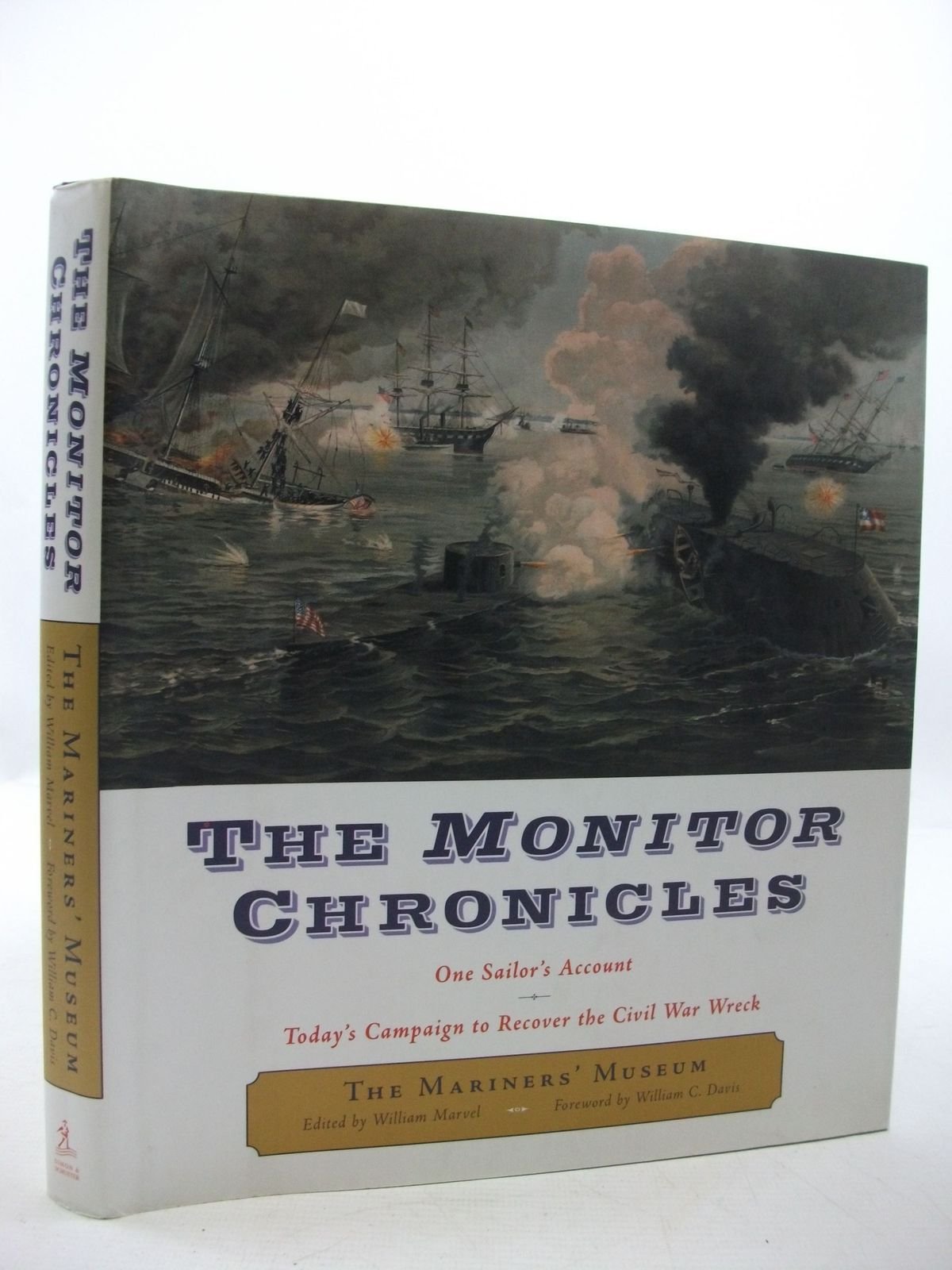
The Monitor Chronicles : One Sailor's Account : Today's Campaign to Recover the Civil War Wreck
$17.57
by Mariners' Museum



An account of ongoing efforts to recover the nineteenth-century wreck of the USS Monitor features more than one hundred photographs, paintings, and technical plans, as well as never before published letters from a common Civil War sailor who served aboard the famous battleship. Though her career was brief, the legendary Civil War ironclad the U.S.S. Monitor helped change the face of naval warfare. The Monitor Chronicles tells the story of the "180 feet of iron"--and some of the great battles of the Civil War--through the eyes of one of her seamen, George Geer. Geer first stepped aboard the Monitor in February 1862, as a newly minted first-class fireman. Like many Northerners, Geer joined the army less out of a desire to preserve the Union--or free the slaves--than to learn a reliable trade. That said, he performed his duties admirably, earning two promotions in under a year. He also proved an admirable correspondent, sending dozens of letters to his beloved wife, Martha, during the ten and a half months the Monitor was afloat. These letters describe in detail what life was like aboard the ironclad--from poor rations to poor ventilation, and from the excitement of battle to the boredom when the ship remained still. In a letter written aboard a rescue vessel, Geer also described the final hours of the ironclad as she sank in stormy seas on December 30, 1862. Combined with dozens of evocative illustrations, Geer's letters provide historians with a fascinating glimpse inside the Monitor . The Monitor Chronicles also contains information on the fate of the ship in the 140 years since she sank and the ongoing campaign to recover her. Essential reading for Civil War buffs. --Sunny Delaney In 1862, George Geer boarded the U.S.S. Monitor as a fireman and engineer and stepped into history. In regular correspondence with his wife back in New York, he recorded the workings of the machinery and crew on the newfangled "cheesebox on a raft," as the Union ironclad was called. He also described the famous battle between the Monitor and the Merrimac, the posturing of commanders, and the sinking of the Monitor off the coast of North Carolina during a storm in 1863. This book collects Geer's very readable and revealing letters and augments them with an intelligent commentary on Union naval technology as well as the combined naval and military operations during the Peninsula campaign of 1862. A biography of Geer is included, while a concluding chapter surveys recent efforts to raise the Monitor from her watery grave. Whatever the success of the latter enterprise, this book triumphs as the best inside-the-hull account of life aboard an ironclad and gives Civil War sailors a rare voice in a subject area crowded with soldiers' accounts and the preoccupation with the war on land. Highly recommended for college and major public libraries.DRandall M. Miller, Saint Joseph's Univ., Philadelphia Copyright 2000 Reed Business Information, Inc. During the Civil War, some 172 feet of seagoing iron, with a deck a mere foot-and-a-half above the water line, made the world's navies instantly obsolete. That's maritime history, retold here. The human story, too, is told by one of the ship's crewmen.The Monitor, the Union's cheesebox on a raft, was the brainchild of the brilliant, feisty John Ericsson. It changed naval warfare forever, and it changed the lives of its sailors. Civil War historian Marvel's (Burnside, 1991) text is composed largely of letters from the Monitor's fireman George Geer to his wife in New York. They date from the time Geer boarded the newly commissioned warship in January 1862 through its foundering in rough seas the last day of the same year. Within weeks of her launching, the Monitor engaged in its historic duel with the Confederate Merrimack (rechristened the Virginia), which withdrew. Each ship's guns were unable to penetrate the other's armor. Marvel's exposition is clear and succinct, as are Geer's letters, in beautiful penmanship and atrocious spelling. Though his depictions of events occasionally tend to be wrong (elevating routine siege fire to major battles and exaggerating casualties), his narrative of the heat and fumes, the crew's bad food, and the scourge of Confederate sharpshooters on shore is remarkably interesting, with a mordant wit often evident. His occasional dispirit, his money worries, his efforts to gain a promotion, and his regular husbandly assurances of his well-being (especially after his survival of the sinking of his ship) attest to the conflict's human concerns. We learn nothing of Geer's postwar life, and Mrs. Geer's letters did not survive (although it is interesting to note that the mails went through with more dispatch then than they seem to today). A final chapter deals with continuing efforts to recover the wreck of the historic ship. A unique history, unusually accessible because it is taken largely from the pen of a long-dead sailor. No prior knowledge of maritime pract