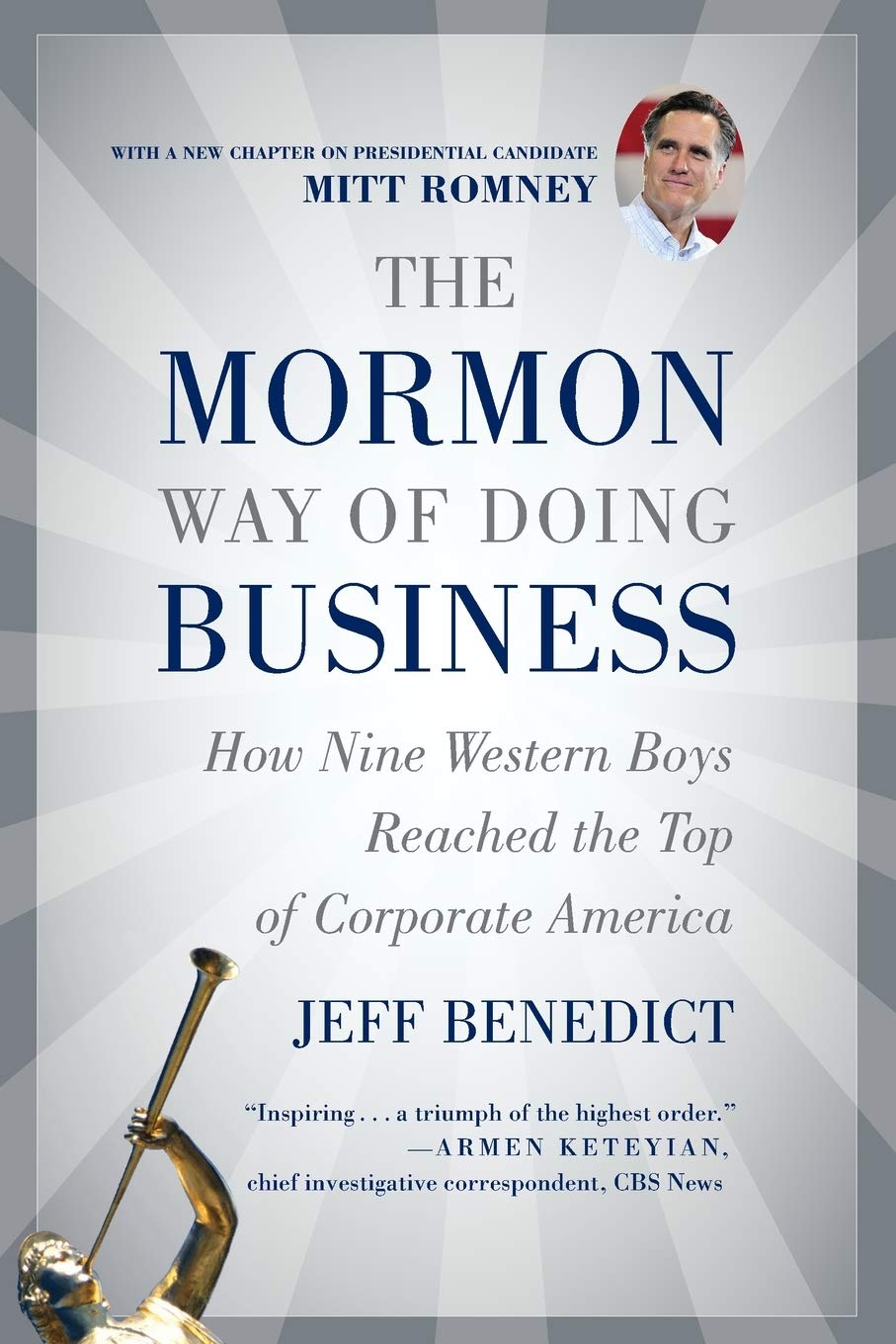
The Mormon Way of Doing Business: How Nine Western Boys Reached the Top of Corporate America
$10.00
by Jeff Benedict



The Founder of JetBlue. The former CEO of Dell Computers. The CEO of Deloitte & Touche. The former Dean of the Harvard Business School - and now a US Presidential candidate in Mitt Romney. They all have one thing in common. They are devout Mormons who work long hours but always spend their Sundays exclusively with their families, and always put their spouses and children first. How do they do it? Critically acclaimed author and investigative journalist Jeff Benedict (a Mormon himself) examines these highly successful business execs and discovers how their beliefs have influenced them, and enabled them to achieve incredible success.With original interviews and unparalleled access, Benedict shares what truly drives these individuals, and the invaluable life lessons from which anyone can benefit. Jeff Benedict is considered one of America's top investigative journalists. He has published several acclaimed books, including The Mormon Way of Doing Business, Out of Bounds, Pros and Cons, and Without Reservation . His articles have been published in Sports Illustrated , the New York Times , and the Los Angeles Times , and he has appeared on ESPN, NBC Nightly News , CBS's 60 Minutes , and ABC News. The Mormon Way of Doing Business How Nine Western Boys Reached the Top of Corporate America By Jeff Benedict Grand Central Publishing Copyright © 2012 Jeff Benedict All rights reserved. ISBN: 978-1-4555-2294-1 CHAPTER 1 ON A MISSION "In business situations we get well prepared and we go in undaunted. I don'tknow if this is unique to the Mormon culture. But we are individuals who have amission and are absolutely undaunted by it." —Dave Checketts, former CEO of Madison Square Garden Corp. "People do a better job if they respect the leader of the company. I learnedthat on my mission—the value of people and how to truly appreciatethem." —David Neeleman, founder and CEO of JetBlue Airlines Many JetBlue passengers have had the experience of boarding a plane, finding aseat, and looking up before takeoff to discover a middle-aged man standing atthe head of the cabin, wearing a flight attendant's apron and a name tag. "Hi,my name is David Neeleman. And I'm the CEO of JetBlue. I'm here to serve youtoday and I'm looking forward to meeting each of you before we land." For the remainder of the flight, Neeleman goes up and down the aisle,distributing snacks, collecting garbage, and making a point to meet everypassenger. He also writes down their comments on a small notepad. Although thepassengers are complete strangers to Neeleman, he quickly establishes a rapportwith them. When the flight lands, Neeleman thanks passengers for flying JetBlueand then works with the flight crew to clean the plane and prepare it for itsnext flight. No other airline has a CEO who works as a flight attendant just so he can servehis customers and get to know them and their needs better. No other airline hasa CEO who works shoulder to shoulder with flight crews in order to appreciatetheir job better. Neeleman does both no less than once a month and sometimes asoften as once a week. For this, he is praised for his business acumen, hisdevotion to his company, and for maintaining a fingertip feel for the directneeds and desires of his customers and employees. SERVICE MATTERS Each time he works a roundtrip flight, Neeleman performs about ten hours ofdirect customer service and employee interaction. It's no surprise that theannual national Airline Quality Ratings study, which is based on TransportationDepartment statistics, routinely ranks JetBlue number one in customer service."There are so many things you can do as a CEO to set an example," said Neeleman."If the CEO is down there helping employees tag bags and clean airplanes,employees feel better about going to work. People will go the extra mile foryou. They know I'm not sitting in some part of the airplane where I don't wantto be talked to. Instead, I hang out with crew members." Direct service to customers and working in the trenches alongside employees maybe unusual concepts for a CEO or business manager. That's simply not the waybusiness is done in corporate America. Neeleman didn't learn this uniqueapproach in business school or by reading some cutting-edge textbook on how tobe a successful leader. He developed these habits at a very young age, longbefore he had any thought of creating an airline. At nineteen, Neeleman served a full-time mission for the Mormon Church. Upongraduating from high school, all young men in the Mormon Church are encouragedto spend two years as missionaries, which entails teaching the gospel of JesusChrist to strangers and performing service for the poor, the elderly, and theneedy. During this time missionaries must completely forgo schooling,employment, entertainment, and dating in order to fully devote all their energyand time to service. They receive no financial compensation, and they areexpected to finance as much of their missionary expen