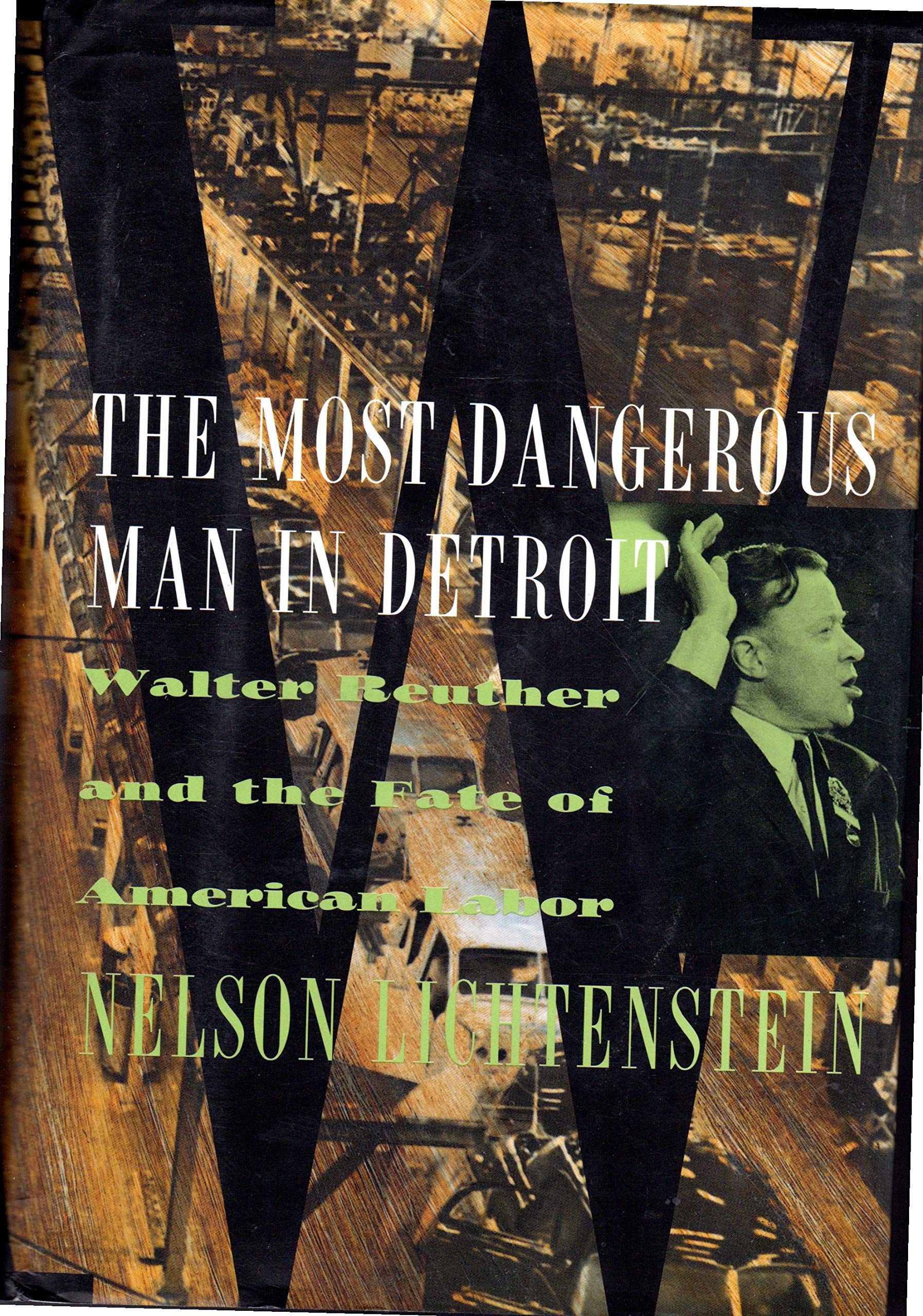
The Most Dangerous Man In Detroit: Walter Reuther And The Fate Of American Labor
$60.60
by Nelson Lichtenstein



Walter Reuther, the most imaginative and powerful trade union leader of the past half-century, confronted the same problems facing millions of working Americans today: how to use the spectacular productivity of our economy to sustain and improve the standard of living and security of ordinary Americans. As Nelson Lichtenstein observes, Reuther, the president of the United Automobile Workers from 1946 to 1970, may not have had all the answers, but at least he was asking the right questions. The Most Dangerous Man in Detroit vividly recounts Reuther's remarkable ascent: his days as a skilled worker at Henry Ford's great River Rouge complex, his two-year odyssey in the Soviet Union's infant auto industry in the early 1930s, and his immersion in the violent labor upheavals of the late 1930s that gave rise to the CIO. Under Reuther, the autoworkers' standard of living doubled. Lichtenstein (history, Univ. of Virginia) has written a comprehensive account of the public career of Reuther (1907-70), one of the outstanding U.S. labor leaders from the 1930s until his untimely death in 1970. The author recounts Reuther's meteoric rise, first in the creation of the auto workers union (UAW) and his titanic battles with the "Big Three" auto manufacturers: General Motors, Ford, and Chrysler. Later, he worked on the formation of the Congress of Industrial Organizations (CIO) as a rival of the older, craft-oriented American Federation of Labor (AFL). In the 1950s and 1960s, Reuther found more creative outlets in the reconstruction of European labor unions and in advancing the American causes of civil rights and Great Society programs. In Lichtenstein's dense text, however, Reuther appears only intermittently, and his personal life all but disappears. Recommended for labor collections of academic libraries.?Harry Frumerman, formerly with Hunter Coll., CUNY Copyright 1995 Reed Business Information, Inc. Lichtenstein's biography of the man whom auto executive, and later GOP politician, George Romney called "the most dangerous man in Detroit" is also a history of the United Auto Workers union, which Walter Reuther helped build and led for two decades, and of the labor movement during a period when great successes laid seeds for later weakness and isolation. Lichtenstein traces Reuther's commitment to the working class to the West Virginia socialism of his German immigrant father; his internationalism owed much to two years he and his brother spent traveling in Germany after the Reichstag fire and working at the Soviet Union's Gorky auto plant. When they returned in 1936, Reuther was elected to the UAW's executive board; he devoted the remaining 30 years of his life to the union. By the late '60s, however, the institution he had built hamstrung him: Reuther knew that unions needed to show solidarity with nonunion workers and attract the energy of a new generation active in the civil rights and antiwar movements, but he was unable to escape institutional constraints. A fascinating biography of a key twentieth-century figure. Mary Carroll Nelson Lichtenstein is a Professor of History at the University of Virginia.